

TL;DR
A fractional safety director is a senior safety professional who manages or advises a company’s safety program on a part-time, recurring, or project basis instead of as a full-time employee. The role covers everything from OSHA compliance and site audits to training coordination and incident investigation. It works best for companies that have outgrown “safety as a side duty” but don’t need (or can’t justify) a full-time safety hire. The employer still owns all OSHA responsibilities, and fractional support fails when leadership won’t act on findings.
A fractional safety director gives a company access to experienced safety leadership without putting a full-time director on the payroll. The word “fractional” means the company buys the safety director function in portions: a day a week, a few days a month, a fixed retainer, the duration of a project, or a bridge period while recruiting.
This is not a lesser version of the role. It is the same work, scoped to the amount of leadership the company actually needs.
One important clarification before going further: hiring a fractional safety director does not transfer OSHA responsibility away from the employer. OSHA still expects employers to provide a workplace free from serious recognized hazards, comply with applicable standards, examine workplace conditions, maintain safe equipment, communicate procedures, and provide required training. Source: OSHA Employer Responsibilities. The fractional director helps the business meet those duties. The business still owns them.
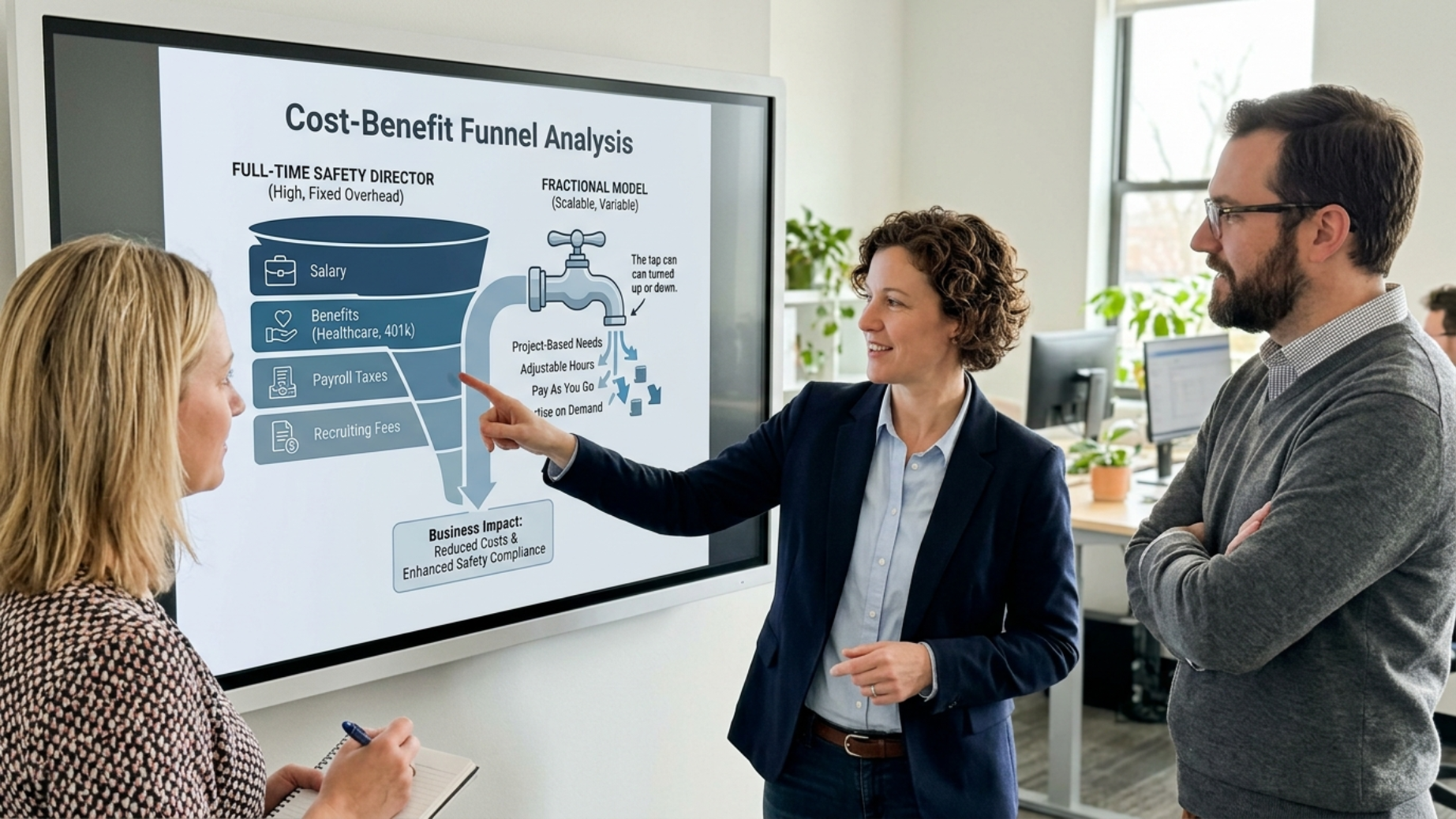
At a Glance: The Value of Fractional Safety Leadership
A Fractional Safety Director provides executive-level safety oversight for 30%–60% less than the cost of a full-time hire. This model is ideal for mid-sized firms ($10M–$100M revenue) that require high-level compliance strategy but lack the daily volume to justify a $130k+ annual salary.
Core Goal: Move from reactive “clipboard safety” to proactive risk management.
Key Benefit: Access to senior credentials (CSP, CHST) on a part-time retainer.
Ownership: The employer retains OSHA legal responsibility; the director provides the roadmap and tools to satisfy it.
What a Fractional Safety Director Does
The scope varies by engagement, but most fractional safety director roles cover a combination of these functions.
Strategy and Leadership
Building a safety roadmap. Setting goals and leading indicators. Briefing executives and operations leaders on safety performance. Clarifying who owns which safety tasks internally. OSHA’s recommended practices identify management leadership as a core element of effective safety programs, noting that management provides the vision and resources needed for implementation. Source: OSHA Recommended Practices (PDF).
OSHA Compliance and Written Programs
Reviewing applicable OSHA standards. Building or updating safety manuals. Creating written programs for hazard communication, fall protection, respiratory protection, lockout/tagout, emergency action plans, confined space, excavation, and site-specific construction plans. Maintaining or reviewing OSHA 300/301/300A logs. If you’re unsure whether your current documentation meets federal requirements, a good starting point is understanding whether your safety manual is actually OSHA-compliant.
Site Inspections and Audits
Conducting scheduled jobsite or facility inspections. Identifying unsafe conditions, prioritizing corrective actions, tracking closeout, and preparing reports with photos, deadlines, and accountable owners. OSHA’s recommended practices describe hazard identification as a proactive, ongoing process that includes initial and periodic workplace inspections, incident and near-miss investigations, and prioritization based on severity and likelihood. Understanding the full cycle of hazard recognition, evaluation, and control is what separates meaningful inspections from clipboard exercises.
Training and Supervisor Coaching
Building a training matrix. Conducting OSHA 10/30 or topic-specific training where qualified. Leading toolbox talks. Coaching supervisors on hazard recognition, stop-work expectations, documentation, and incident response. OSHA requires that training be delivered in a language and vocabulary workers can understand, which makes bilingual capability critical for companies with Spanish-speaking crews. For a broader look at what federal law requires, see this overview of OSHA-required training.
Incident Investigation and Post-Incident Support
Preserving facts. Interviewing witnesses. Identifying root causes. Recommending corrective actions. Supporting OSHA recordkeeping decisions. OSHA’s recommended practices call for investigating all injuries, illnesses, incidents, and close calls to uncover underlying hazards and program shortcomings.
Contractor and Subcontractor Coordination
Reviewing subcontractor safety documentation. Coordinating JHAs and AHAs. Establishing orientation requirements. Communicating site hazards. Tracking corrective actions by trade. This is especially common in construction, where a general contractor or owner may require documented safety coordination across multiple subs.
Metrics and Continuous Improvement
Tracking leading indicators (inspections completed, hazards found, closeout time, near misses reported, training completion) alongside lagging indicators (recordable incidents, DART rate, lost time, workers’ comp claims, OSHA citations). Reporting trends to leadership. Adjusting the plan.
Modern Safety Tech Stack for 2026
A modern fractional director doesn’t just bring a binder; they implement a digital safety ecosystem. Look for directors who integrate:
EHS Management Software: Real-time dashboards for OSHA 300 logs and corrective actions.
AI-Driven Hazard Recognition: Using photo-based AI to identify PPE violations or fall hazards from site photos.
Predictive Analytics: Using lagging data to predict where the next “Near Miss” is likely to occur.
Digital Toolbox Talks: QR-code based attendance tracking for instant compliance records.
What “Fractional” Looks Like in Practice
There is no single format. A fractional safety director engagement might be:
Monthly advisory: Recurring leadership calls, document reviews, and periodic site visits.
Weekly operational support: Scheduled inspections, corrective action follow-up, training, and supervisor meetings.
One or two days per week: A consistent presence without full-time headcount.
Project-based: Supporting a specific construction project, shutdown, facility expansion, prequalification effort, or safety program buildout.
Interim: Covering a gap after a safety director leaves or while the company recruits.
Hybrid: A fractional director provides strategic leadership while an on-site safety professional handles daily field coverage.
The hybrid model matters more than most people realize. Many companies start with fractional advisory and quickly discover they also need boots on the ground for daily orientations, permits, or high-risk monitoring. Those are different needs, and they often require different solutions.
Why Companies Hire a Fractional Safety Director
The business triggers are predictable. Here are the most common.
Safety is sitting on someone’s desk as an extra duty. The HR director, operations manager, superintendent, or office manager is handling safety on top of their real job. That might work at a very small scale, but risk compounds when the company adds crews, jobsites, equipment, or subcontractors. Many organizations reach a point where they are too complex for safety to remain an extra duty but not yet ready for a full-time safety director.
The workload doesn’t fill 40 hours a week. A small or mid-size contractor might need inspections, toolbox talks, supervisor coaching, OSHA documentation, and executive reporting, but only on a scheduled cadence. Paying a full-time salary for part-time work doesn’t make financial sense.
A GC, owner, insurer, or prequalification platform is demanding stronger documentation. ISNetworld, Avetta, and owner-controlled safety programs all push subcontractors to produce written programs, site-specific safety plans, training records, and audit histories. A fractional safety director can build that documentation and make sure it reflects real operations.
Multiple sites need a consistent system. When safety practices differ from project to project or facility to facility, incidents become a matter of time. A fractional director can standardize inspection forms, corrective action tracking, training expectations, and reporting across locations.
Something went wrong. A serious incident, an OSHA citation, a bad audit, or a spike in workers’ comp claims. If you’ve just received an OSHA citation, understanding the four-step response process is an urgent first move.
The talent market is tight. BLS projects 12% employment growth for occupational health and safety specialists from 2024 to 2034, with roughly 18,300 openings per year. Source: BLS Occupational Outlook Handbook. Qualified safety directors are hard to find and expensive to recruit.
One person can’t do everything well. This is an underappreciated point. One safety provider’s page frames it well: few people are equally strong at writing programs, delivering training, managing field inspections, handling technical specialties, and coaching executives. A fractional approach, or fractional team, can cover more ground than a single generalist hire.
When Fractional Safety Is Not Enough
Honesty here builds trust. A fractional safety director is not the right answer in every situation.
The site requires daily safety presence. If a GC or owner contract requires a dedicated full-time safety professional, or if the work involves constant high-risk activities like hot-work permits, confined space entry, crane operations, or daily orientations, fractional visits won’t satisfy the need. You need on-site safety staffing or a full-time employee.
Nobody internal owns follow-through between visits. This is the failure mode practitioners talk about most. In a discussion among safety professionals on Reddit, multiple practitioners emphasized that consultants can identify gaps and build systems, but leadership and the site team must act on recommendations between visits or nothing changes. One practitioner compared two similar construction clients: the one that used weekly reports in foreman meetings improved, while the other argued every deficiency and stayed stuck. Source: r/SafetyProfessionals.
Leadership won’t fund corrective actions. Reports without follow-through become liability documentation. If you identify a fall hazard, document it in a report, and nobody fixes it, that report can be used against the company.
The company wants a binder, not a program. Practitioners on Reddit are blunt about this: the strongest red flag is polished paperwork that doesn’t match how work actually happens on site. A safety manual isn’t enough without the management system behind it.
The risk profile demands specialists. Process safety management, industrial hygiene exposure monitoring, high-voltage utility work, or hazardous waste operations may require technical experts beyond the scope of a general fractional safety director. In those cases, fractional leadership might still make sense, but it needs to be paired with specialty support.
Fractional Safety Director vs. Safety Consultant vs. Safety Staffing
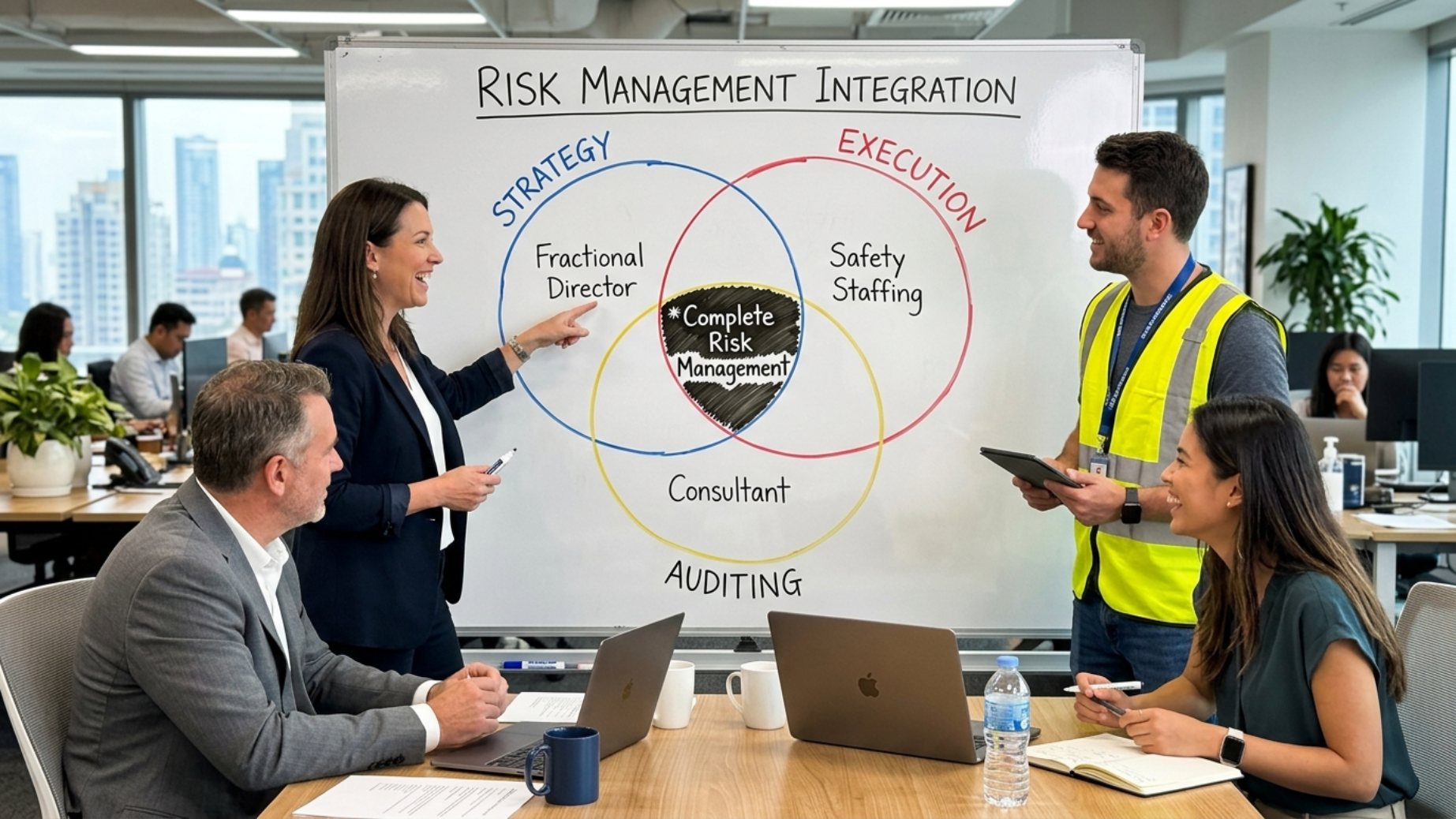
These terms overlap, which confuses buyers. Fractional is a specific delivery model within the broader outsourced safety department category—same external program ownership and credentialed leadership, but scoped to part-time hours instead of full department coverage. Here is a plain comparison.
Term | What it means | Best fit | Not ideal when |
|---|---|---|---|
Fractional safety director | Part-time senior safety leader who manages or improves the program on a recurring basis | Company needs ongoing leadership but not a full-time director | Site needs daily field coverage or no internal owner exists |
Fractional safety manager | Similar to director, often more tactical: inspections, training, logs, site support | Small/mid-size business needs hands-on program management | Executive strategy or complex multi-site system design is required |
Safety consultant | External expert hired for advice, audits, training, program writing, or specific projects | Defined problem, gap analysis, specialized technical need | Company expects daily ownership or culture change without internal action |
Outsourced safety department | External team covers multiple functions: inspections, training, documentation, program management, incident response | Company needs more than one person’s skill set but not an internal department | Company has enough scale to justify building its own |
On-site safety staffing | A safety professional placed at a jobsite or facility for a defined schedule, often full-time | Project requires physical presence, GC requirement, high-risk work, daily permits | Need is mostly strategic or monthly |
Interim safety director | Temporary director fills a vacancy during a transition | Safety leader leaves, company is actively recruiting | Need is ongoing but only a few hours per month |
Full-time safety director | Internal W-2 employee who owns the safety function | Large workforce, many sites, continuous high-risk work, mature system | Workload is too small or seasonal to justify full-time headcount |
The distinction between fractional leadership and on-site staffing matters most. A fractional safety director sets direction, builds programs, and holds the organization accountable. An on-site safety professional handles daily field enforcement, orientations, permits, and real-time hazard intervention. Many companies need both, and some providers (including ESR) can pair fractional safety leadership with on-site safety staffing under one engagement.
How to Decide: The Coverage vs. Ownership Matrix
Your real need | Best model |
|---|---|
Safety program, training plan, audits, and leadership reporting, but not daily coverage | Fractional safety director |
GC requires a safety person on site every day | On-site safety staffing or full-time hire |
Safety director quit and you need coverage while hiring | Interim or fractional safety director |
One narrow technical problem (silica, noise, PSM, confined space, crane lift plan) | Specialist consultant |
No internal safety department, want one vendor to run most of it | Outsourced safety department |
500+ employees, multiple high-risk sites, constant daily issues | Full-time safety director plus support staff |
Typical Scope of Work
When engaging a fractional safety director, the scope of work should spell out exactly what’s included and what’s not. A well-defined agreement usually covers:
Initial gap assessment of current programs, records, and field conditions
Review of applicable OSHA standards for the company’s operations
Written program review and updates
Training matrix with schedule and responsibilities
Site or facility inspection schedule and format
Corrective action log with assigned owners and due dates
Incident investigation process and reporting
OSHA recordkeeping support (300/301/300A)
Safety meeting cadence and agenda structure
Leadership reporting dashboard with leading and lagging indicators
Contractor and subcontractor coordination expectations
Emergency response plan review
Bilingual training needs, if applicable
Clear exclusions: legal representation, daily on-site staffing, industrial hygiene sampling, or other items not contracted
For companies that want a baseline assessment before committing to ongoing fractional support, a mock OSHA inspection or jobsite safety assessment is often a practical first step.
What Does a Fractional Safety Director Cost?
Pricing depends on scope, industry risk, visit frequency, number of sites, training needs, and whether the role is advisory, hands-on, or paired with on-site staffing. No two engagements are identical.
The comparison point is not just salary. A full-time safety director brings salary plus benefits, recruiting costs, payroll burden, tools, continuing education, and management time. BLS data puts the median annual wage for occupational health and safety specialists at $83,910 as of May 2024. In construction, the median is $84,890. The top 10% earn more than $130,460. Source: BLS. Add 25-35% for benefits and burden and a full-time safety director easily costs $110,000 to $170,000 per year, before you account for recruiting time and turnover risk.
Fractional arrangements are often less expensive when the workload is genuinely part-time. But the real question isn’t “is it cheaper?” It’s “what’s the cost of not having safety leadership at all?”
Consider the numbers. The NSC continues to report total work injury costs exceeding $180 billion annually, emphasizing the ROI of prevention. OSHA penalties add to the math: As of January 2026, the maximum penalty for a Serious violation is approximately $16,800, and Willful/Repeated is approximately $168,000 (Estimate based on standard 1.5–2% inflation adjustments). Understanding safety’s return on investment makes it easier to justify the spend to leadership.
Cost Comparison: Fractional vs. Full-Time (2026 Projections)
Expense Category | Full-Time Safety Director (W-2) | Fractional Safety Director |
Annual Base Salary | $85,000 – $140,000 | $24,000 – $60,000 (Retainer) |
Benefits & Taxes (30%) | $25,500 – $42,000 | $0 |
Recruitment Fees | $15,000 – $25,000 (One-time) | $0 |
Training & Equipment | $5,000+ | Included in service |
Total Annual Liability | $130,500 – $212,000+ | $24,000 – $60,000 |
Best For | 500+ employees / High-risk | 20–250 employees / Scaling |
How to Choose the Right Provider
Not all fractional safety directors deliver the same value. Here’s what to evaluate.
Industry experience. A fractional safety director for a concrete subcontractor faces different hazards than one for a biotech facility. Ask where they’ve worked, not just what certifications they hold.
Credentials. CSP, CHST, OSHA 500/501, NCCER instructor status, and relevant degrees all matter. Practitioners on Reddit who have started consulting firms emphasize that credentials, real field experience, and professional liability insurance are table stakes, not differentiators. Source: r/SafetyProfessionals.
Field credibility. Has the person actually worked on jobsites and in plants, or have they only written programs from an office? Workers and supervisors can tell the difference immediately.
Communication range. The fractional director needs to talk to executives about risk and ROI in one meeting and then talk to a crew about fall protection in the next. Both conversations require credibility.
Language capability. If you have Spanish-speaking crews, bilingual safety communication isn’t a nice-to-have. It’s a compliance and operational requirement.
Reporting method. Look for inspection reports with photos, corrective actions with due dates and assigned owners, closeout tracking, and trend summaries. Avoid anyone who sends you a generic template.
Availability for urgent needs. Incidents, OSHA inspections, and serious hazards don’t wait for the next scheduled visit. Ask about response time.
No boilerplate. Plans and programs should reflect your actual work. A LinkedIn practitioner offered a useful principle: when starting as a safety manager, don’t begin by rewriting the safety plan. First review what exists, walk the site, listen to crews, and then build from what’s real, not from a template.
Clear professional boundaries. Understand what the provider takes responsibility for and what stays with you as the employer. This should be in writing.
First 30 Days: What Onboarding Should Look Like
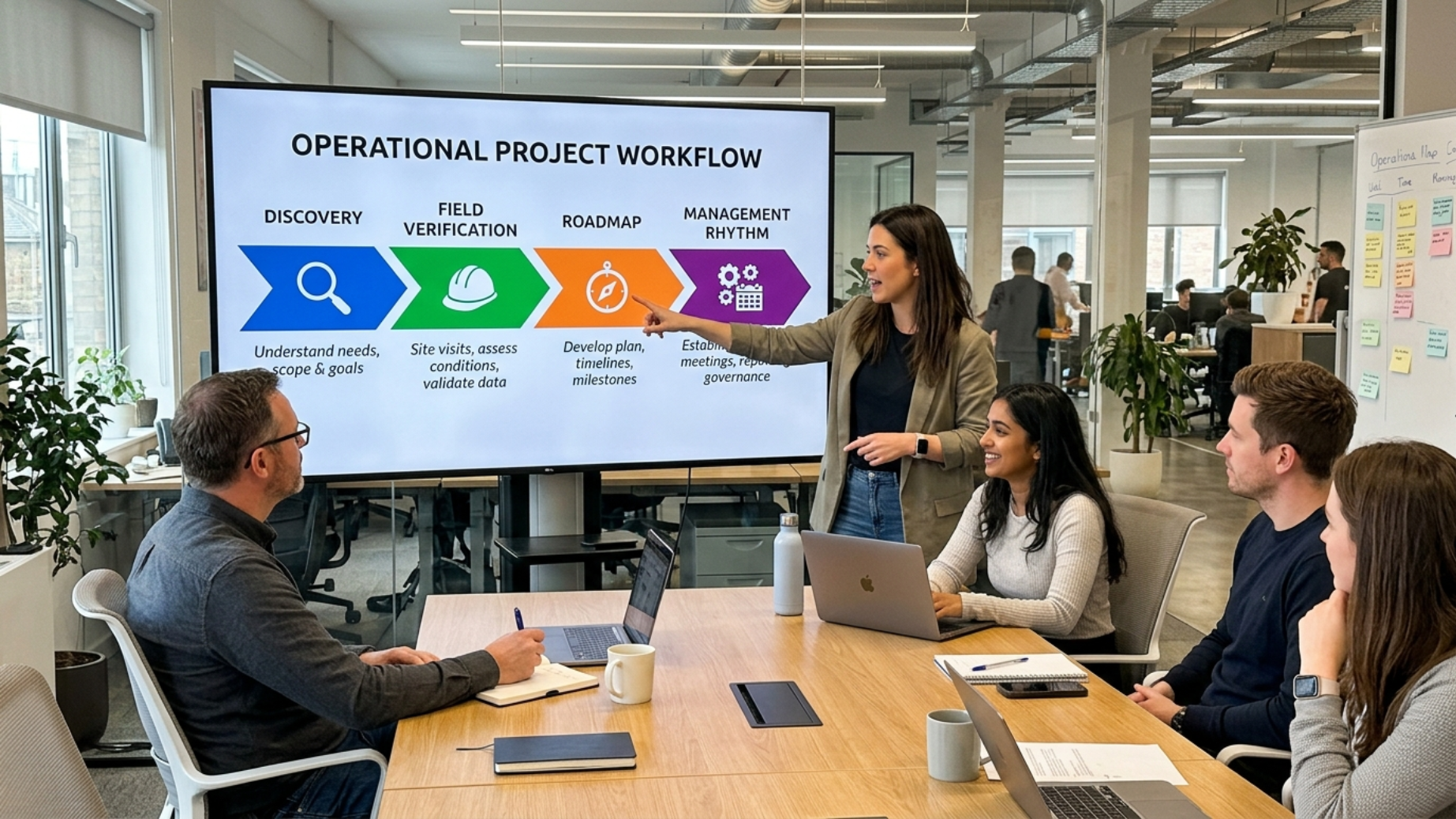
A well-run fractional safety director engagement should follow a structured ramp-up.
Week 1: Discovery
Review OSHA logs, incident history, insurance loss runs (if available), written programs, training records, SDS/HazCom documentation, inspection records, any prior citations, prequalification requirements, and active contracts. Identify high-risk tasks and sites. Meet leadership and define authority, access, and expectations.
Week 2: Field Verification
Walk the site or facility. Talk with supervisors and workers. Compare written procedures to actual conditions. Identify immediate serious hazards. Build a priority list. This step is where a fractional director earns credibility or loses it. One LinkedIn practitioner put it well: look for gaps, not faults, and listen before prescribing.
Week 3: Roadmap
Create a 30/60/90-day plan. Set inspection cadence. Establish a corrective action tracker. Build a training matrix. Assign internal owners for every action item.
Week 4: Management Rhythm
Start leadership reporting. Review open corrective actions. Schedule recurring site visits and training. Decide what requires additional staffing or specialist support. At this point, leadership should have a clear picture of the company’s safety posture and a plan to improve it.
The Three A’s: Why Fractional Safety Succeeds or Fails
A fractional safety director needs three things to be effective:
Access. To leadership, records, jobsites, supervisors, and workers. If the fractional director can’t get on site, can’t see incident records, or can’t talk to crews, the engagement is decorative.
Authority. To recommend and assign corrective actions, escalate repeat issues, stop work when warranted, and report directly to leadership. If the role is advisory-only with no expectation that anyone acts, it becomes a paper exercise.
Accountability. Named internal owners for every action item, due dates, closeout tracking, and regular leadership review. The fractional director creates the structure, but someone inside the company has to run it between visits.
Without all three, fractional safety becomes advice without execution. Practitioners on Reddit have made this point repeatedly: consultants add real value when the company is committed to acting on findings. They fail when the company wants a signature on a binder but won’t fund controls, train supervisors, or change production-first habits.
Metrics a Fractional Safety Director Should Report
Measuring the role requires both leading and lagging indicators. OSHA specifically identifies leading indicators as better measures of program effectiveness because they capture effort and engagement before incidents occur.
Leading indicators:
Inspections completed vs. scheduled
Hazards identified and classified by severity
Corrective action closeout time
Repeat findings (trending up or down)
Near misses reported
Training completion rates
Supervisor safety meetings held
JHA/AHA completion
Management walkthroughs
Worker safety suggestions
Lagging indicators:
Recordable incidents and TRIR
DART cases
Lost-time incidents
Workers’ compensation claims and costs
OSHA citations
Vehicle incidents
Property damage
For a deeper look at how assessments, audits, and continuous improvement fit into a safety management system, ESR has covered that process in detail.
Fractional Safety in Action: Industry Use Cases
Different industries face different risk profiles. Here is how the fractional model scales to meet specific operational needs:
Industry | Core Challenge | The Fractional Solution |
Construction Subcontractors | GC-required documentation & high-risk site audits. | Weekly site inspections, bilingual (EN/ES) toolbox talks, and site-specific safety plans. |
Manufacturing & Fabrication | Outdated LOTO, forklift safety, and machine guarding. | Training matrix overhaul, OSHA 300 log management, and monthly plant safety audits. |
Utility & Telecom | Distributed crews, vehicle safety, and electrical hazards. | Standardizing JHAs across mobile crews and coaching field supervisors on remote safety. |
Municipalities & Gov | Multiple departments (Parks, Public Works) with no central lead. | Department-wide hazard assessments and the creation of a unified Safety Committee. |
Warehousing & Logistics | Rapid scaling, ergonomics, and high-volume forklift traffic. | Pedestrian safety planning, incident root-cause analysis, and supervisor leadership training. |
When You Need More Than Fractional
Sometimes the assessment reveals that fractional support isn’t enough on its own. A company with rapid growth, multiple high-risk projects, daily on-site coverage requirements, or a completely absent safety function may need an outsourced safety department, dedicated safety staffing, or both.
ESR operates as a hybrid consulting and staffing firm. For companies that need fractional or outsourced safety leadership, ESR provides full program management with credentialed professionals (CSP, CHST, OSHA 500/501, NCCER instructors, MS-OSH). For companies that need daily on-site safety coverage, ESR’s nationwide staffing model offers a 48-hour average placement turnaround. Bilingual EN/ES field and training staff are available for companies with Spanish-speaking workforces. Local consulting within 50 miles of ESR’s offices in Raleigh, Charlotte, Wilmington, Alexandria (VA), and Allen (TX) carries no travel surcharge.
If you’re not sure which model fits, requesting a safety professional is a practical way to start the conversation.
Frequently Asked Questions
Is a fractional safety director the same as a safety consultant?
Not exactly. A safety consultant is typically brought in for defined problems: an audit, a training class, program writing, or an investigation. A fractional safety director usually provides ongoing leadership, manages the program over time, and builds the management rhythm that keeps safety moving between visits.
Can a fractional safety director satisfy OSHA requirements?
They can help you comply, but the employer retains all OSHA obligations. OSHA holds the employer responsible for providing a safe workplace, not the outside consultant or director. Source: OSHA.
How many hours does a fractional safety director work?
It depends entirely on the scope. Some engagements are a few hours per month for advisory and document review. Others are one or two days per week with on-site inspections, training, and leadership meetings. Project-based or interim engagements may be more intensive for a defined period.
When should I hire a full-time safety director instead?
When your risk profile, headcount, number of active sites, contractual requirements, and daily workload require someone present every day. If safety issues arise faster than a fractional visit cadence can address, full-time is the right call.
What should a fractional safety director agreement include?
At minimum: scope of services, visit frequency, deliverables, authority granted, reporting format and cadence, response time for urgent issues, training responsibilities, exclusions, and the name of the internal point of contact who owns day-to-day follow-through.
Can fractional safety support include Spanish-language training?
Yes, if the provider has qualified bilingual trainers. For companies with Spanish-speaking crews, bilingual safety communication is often both an OSHA compliance need and a practical necessity. Not all providers offer this.
What is the difference between a fractional safety director and safety staffing?
Fractional is leadership and program management: strategy, written programs, audits, training planning, metrics, and leadership reporting. Safety staffing places a credentialed safety professional on site for a defined schedule to handle daily field work: orientations, permits, inspections, hazard monitoring, and real-time enforcement. Many companies need both.
Is Fractional Right for You?
If your company has more than 20 employees but fewer than 200, and your current safety “lead” is an overworked HR manager, a Fractional Safety Director is the most cost-effective way to lower your EMR (Experience Modifier Rate) and avoid five-figure OSHA fines. It provides the strategy of a veteran and the compliance of a specialist without the executive salary burden.