
TLDR
Safety consulting in Wilmington, NC covers everything from one-time OSHA audits and jobsite inspections to ongoing outsourced safety management for employers without a full-time safety director. North Carolina operates its own OSHA-approved State Plan through NCDOL, which means Wilmington employers face state-level enforcement, not just federal OSHA oversight. This glossary breaks down the terms you will encounter when hiring a safety consultant, preparing for an inspection, or deciding between free public consultation, private consulting, and on-site safety staffing.
Wilmington is not slowing down. New Hanover County permitted 1,008 residential buildings resulting in 2,717 units in 2025, with more than half of those units being apartments approved within the City of Wilmington. Commercial permitting added 79 new construction permits and 527 total commercial permits that same year, covering everything from new builds to upfits and alterations source.
This surge in permitting is heavily concentrated in the Wilmington Trade District and the Cape Fear industrial corridor. As the region transitions from a historic port city into a major hub for tech and life sciences, the volume of high-density “upfit” projects and new industrial builds has increased safety exposure in tight, urban environments. This rapid growth in the Cape Fear sector is why generic safety plans are no longer sufficient for Wilmington’s increasingly complex jobsite logistics.
That volume of work creates real safety exposure. And if you are searching for safety consulting in Wilmington, NC, you probably already feel it. Maybe you need help before a project starts. Maybe an OSHA letter arrived. Maybe your ISNetworld profile is blocking bids, or you simply do not have a safety manager and the risk has outgrown what HR can handle.
This glossary is built for that moment. It explains the terms you will see in proposals, OSHA correspondence, GC requirements, and consulting agreements, then helps you figure out which type of support fits your situation.
Direct Answer: Safety Consulting in Wilmington, NC
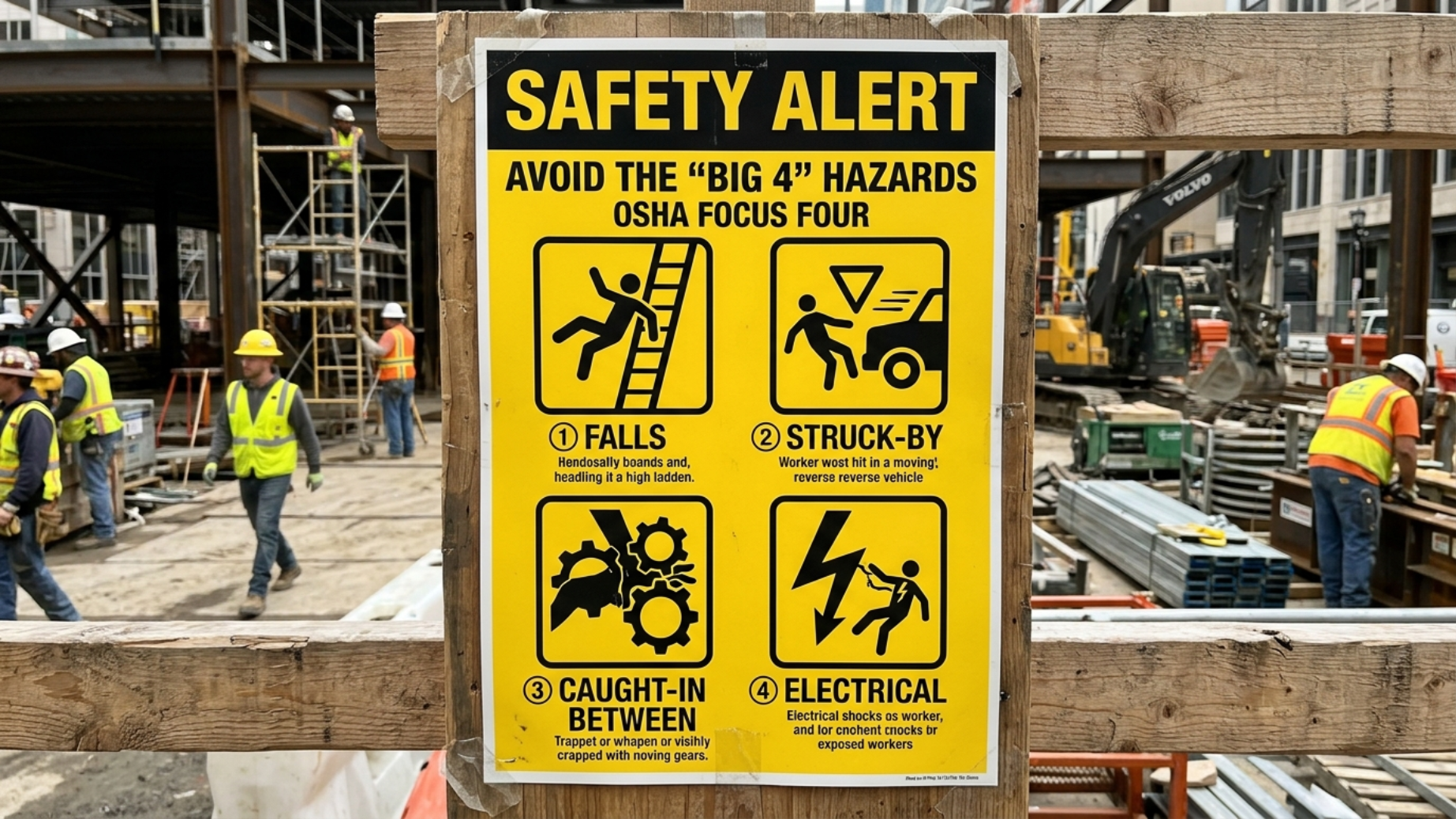
Professional safety consulting in Wilmington, NC, provides businesses with OSHA-compliant audits, site-specific safety plans, and on-site staffing. Because North Carolina is a State Plan state, Wilmington employers are governed by NC OSH (NCDOL) standards rather than federal oversight. Key services include preparing for the 2026 Struck-By Special Emphasis Program, managing ISNetworld prequalification, and conducting bilingual safety training to reduce “Big 4” construction hazards (Falls, Struck-by, Caught-in, and Electrical).
What Is Safety Consulting?
Safety consulting is professional support that helps an employer identify workplace hazards, understand OSHA and state safety requirements, improve written programs, train workers and supervisors, prepare for inspections, investigate incidents, and build a practical safety management system.
In the Wilmington area, safety consulting commonly applies to construction projects (multifamily, commercial, infrastructure), manufacturing and industrial facilities, utilities, telecom, municipalities, and healthcare or life sciences operations.
What a safety consultant actually does on your site matters more than the title. A good consultant walks the jobsite or production floor, identifies hazards, connects those hazards to specific OSHA or NC OSH standards, prioritizes risk, and helps your supervisors take ownership of corrective actions. A bad one hands you a binder and sends an invoice.
Practitioners on Reddit are blunt about this distinction. In a discussion about companies without a full-time safety manager, one consultant described the role as “extra hands, outside perspective, and third-party audit support,” while another warned that a consultant sent to a site without proper onboarding may simply produce a deficiency email and leave source. The takeaway is straightforward: a consultant can build the system, but your leadership has to run it.
A safety manual, on its own, is not a safety program. If your written programs are collecting dust or were copied from a template, they are not protecting anyone. Understanding what makes a safety manual actually OSHA-compliant is a useful first step before bringing in outside help.
Why Safety Consulting Matters in Wilmington, NC
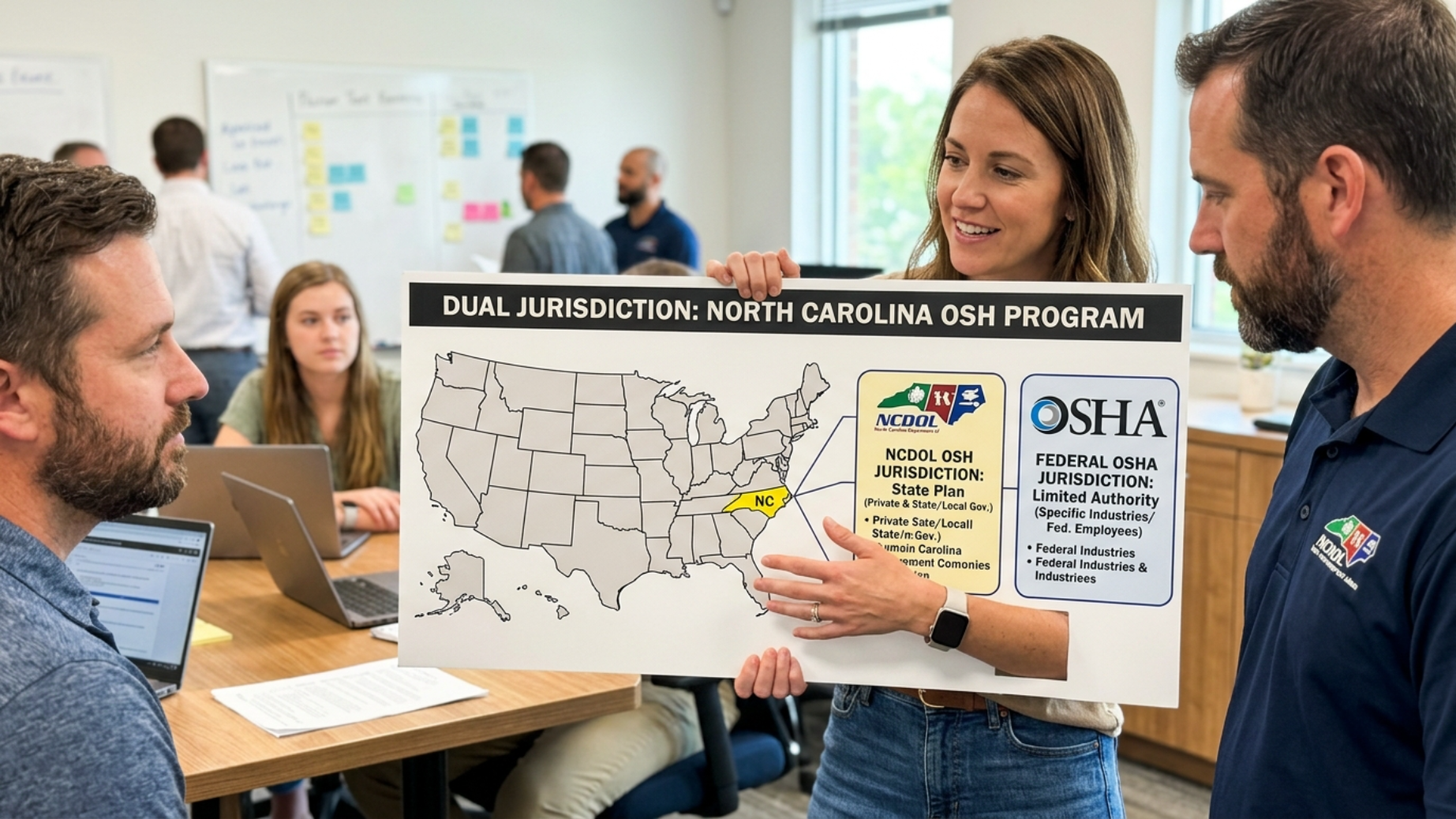
North Carolina Is a State Plan State
This is the single most important regulatory fact that many competitor pages ignore. North Carolina operates an OSHA-approved State Plan that covers most private and public sector employers and employees in the state. Federal OSHA retains jurisdiction over certain exceptions, including federal employees, USPS, private-sector maritime activities, railroad employment, military bases, and some others source.
What this means for a Wilmington employer: your inspections, citations, and enforcement actions will likely come from NC OSH through the North Carolina Department of Labor (NCDOL), not a federal OSHA compliance officer. The standards are at least as effective as federal OSHA’s, including penalty levels, but the inspection priorities, emphasis programs, and consultation resources are state-administered.
Construction Fatalities Are Concentrated in Familiar Hazards
Hazard Category | % of NC Construction Fatalities | Key Preventive Control |
Falls from Elevation | 22% | Guardrails & Personal Fall Arrest (PFAS) |
Struck-By | 37% | High-viz gear & spotter protocols |
Caught-In/Between | 18% | Trench shoring & machine guarding |
Electrocutions | 6% | Lockout/Tagout (LOTO) & grounding |
While the “Big 4” remain a priority, the NCDOL officially launched a new Struck-By Special Emphasis Program (SEP) on October 1, 2025. For 2026, the state is in an “Education and Outreach” phase, with focused enforcement and inspections scheduled to begin October 1, 2026. A key date for Wilmington employers is April 20–24, 2026, which marks the National Struck-By and Work Zone Awareness Week. Participating in safety stand-downs during this week is a proactive way to demonstrate compliance before the new enforcement window opens.
The Bureau of Labor Statistics reported 196 fatal work injuries across North Carolina in 2024, up from 177 in 2023. The construction sector had the highest number of private-industry fatalities, with 36 deaths. Falls, slips, and trips caused 14 of those 36 construction fatalities, and specialty trade contractors accounted for 22 of the sector’s fatal workplace injuries source.
These are not abstract numbers. They represent real failures in hazard control, training, supervision, and planning, exactly the problems safety consulting in Wilmington, NC is meant to address.
Starting in late 2025 and into 2026, North Carolina has intensified focus on Struck-By hazards. This is now a standalone Special Emphasis Program (SEP) in the NCDOL Strategic Management Plan.
What this means for Wilmington: Inspectors are specifically looking at materials handling, vehicle safety in tight coastal jobsites, and falling object protection.
Consultant Role: A 2026 safety audit should now include a specific “Struck-By Audit” to ensure compliance before this focused enforcement hits your site.
Penalties Are Not Trivial
Violation Type | Maximum Penalty (2026) | Minimum (Willful) |
Serious | $16,550 | N/A |
Other-than-Serious | $16,550 | N/A |
Willful or Repeated | $165,514 | $11,524 |
Failure to Abate | $16,550 / day | N/A |
Posting Requirements | $16,550 | N/A |
Under the 2026 Inflation-Adjusted Maximums (effective January 2026), the financial stakes for non-compliance have reached record highs. North Carolina’s State Plan mirrors these federal increases:
Serious & Other-Than-Serious: $16,550 per violation
Willful or Repeated: $165,514 per violation
Failure to Abate: $16,550 per day beyond the abatement date.
For small businesses in Wilmington (under 25 employees), NCDOL may offer penalty reductions of up to 70%, but “Willful” violations carry a mandatory minimum of $11,524 that cannot be waived.
If you have received an OSHA citation and are unsure how to respond, understanding the four-step process for handling citations can prevent a manageable problem from escalating.
Safety Consulting Glossary
The terms below are grouped by how you will encounter them: regulatory and compliance terms first, then field safety and hazard control, training and workforce, program and business support, and current hazard topics.
OSHA and Regulatory Terms
OSHA (Occupational Safety and Health Administration)
The federal agency that sets and enforces workplace safety and health standards. In North Carolina, most enforcement happens through the state’s OSHA-approved plan administered by NCDOL, not directly through federal OSHA.
NC OSH / NCDOL
North Carolina’s Occupational Safety and Health program, run by the North Carolina Department of Labor. This is the enforcement body most Wilmington employers will interact with for inspections, complaints, and compliance.
State Plan
An OSHA-approved state program that assumes responsibility for occupational safety and health enforcement. North Carolina’s State Plan covers most workplaces, with specific federal exceptions source. When a safety consultant mentions “State Plan,” they mean your employer is subject to state-level enforcement that mirrors or exceeds federal OSHA requirements.
OSHA On-site Consultation Program
A free, confidential, non-enforcement consultation service that helps employers (typically small businesses) identify hazards and improve safety programs. NCDOL states that consultants do not issue citations or penalties source. Practitioners on Reddit have called these programs one of the “best-kept secrets” in occupational safety, while cautioning that management must be ready to correct serious hazards identified during the visit source.
OSHA Inspection
A formal visit by a compliance officer, often triggered by complaints, referrals, severe injuries or fatalities, programmed emphasis programs, or hazards visible from outside a worksite. One detail that surprises many employers: hazards visible in plain view during an inspection walk-through can expand the scope of the inspection. A former OSHA compliance officer on Reddit advised taking inspectors by the most direct route needed, because anything visible along the way can become part of the record source.
OSHA Citation
A formal notice alleging that an employer violated an OSHA or State Plan requirement. Citations classify violations (serious, other-than-serious, willful, repeated) and propose penalties. The classification affects both the fine amount and the employer’s enforcement history.
Abatement
Correcting a cited or identified hazard by the required deadline. Examples include installing missing guardrails, retraining workers, updating a written program, or repairing defective scaffolding. Failure-to-abate penalties can reach $16,550 per day beyond the deadline source.
OSHA 300, 300A, and 301
Recordkeeping forms used to track work-related injuries and illnesses. The 300 Log records individual incidents, the 300A Annual Summary aggregates them, and the 301 Incident Report captures detailed information about each case. Covered employers must also submit data electronically through OSHA’s Injury Tracking Application (ITA) source. For employers unsure whether their establishment is covered, confirm through the ITA Coverage Application or ask a qualified safety professional.
OSHA Reportable Incident
A severe work-related event requiring rapid notification: fatalities must be reported within 8 hours, and in-patient hospitalizations, amputations, and loss of an eye must be reported within 24 hours, subject to OSHA’s specific timing rules source. Employers can report by calling the OSHA Area Office, calling 1-800-321-OSHA, or submitting electronically.
General Duty Clause
Section 5(a)(1) of the OSH Act, which requires employers to provide a workplace free from recognized hazards likely to cause death or serious physical harm, even when no specific OSHA standard covers the hazard. Understanding how the General Duty Clause works is important because it is the mechanism OSHA uses when a hazard falls outside an existing regulation.
Field Safety and Hazard Control Terms
Jobsite Safety Inspection
A field inspection focused on active work conditions: fall exposures, ladder use, scaffold integrity, housekeeping, PPE compliance, equipment condition, traffic control, excavation, electrical hazards, and struck-by risks. A useful inspection produces more than a checklist. It includes photographs, responsible parties, due dates, and follow-up verification.
Safety Audit / Safety Assessment
A structured review of workplace conditions, safety programs, training records, OSHA logs, written procedures, and field practices. Audits should go beyond “compliant or not compliant” and rank risk by severity and probability, identify root causes, and assign corrective actions using the hierarchy of controls. Learn more about how assessments and audits drive continuous improvement.
Mock OSHA Inspection
A simulated OSHA-style inspection conducted before an actual compliance officer shows up. A thorough mock inspection checks the opening conference process, document readiness (OSHA logs, training records, written programs, SDS), visible hazards along realistic walking routes, and employee interview preparedness. This is one of the highest-value services in safety consulting for Wilmington, NC employers who know an inspection could happen at any time.
Competent Person
Under OSHA construction standards (29 CFR 1926.32), a competent person is someone capable of identifying existing and predictable hazards that are unsanitary, hazardous, or dangerous to employees, and who has the authority to take prompt corrective measures source. This is not just a title. A scaffold competent person, for example, must be able to recognize scaffold hazards and have the authority to stop use or correct the issue immediately.
JHA / JSA / AHA (Job Hazard Analysis / Job Safety Analysis / Activity Hazard Analysis)
Planning tools that break work into steps, identify hazards at each step, and choose controls before work begins. AHAs are commonly required on construction, government, and owner-controlled projects. Before steel erection, trenching, crane operations, or confined space entry, the crew should review the task steps, associated hazards, required controls, PPE, competent-person requirements, and stop-work triggers.
Site-Specific Safety Plan (SSSP)
A safety plan customized to a specific project, site, owner, general contractor, contract, hazard profile, and scope of work. A generic safety manual is not a site-specific safety plan. A Wilmington waterfront or coastal project, for example, may need site-specific emergency contacts, hurricane and tropical weather planning, heat exposure controls, traffic control, fall protection details, crane coordination, and subcontractor orientation procedures.
Hierarchy of Controls
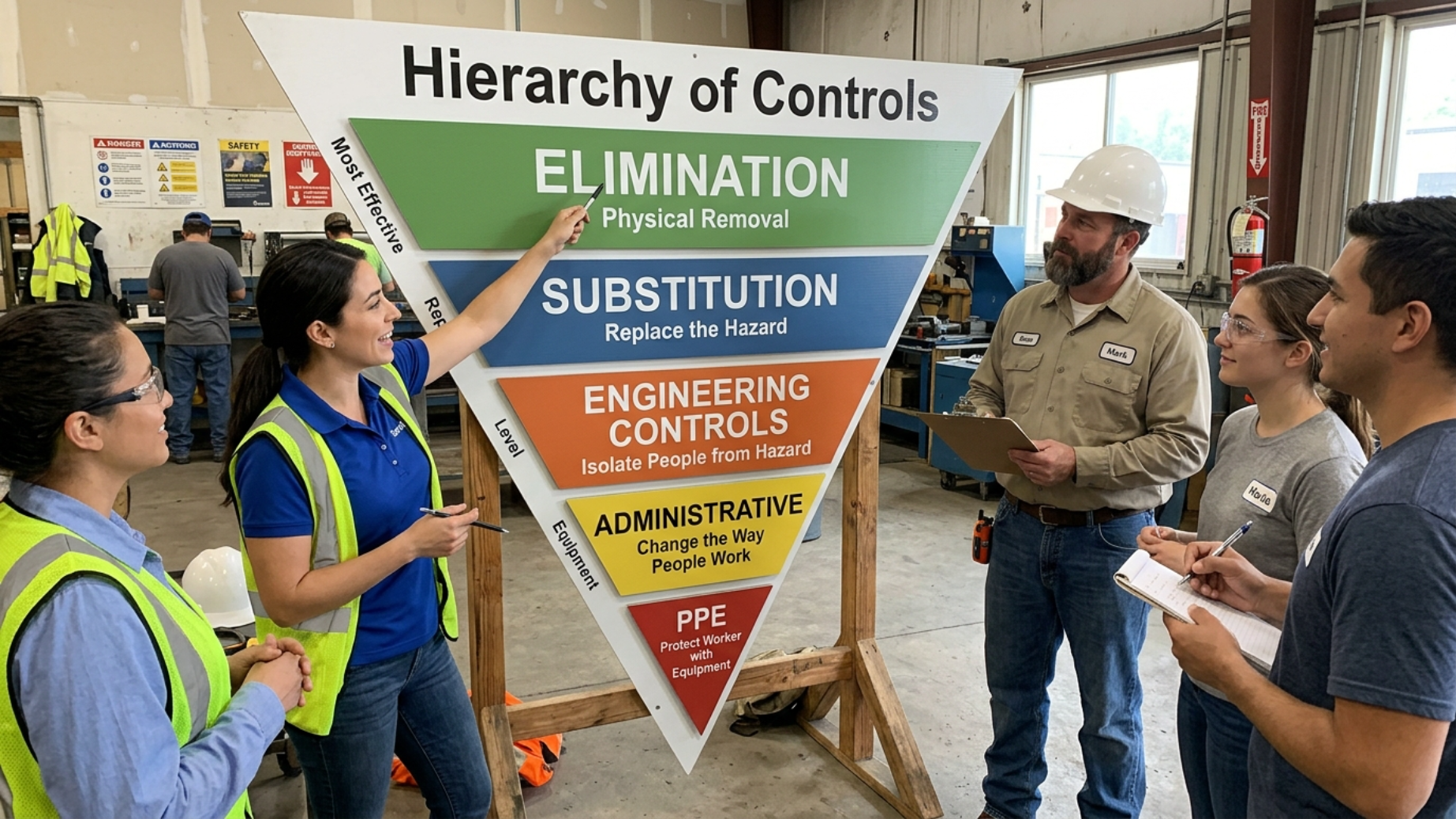
A risk-control framework that ranks hazard controls from most effective to least effective: elimination, substitution, engineering controls, administrative controls, and PPE. NIOSH states that higher-level controls (elimination, substitution, engineering) are more effective because they reduce exposures without relying heavily on human behavior source. A good safety consultant applies this framework instead of defaulting to “just wear your PPE.” For a deeper look at how hazard recognition and control fit into a broader safety system, see this overview of hazard recognition, evaluation, and control.
Corrective Action Plan
A documented plan that assigns each safety issue to an owner, a due date, a control method, and a verification step. Example: “Replace damaged ladder by Friday. Superintendent to remove it from service today. Safety manager to verify replacement and train crew during Monday toolbox talk.” Good plans prioritize high-severity hazards first and separate immediate fixes from longer-term improvements.
Incident Investigation / Root Cause Analysis
A structured review after an injury, near miss, property damage event, or serious hazard exposure. The goal is to determine what happened, why it happened, and how to prevent recurrence. After a fall, the investigation should look beyond “worker was careless” and review planning, supervision, access, anchor points, training, equipment, schedule pressure, and subcontractor coordination.
Training and Workforce Terms
OSHA 10 / OSHA 30
Outreach Training Program courses providing basic (10-hour) or more advanced (30-hour) hazard awareness training. Students receive a course completion card, not a certification. OSHA explicitly states that these courses are voluntary, do not meet the training requirements for any specific OSHA standard, and are not certifications source. A GC may still require OSHA 10 cards for workers and OSHA 30 cards for supervisors, but these should not be confused with standard-specific required training. For a broader view of what OSHA actually requires, read this overview of OSHA-required training.
Practitioners on Reddit note that OSHA 10/30 training often functions as a “loss leader” for consulting firms because online options create pricing pressure. The real value of a safety consultant usually comes from audits, manual development, and prequalification support rather than outreach training alone source.
Bilingual Safety Training
Safety training delivered in the language workers actually understand. For construction and industrial crews in the Wilmington area, this most commonly means English and Spanish. Fall protection, scaffold safety, HazCom, and site orientation should all be delivered so that supervisors and field crews understand the same hazard controls, inspection expectations, and stop-work rules.
Toolbox Talk
A short, focused safety discussion (typically 5 to 15 minutes) held at the start of a shift or before a specific task. Topics rotate based on current site hazards, recent incidents, seasonal risks, or upcoming high-risk work phases.
Training Matrix
A document tracking which employees have completed which training, when it was completed, when it expires, and what gaps remain. A well-maintained training matrix is one of the first things a compliance officer or prequalification reviewer will request.
Site Orientation
A briefing for workers, subcontractors, and visitors before they enter a jobsite or facility. Covers site-specific hazards, emergency procedures, PPE requirements, reporting protocols, and rules of engagement.
Program and Business Support Terms
Safety Manual
A written collection of an employer’s safety policies, procedures, and programs. A manual should be customized to the employer’s actual operations, not a generic template purchased online. It typically includes programs for hazard communication, fall protection, lockout/tagout, respiratory protection, emergency action, and other applicable standards.
Fractional Safety Manager / Outsourced Safety Department
Ongoing safety leadership provided part-time or externally when a company does not need or cannot justify a full-time internal safety director. A growing subcontractor might use an outsourced safety department for monthly inspections, safety meetings, training matrix management, OSHA log review, prequalification support, and management coaching.
The hybrid model works best. Practitioners consistently describe the ideal setup as a consultant building the framework while an internal person owns follow-through between visits source.
Safety Staffing / On-site Safety Professional
Placing a credentialed safety professional on-site for a project, shutdown, outage, construction phase, or temporary coverage need. This is different from consulting because the professional is embedded on-site, often full-time, for the duration of the assignment. A project owner or GC may require full-time safety coverage that the contractor cannot hire fast enough.
ISNetworld / Avetta Prequalification
Contractor management platforms used by owners, developers, and GCs to evaluate a contractor’s safety programs, insurance, OSHA logs, training records, and compliance documentation before awarding work. A subcontractor with field experience but weak written programs, incomplete training records, or missing OSHA logs may lose bids because their prequalification profile fails review.
Expert Witness
A qualified safety professional retained to provide technical analysis, opinions, and testimony in legal proceedings related to workplace incidents, OSHA citations, or safety-related disputes.
Current Hazard Topics
Fall Protection
Fall protection (29 CFR 1926.501) has been the most-cited OSHA standard for years. It covers guardrails, safety nets, personal fall arrest systems, warning lines, and other measures to protect workers at elevation. Fall protection training (29 CFR 1926.503) also appears on OSHA’s FY 2025 Top 10 list as a separate citation category source.
Hazard Communication / SDS (Safety Data Sheets)
The HazCom standard (29 CFR 1910.1200) requires employers to inform workers about chemical hazards through labels, safety data sheets, and training. It consistently ranks among OSHA’s most-cited standards. Learn more about OSHA Hazard Communication standards.
Lockout/Tagout (LOTO)
The control of hazardous energy standard (29 CFR 1910.147) requires procedures to isolate energy sources during maintenance and servicing. Proper LOTO programs include written procedures, training, periodic inspections, and authorized/affected employee identification.
Respiratory Protection
29 CFR 1910.134 covers the selection, use, and maintenance of respirators. Requirements include a written program, medical evaluations, fit testing, and training.
Machine Guarding
29 CFR 1910.212 requires guards on machines with parts that could injure workers through contact, nip points, rotating parts, flying chips, or sparks.
PPE Fit
OSHA’s construction PPE final rule, effective January 13, 2025, revised 29 CFR 1926.95 to explicitly require that employers provide PPE that properly fits construction workers source. This means hard hats, gloves, eye protection, harnesses, respirators, and high-visibility gear must actually fit the worker using them. For the full details, read this breakdown of OSHA’s final rule on PPE fit requirements.
Heat Illness Prevention Plan
OSHA published a proposed Heat Injury and Illness Prevention rule on August 30, 2024. If finalized, the standard would require employers to create a plan to evaluate and control heat hazards, including water, rest, shade or cooling, acclimatization, monitoring, emergency response, and supervisor training source. Wilmington’s coastal climate makes this particularly relevant for construction, utilities, landscaping, roofing, concrete, and industrial work. Read more about the DOL proposed heat rule and what it could mean for employers.
As of January 2025, OSHA’s final rule on PPE Fit in Construction is in full effect. It is no longer enough to provide gear; that gear must properly fit the individual worker. Safety consultants in Wilmington are now tasked with performing “Fit Audits” to ensure harnesses and respirators are sized correctly for a diverse workforce, preventing “one-size-fits-all” citations.
Safety Consulting vs. Free NCDOL Consultation vs. Safety Staffing
This is the comparison most competitor pages avoid making, even though it is the first decision many employers need help with.
Option | Best For | Limits |
|---|---|---|
Free NCDOL On-site Consultation | Small businesses wanting confidential hazard identification and compliance guidance at no cost | Not project-specific staffing. Not emergency legal response. May require correction of serious hazards found during the visit. Scheduling depends on program availability. |
Private Safety Consulting | Audits, written programs, training, inspections, mock OSHA prep, incident investigation, prequalification, management coaching | Requires a paid scope. Quality depends entirely on consultant fit and field experience. |
Safety Staffing | Temporary or long-term on-site safety coverage required by a project, GC, owner, outage, or staffing gap | More like embedded labor than a one-time consulting deliverable. |
Fractional / Outsourced Safety Department | Growing employers without a full-time safety director who need ongoing advisory and program management | Needs an internal champion and leadership commitment to follow through between visits. |
Free NCDOL consultation is genuinely valuable. It is not something to dismiss. But it is designed for different circumstances than hiring a private safety consultant in Wilmington, NC to write a site-specific plan, staff a six-month project, help you respond to an OSHA citation, or manage your ISNetworld profile.
Evolution Safety Resources supports Wilmington-area employers with local safety consulting and provides nationwide safety staffing for projects requiring qualified on-site coverage. ESR’s team holds credentials including CSP, CHST, OSHA 500/501, NCCER instructor certifications, and MS-OSH degrees, with bilingual English/Spanish field and training staff. If your project needs an on-site safety professional, ESR’s staffing line offers a 48-hour average placement promise. Request support through ESR’s field services and safety staffing page.
When Should a Wilmington Employer Call a Safety Consultant?
There are at least ten practical triggers:
You are starting a new project and need a site-specific safety plan, AHAs, or subcontractor orientation materials.
A GC, owner, or municipality requires safety documentation before you can mobilize.
Your ISNetworld or Avetta profile is incomplete or blocking bids.
You have no full-time safety manager, but your risk has outgrown what HR or operations can handle.
You need a mock OSHA inspection before a high-risk phase such as steel erection, roofing, or demolition.
You received an OSHA or NC OSH letter, complaint, inspection notice, or citation.
You had a serious incident, near miss, hospitalization, amputation, eye loss, or fatality.
Your crews include Spanish-speaking workers who need bilingual training.
You need temporary on-site safety coverage faster than you can hire internally.
You have repeat issues with falls, ladders, scaffolds, forklifts, LOTO, HazCom, machine guarding, respiratory protection, or PPE fit.
If your trigger is a jobsite that needs a walk-through or OSHA-readiness review, ESR’s jobsite safety inspections and mock OSHA inspections page explains what that process looks like.
What Should a Good Safety Consulting Deliverable Include?
“Binder safety” is a term practitioners use to describe the worst version of safety consulting: canned programs, check-the-box videos, and generic manuals that look impressive on a shelf but change nothing in the field. One Reddit user summarized the best approach as a hybrid: use a consultant to build the framework, then assign an internal owner with simple tools for inspections, incident tracking, and follow-through source.
A useful safety consulting deliverable should include:
Site walk-through findings with photographs
Standards or best-practice references tied to each finding
Risk ranking by severity and likelihood
A corrective action plan with an assigned owner and due date for every item
Immediate fixes separated from longer-term improvements
Training gaps and training matrix updates
Required written-program updates
Recordkeeping and OSHA log review (if in scope)
Follow-up verification to confirm corrective actions were completed
Supervisor coaching on how to sustain improvements
Bilingual delivery where the workforce requires it
Good safety work turns findings into corrective actions with owners and due dates. If your consultant’s report does not include those elements, you are paying for paperwork, not risk reduction.
How to Choose a Safety Consultant in Wilmington, NC
A LinkedIn article from Safety Knights emphasizes that the right EHS consultant depends on industry fit, language, real risks, culture-building, supervisor engagement, and clear scope with defined success criteria source. Here are the questions worth asking:
Have you worked in our industry: construction, manufacturing, utilities, municipalities, telecom, healthcare, life sciences, or industrial facilities?
Do you understand North Carolina’s State Plan environment and NCDOL enforcement procedures?
Will you walk the site or floor, or only review documents?
What credentials do your assigned professionals hold? (Look for CSP, CHST, OSHA 500/501, NCCER, or relevant graduate education.)
Can you provide bilingual English/Spanish training and field support?
Can you support both one-time consulting and on-site staffing if the scope changes?
What will the final deliverable look like?
How do you track corrective actions?
How fast can you place an on-site safety professional if needed?
Can you support ISNetworld, Avetta, or owner prequalification requirements?
Can you help after an OSHA citation, incident, or serious injury?
A Note on Pricing
Safety consulting pricing varies by scope, hazard level, location, deliverables, credentials, and duration. Practitioner discussions show that consulting may be quoted hourly, by project, or by retainer. Long-term outsourcing and specialized work command very different rates source. Ask for a defined scope and deliverable before comparing costs. The cheapest option and the best option are rarely the same thing.
Common Wilmington Safety Consulting Scenarios
Scenario 1: GC needs a mock OSHA inspection before a high-risk phase.
A general contractor wants a third-party walk-through before vertical construction begins. The consultant checks fall protection systems, ladder placement, scaffold access, housekeeping, electrical panel clearance, documentation, and superintendent readiness. Findings reference OSHA’s Top 10 cited standards and NCDOL’s Big 4 construction hazards.
Scenario 2: Specialty subcontractor needs prequalification help.
A concrete or steel subcontractor has decades of field experience but weak written programs, incomplete training records, and no ISNetworld profile. A consultant builds or updates the documentation package, ensures the OSHA 300 logs are accurate, and aligns the written programs with the actual work the company performs.
Scenario 3: Manufacturer needs OSHA 1910 compliance support.
A Wilmington-area manufacturing facility needs review of its lockout/tagout procedures, machine guarding, HazCom/SDS management, forklift operations, respiratory protection program, PPE assessments, and electronic injury reporting through the ITA.
Scenario 4: Employer had a serious incident.
A worker is hospitalized after a fall. The employer must report to OSHA within 24 hours. A consultant helps with incident investigation, root cause analysis, OSHA 300/301 documentation, corrective actions, and future prevention measures. This is not legal advice, but having a qualified safety professional involved early can prevent documentation gaps from becoming larger operational and legal problems.
Scenario 5: Project requires full-time safety coverage starting next week.
A developer or GC requires a credentialed safety professional on-site for a twelve-month build, and the contractor has no one available internally. This is safety staffing, not just consulting. ESR’s staffing line is built for this scenario, with a 48-hour average placement promise and no travel surcharge within 50 miles of its Wilmington office.
Wilmington-Area Hazards to Prioritize
Based on NCDOL’s construction Special Emphasis Program data and OSHA’s FY 2025 Top 10 most-cited standards source, Wilmington-area employers should pay particular attention to:
Falls from elevation (the leading cause of construction fatalities in North Carolina)
Struck-by hazards (a new Struck-by Special Emphasis Program takes effect October 1, 2025, with enforcement starting October 1, 2026)
Caught-in/between hazards (trenching, excavation, equipment)
Electrical hazards (temporary power, overhead lines, panel clearance)
Ladder safety (consistently in OSHA’s Top 10)
Scaffold safety (consistently in OSHA’s Top 10)
Powered industrial trucks (forklifts in warehousing, manufacturing, and construction material handling)
Heat illness (coastal North Carolina summers create serious outdoor and indoor heat exposure)
FAQs
What does a safety consultant do?
A safety consultant helps identify hazards, interpret OSHA and NC OSH requirements, inspect jobsites or facilities, train workers, improve written programs, investigate incidents, prepare for inspections, and create corrective action plans. The scope depends on the engagement: some projects involve a single audit, while others cover ongoing program management.
Is North Carolina OSHA the same as federal OSHA?
Not exactly. North Carolina operates an OSHA-approved State Plan covering most private and public workplaces, with federal OSHA retaining jurisdiction over specific exceptions like federal employees, USPS, private-sector maritime, railroad employment, and military bases source. Most Wilmington employers interact with NC OSH/NCDOL for enforcement.
Is NCDOL’s consultation program free?
Yes. NCDOL states that all consultation services are free, confidential, and separate from compliance enforcement. Consultants do not issue citations or penalties source. It is an excellent resource, particularly for small businesses.
Why hire a private safety consultant if free consultation exists?
Private safety consulting in Wilmington, NC may be the better fit when you need faster scheduling tied to a project timeline, written deliverables like a site-specific safety plan or AHA, ISNetworld or Avetta prequalification support, bilingual training, on-site staffing, incident response, mock OSHA inspections, or ongoing outsourced safety management. Free consultation and private consulting solve different problems.
Does OSHA 10 or OSHA 30 make a worker “OSHA certified”?
No. OSHA states that Outreach Training Program courses are voluntary, do not meet the training requirements for any OSHA standard, and are not certifications. Students receive course completion cards source. Many GCs require them, but they do not replace standard-specific training requirements.
What are the most common OSHA violations?
OSHA’s FY 2025 Top 10 most-cited standards included fall protection, Hazard Communication, ladders, lockout/tagout, respiratory protection, scaffolding, fall protection training, powered industrial trucks, eye/face protection, and machine guarding source.
When must an employer report a serious incident to OSHA?
Employers must report work-related fatalities within 8 hours and in-patient hospitalizations, amputations, and loss of an eye within 24 hours, subject to OSHA’s specific timing rules source. Reports can be made by calling the OSHA Area Office, calling 1-800-321-OSHA, or submitting online.
What is the difference between safety consulting and safety staffing?
Safety consulting is typically project-based or advisory: an audit, a training class, a written program, an investigation. Safety staffing places a credentialed safety professional on-site for a defined schedule, project, outage, or temporary coverage need. One is a deliverable, the other is embedded labor. Many employers start with consulting and transition to staffing when the scope grows, or they need both simultaneously.
Safety consulting in Wilmington, NC is not an abstraction. With active construction across New Hanover County, state-level enforcement through NCDOL, and North Carolina construction fatality rates that consistently exceed the all-industry average, the question for most employers is not whether they need safety support but what kind and how fast. Whether that means a one-time mock OSHA inspection, a prequalification overhaul, bilingual training for field crews, or a full-time safety professional on-site by Thursday, the right starting point is understanding the terms and choosing the support that matches your actual risk. Contact Evolution Safety Resources to discuss which option fits your situation.