
TL;DR
Construction safety staffing is the placement of qualified safety professionals on construction jobsites for temporary, contract, or project-duration coverage. Contractors use it when they need on-site safety oversight faster than a traditional hiring process allows, whether the driver is an owner requirement, a federal contract, a high-risk work phase, or a sudden vacancy. The right staffing fit matches a person’s hazard knowledge, credentials, documentation habits, and communication skills to the specific project, not just a job title to an open seat.
Construction Safety Staffing Definition
Construction safety staffing is the use of temporary, contract, temp-to-hire, or project-based safety professionals to provide on-site safety oversight for a construction project. These professionals handle daily inspections, safety meetings, documentation, hazard follow-up, subcontractor coordination, incident response, and owner or general contractor compliance requirements.
This is different from a one-time safety consultation, where someone visits a site, writes a report, and leaves. A staffed safety professional is embedded on the jobsite, sometimes for weeks, sometimes for the full project duration. Their job is to help the contractor maintain field-level hazard control and compliance follow-through every day the site is active.
It is also different from a permanent direct-hire search, which can take weeks or months. Construction safety staffing fills the gap when a contractor needs qualified coverage now, not after three rounds of interviews.
OSHA’s construction standards require employers to initiate and maintain safety and health programs and to provide frequent and regular inspections of jobsites, materials, and equipment by competent persons designated by the employer (OSHA 1926.20). When a contractor lacks the internal safety capacity to meet those obligations, staffing a qualified professional is one of the fastest ways to close the gap.
Construction Safety Staffing in Practice
Here is what this looks like on a real project.
A general contractor wins a six-month commercial build. The owner’s contract requires daily safety oversight, documented inspections, and a dedicated safety professional on site whenever work is being performed. The GC’s internal safety director already covers three other projects and cannot be present full-time. So the GC engages a construction safety staffing firm to place a qualified professional for the project’s duration.
That person shows up on day one, reviews the site-specific safety plan, meets the superintendent and subcontractor leads, and starts working. Daily walks. Hazard documentation. Corrective action tracking. Toolbox talk support. JHA and AHA reviews. Training record verification. Subcontractor competent person coordination. Daily safety reports to project leadership.
When the project wraps, the staffing engagement ends. No severance, no long-term payroll commitment, no gap in coverage during the build.
Why Contractors Use Construction Safety Staffing
The reasons vary, but they almost always come back to one thing: the contractor needs qualified safety coverage on site and cannot wait for a traditional hire.
Owner or GC contract requirement
Many project contracts require a dedicated Site Safety Officer (SSO), Site Safety and Health Officer (SSHO), or safety manager. If the contractor does not have someone available internally, staffing fills the requirement.
Federal or government projects
USACE and NAVFAC projects governed by the EM 385-1-1 (2024 Revision) require a designated SSHO at the site of work whenever work is performed. The 2024 overhaul reorganized the manual into 37 chapters and strictly redefined the training and documentation requirements for SSHOs.
High-risk work phases
Steel erection, excavation, demolition, confined space entry, crane operations, roofing, energized electrical work, and commissioning all carry elevated risk. Contractors often staff additional safety support during these phases even if they have internal safety resources for the rest of the project.
Labor shortages
The AGC/Sage 2026 Construction Hiring and Business Outlook reveals that labor scarcity remains the primary bottleneck for the industry. 82% of firms report difficulty filling hourly craft positions, while 80% struggle to fill salaried safety and management roles. With an estimated 349,000 net new workers needed in 2026 alone to meet demand, contractors are increasingly turning to specialized staffing to bypass traditional hiring friction and keep high-growth projects, like data centers and healthcare facilities, on schedule.
Temporary vacancy
The internal safety manager quits, goes on leave, transfers to another project, or gets pulled for an emergency. The project still needs coverage tomorrow morning.
Multi-site coverage gaps
A corporate safety director physically cannot be at every jobsite every day. Staffing gives each site a dedicated safety presence while the director manages the program across the portfolio.
Post-incident response
After a serious incident, OSHA complaint, citation, or close call, contractors sometimes need immediate additional safety support. If your company has received an OSHA citation, having qualified safety staff on site quickly can help stabilize the situation and prevent repeat issues.
Bilingual workforce communication
On many construction sites, a significant portion of the workforce speaks Spanish as a first language. A safety professional who can communicate directly with crews in their primary language is more effective than one who cannot.
Data center and mission-critical construction
Data center projects are driving significant safety staffing demand right now. These builds involve high worker density, complex electrical systems, aggressive schedules, owner-driven compliance programs, and commissioning hazards that require experienced safety oversight. LinkedIn job listings show data center construction safety manager roles posted as contract positions with pay rates in the $60 to $75 per hour range, reflecting the specialized demand.
Common Construction Safety Staffing Roles
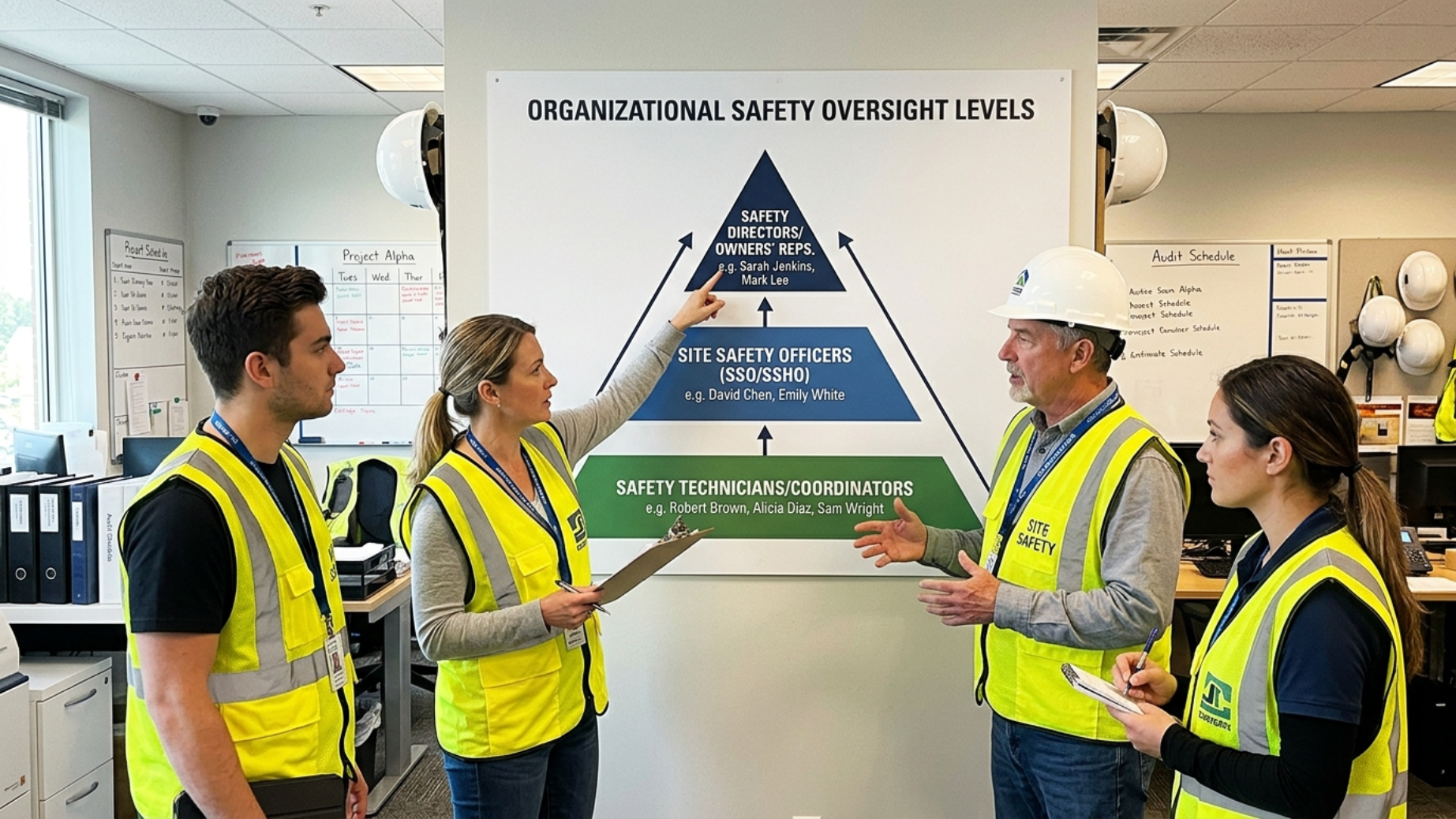
Not every project needs the same level of safety professional. Here is what the most common titles actually mean.
Role | What They Do | Typical Use Case |
|---|---|---|
Safety Coordinator | Entry to mid-level field support: inspections, orientations, documentation | Smaller projects, support roles, administrative safety tasks |
Safety Technician | Hands-on field safety: shift coverage, fire watch, confined space support | High-activity sites, outage work, industrial construction |
Site Safety Officer (SSO) | On-site safety representative for the project | Commercial, industrial, energy, and general construction |
Site Safety and Health Officer (SSHO) | Federal/government construction safety role with specific qualifications | USACE, NAVFAC, VA, military, and federal contract work |
Safety Manager | Leads the jobsite safety program, coordinates subs, reports to leadership | Larger projects, GC/owner requirements, complex multi-trade work |
Safety Director | Program-level leader across multiple projects | Corporate safety leadership (usually direct hire or fractional) |
Owner’s Rep Safety Professional | Represents the project owner’s safety interests | Data centers, healthcare, large capital projects |
Credential Quick Guide
Credentials matter, but they are not interchangeable. Here is what the most common ones actually indicate.
OSHA 30-Hour: A training course covering construction (or general industry) safety topics. It is not a professional certification. It shows the person sat through 30 hours of safety training, which is valuable but does not prove they can manage a jobsite safety program.
CHST (Construction Health and Safety Technician): A construction-specific credential from the Board of Certified Safety Professionals. Candidates must have construction safety duties, at least three years of construction safety experience, and pass an exam. This is a meaningful filter for field safety roles.
CSP (Certified Safety Professional): A higher-level BCSP credential for experienced safety professionals. Valuable for senior roles, but not automatically construction-specific. Always check whether the person’s actual experience matches your project type.
OSHA 500/501: Authorized outreach trainer credentials. The person can teach OSHA 10 and OSHA 30 courses. Useful when the project needs on-site training delivery capability.
EM 385-1-1 Training: Essential for SSHO roles on federal projects. Following the major March 2024 revision, candidates must demonstrate proficiency across the newly reorganized 37 chapters of the manual to be considered qualified for USACE contract work.
Competent Person: OSHA defines this as someone capable of identifying existing and predictable hazards and authorized to take prompt corrective measures. This is not just a training card. It requires both knowledge and authority.
For a broader look at what OSHA expects from construction employers regarding training, the overview of OSHA-required training breaks down the key requirements.
What a Staffed Construction Safety Professional Does on Site
The daily work of a staffed safety professional is practical, repetitive, and documentation-heavy. On a typical day, they may:
Conduct jobsite safety walks and document findings
Identify unsafe conditions and acts, then track corrective actions to closure
Review JHAs, JSAs, AHAs, pre-task plans, and work permits
Support or lead toolbox talks and safety meetings
Verify training records and certifications for workers and subcontractors
Check PPE use and site access controls
Coordinate with subcontractor competent persons
Monitor high-risk work (fall protection, excavation, crane lifts, hot work, confined space, electrical)
Prepare daily safety reports
Support incident and near-miss investigations
Maintain SDS/HazCom information
Participate in owner/GC meetings
Assist with site orientations and visitor safety briefings
Escalate serious hazards to project leadership
Help enforce the site-specific safety plan
The Role of Technology in Modern Safety Staffing
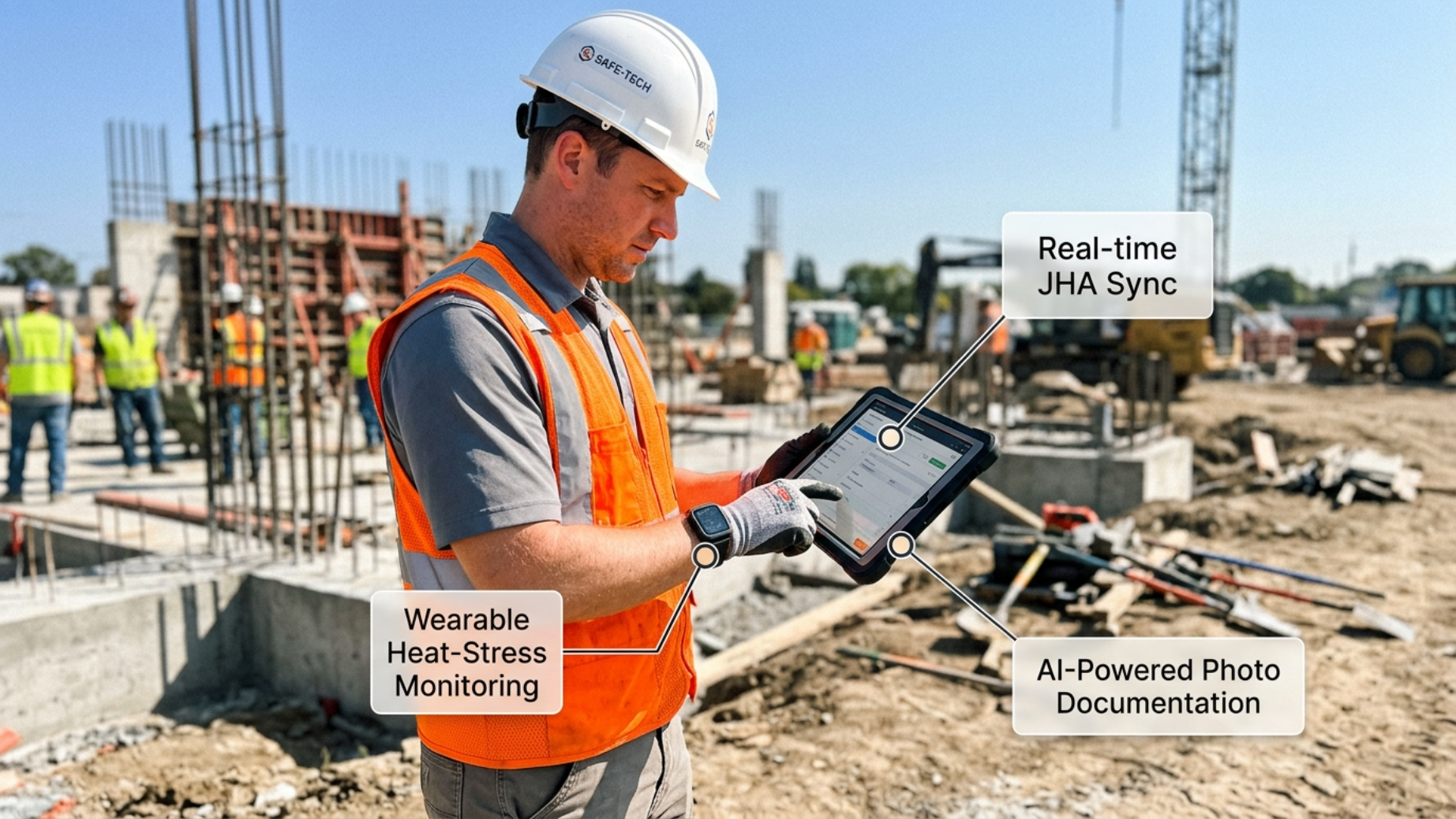
In 2026, a “qualified” safety professional is no longer just a person with a clipboard. Ask whether your staffed professional is proficient in:
Predictive Analytics: Using safety software to identify “Hot Zones” before an incident occurs.
Wearable Tech Monitoring: Coordinating the use of heat-stress sensors and fall-detection wearables.
AI-Enhanced Documentation: Utilizing AI tools to transcribe field notes into structured OSHA-compliant reports instantly.
Documentation Is the Job
Practitioners on Reddit consistently emphasize that documentation is not a side task for construction safety managers. It is the core of the work. In one thread about starting as a new safety manager on a Texas data center project, experienced commenters recommended tracking daily worker counts, hours worked, contractor activities, SDS records, equipment inspection forms, competent person submissions, toolbox talk attendance, and training records, all in searchable formats (r/SafetyProfessionals).
If a staffed safety professional is not producing usable, organized records every single day, the value drops significantly. Good documentation protects the contractor during audits, OSHA inspections, litigation, and owner reviews. Understanding why a safety manual alone is not enough helps explain why daily field documentation matters so much.
Subcontractor Coordination Takes Real Time
On multi-trade construction sites, subcontractor management is where safety programs break down. A practitioner discussion on Reddit called contractor management a “weak link” in mid-to-large organizations, emphasizing the importance of contract language, enforcement, and verifying that a sub’s safety person actually understands safety rather than functioning as a sales representative (r/SafetyProfessionals).
A staffed safety professional often spends a large portion of each day coordinating with subcontractor competent persons, verifying sub training records, reviewing sub-specific AHAs, and following up on corrective actions issued to sub crews.
Construction Safety Staffing vs. Safety Consulting vs. Direct Hire
These three options solve different problems. Choosing the wrong one wastes time and money.
Option | Best For | Typical Timeline | What You Get |
|---|---|---|---|
Construction safety staffing | Need a safety person on site for days, weeks, or months | Days to start | Embedded field safety coverage |
Safety consulting | Need an expert assessment, program review, audit, or investigation | One-time or periodic | Report, plan, training, investigation |
Direct hire recruiting | Need a permanent safety employee | Weeks to months | Candidate search and placement |
Fractional/outsourced safety department | Need ongoing safety leadership without a full-time hire | Monthly/retainer | Program management, inspections, advisory |
The key distinction: staffing puts a person on your site. Consulting gives you expert analysis and deliverables. Direct hire gives you a permanent employee, eventually. Some contractors need more than one of these at different times on the same project.
Quick Decision: Which One Do You Need?
Answer these in order. The first yes is your answer.
Do you need someone on site within the week? Staffing. Nothing else moves that fast.
Is the need tied to a project or phase that ends? Staffing. Coverage without a permanent payroll commitment.
Do you need a report, audit, or investigation rather than daily presence? Consulting.
Do you need safety leadership across multiple sites, but not a full-time executive? Fractional or outsourced safety department.
Will you need full-time safety leadership indefinitely, and can you wait weeks to months? Direct hire.
Most contractors staff the project and revisit direct hire once volume justifies it. These are not competing choices, they are sequenced ones.
If your project needs periodic safety inspections rather than full-time embedded coverage, jobsite safety inspections and mock OSHA inspections may be a better fit than continuous staffing.
How to Choose the Right Construction Safety Staffing Partner
Not all staffing providers are equal. A general temp agency that also happens to have a “safety” category is not the same as a firm that specializes in safety staffing for construction.
ResponsAble Staffing’s website directly addresses this frustration, noting that generic staffing agencies often send whoever is available without understanding what safety roles actually require. That matches what buyers report: getting flooded with resumes from people who have never managed a construction site.
Here is what to evaluate:
1. Do they specialize in safety? A firm that staffs electricians, welders, laborers, and also safety people is not the same as one built around safety roles.
2. How do they verify construction experience? Ask for project-type experience, not just years in “safety.” Someone strong in warehouse safety may not be ready for steel erection or data center commissioning.
3. How do they verify credentials? CHST, CSP, OSHA 30, OSHA 500, First Aid/CPR, EM 385 training. Ask how they confirm these are current and legitimate.
4. Can they match your hazard profile? Excavation, fall protection, electrical, confined space, heavy civil, demolition. The person’s experience should align with your project’s actual risks. Understanding hazard recognition, evaluation, and control principles helps you evaluate whether a candidate truly understands field hazards.
5. Who supervises the placed professional? Some firms provide regional directors who support placed staff with resources and periodic site visits. Others drop a person off and disappear.
6. What happens if the person is not a fit? Replacement policy matters. If your staffed safety professional gets sick, quits, or is not performing, how quickly can the provider send a replacement?
7. Who handles payroll, insurance, workers’ comp, and HR? This is one of the administrative advantages of staffing over direct hire. Make sure the arrangement is clear.
8. What documentation will you receive? Daily reports, inspection logs, corrective action tracking, training logs, meeting attendance, incident reports. Define expectations before the person starts.
9. Can the person communicate with your crews? On construction sites with Spanish-speaking workers, bilingual capability is not a nice-to-have. It directly affects whether safety messages land.
10. Do they understand owner, GC, insurance, and prequalification requirements? ISNetworld, Avetta, CCIP/OCIP, federal contract specs. Your staffing provider should understand the compliance environment you operate in.
11. Can they place someone quickly? Speed matters when the project is already underway and safety coverage gaps create risk.
12. Do they offer consulting backup? If a site issue turns into an OSHA inspection, incident investigation, or program rewrite, can the same provider support you beyond the staffed role?
What to Prepare Before Requesting Safety Staffing
The better your request, the better your placement. Before contacting a construction safety staffing provider, prepare:
Project location
Start date and expected duration
Work schedule (shifts, weekends, overtime expectations)
Number of workers on site
Number and types of subcontractors
Type of construction (commercial, industrial, civil, data center, healthcare, utility, steel, concrete, demolition)
High-risk scopes (fall protection, steel erection, excavation, cranes, confined space, hot work, energized electrical, traffic control)
Owner/GC safety requirements
Required credentials (OSHA 30, CHST, CSP, SSHO, EM 385, First Aid/CPR, OSHA 500, bilingual)
Reporting requirements (daily reports, specific software platforms, meeting schedules, owner reports)
Authority level (stop-work authority, corrective action authority, escalation procedure)
PPE and site access requirements
Travel/per diem expectations
Whether the need is temporary, project-duration, temp-to-hire, or direct hire
Any recent incidents, citations, audits, or compliance issues
This list may seem long, but it prevents the most common staffing mismatch: getting a person who has the right credential but the wrong experience for your site.
Need a qualified construction safety professional on site quickly? Evolution Safety Resources provides nationwide safety staffing with a 48-hour average placement, bilingual EN/ES field support, and credentialed professionals (CSP, CHST, OSHA 500/501, NCCER instructors) for short-term, long-term, and project-duration coverage.
Common Mistakes to Avoid
Hiring by credential alone
A CHST, CSP, or OSHA 30 card is a useful filter, but it does not guarantee the person can manage your jobsite. OSHA’s competent person definition includes both hazard recognition and authorization to take prompt corrective measures. Training alone is not enough if the person lacks practical field experience and real authority.
Practitioners on Reddit reinforce this point. In a discussion about competent person courses, commenters argued that a course can teach the rules, but competence depends on the ability to actually identify hazards and take corrective action in the field (r/SafetyProfessionals).
Not defining stop-work authority
If the staffed safety person cannot stop work, escalate hazards, or require corrective actions, they become a note-taker instead of a safety resource. A Reddit burnout thread described this tension clearly: safety professionals placed in positions where they have stop-work authority “on paper” but no practical backing when management does not support discipline or follow-through (r/SafetyProfessionals). Define authority before the person arrives. Put it in writing. Make sure the superintendent and project manager know the arrangement.
Using a general temp agency
Safety staffing is not generic labor staffing. The wrong placement creates false confidence, weak documentation, and poor field influence. A specialized safety staffing provider vets for construction experience, credential validity, hazard-specific knowledge, and communication ability. A general temp firm usually does not.
Not matching the person to the project type
A safety professional experienced in light commercial work is not automatically ready for steel erection, data center commissioning, high-voltage electrical, deep excavation, or heavy civil construction. Ask about project-type experience specifically.
Failing to define reporting expectations
If the contractor does not specify report format, frequency, stakeholders, and corrective-action workflows before the person starts, the documentation produced may not satisfy owner, GC, insurance, or OSHA expectations. Agree on deliverables upfront.
Assuming staffing replaces a safety program
A staffed person needs a site-specific safety plan, company policies, owner requirements, an authority structure, and leadership support behind them. Without those, they are reacting to problems instead of preventing them. OSHA’s construction safety program guidance emphasizes program elements like assigning injury prevention responsibilities, conducting regular inspections, investigating accidents, and informing employees of hazards.
If your company does not have a written safety program, start there. Check whether your safety manual is OSHA compliant before bringing someone on site to enforce it.
Assuming staffing transfers OSHA liability
It does not. More on this below.
Does a Staffing Agency Take Over Safety Responsibility?
No. This is the single most misunderstood aspect of construction safety staffing.
OSHA states that staffing agencies and host employers are joint employers of temporary workers and both are responsible for providing and maintaining a safe work environment. OSHA recommends that staffing agencies and host employers define their respective compliance responsibilities in their contract.
For construction safety staffing, the contract should clarify:
Who provides site orientation
Who provides PPE
Who controls stop-work authority
Who receives daily reports
Who approves corrective actions
Who maintains OSHA logs
Who owns the site-specific safety plan
Who communicates with OSHA during an inspection
Who manages subcontractor safety enforcement
Who handles incident investigation
Who replaces the safety professional if needed
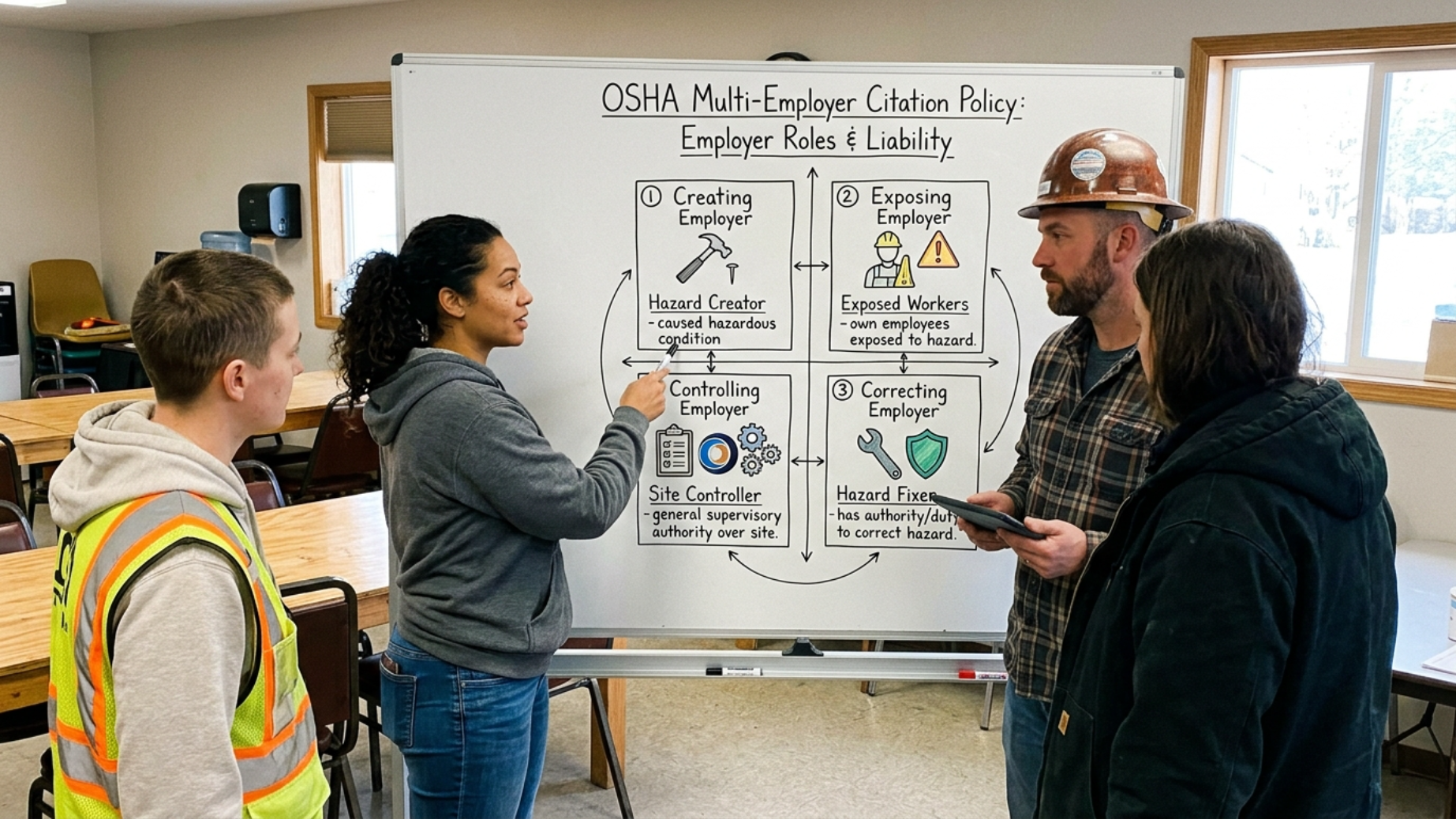
This joint responsibility is solidified by the OSHA Multi-Employer Citation Policy (CPL 02-00-124). On a typical 2026 jobsite, OSHA can cite multiple entities for a single hazard by categorizing them into four roles:
Creating Employer: The one who caused the hazard.
Exposing Employer: The one whose workers are near the hazard (this often includes the staffing agency).
Correcting Employer: The one responsible for fixing the hazard.
Controlling Employer: The general contractor or owner with overall site authority.
2026 OSHA Role | Definition | Typical Staffing Context |
Controlling | General supervisory authority over the site. | The Contractor who hires the safety staff. |
Exposing | Employer whose workers are exposed to hazards. | The Staffing Agency and the Contractor. |
Creating | The entity that actually caused the violation. | The Subcontractor performing the unsafe act. |
Correcting | The entity responsible for fixing the hazard. | The Staffed Safety Professional managing the abatement. |
For contractors using staffing, understanding this policy is critical. Even if a staffing agency provides the professional, the Host Employer (the contractor) usually remains the “Controlling” or “Exposing” employer, meaning you cannot contract away your legal duty to maintain a safe site.
A staffed safety professional can strengthen a project’s safety program. They cannot transfer legal responsibility away from the contractor or host employer. Understanding the General Duty Clause helps explain why this responsibility always stays with the employer, regardless of who is providing day-to-day safety oversight.
The 5-Fit Framework for Construction Safety Staffing
Most contractors ask for a person with a specific credential or title. That is a start, but the best construction safety staffing decisions consider five dimensions of fit.
1. Hazard Fit
Match the person to the work, not just the title. Fall protection-heavy projects need someone strong in fall protection planning, inspections, and rescue planning. Excavation projects need trenching competent person knowledge. Data center commissioning needs lockout/tagout and energized electrical work experience. A safety professional who is strong in one area may be weak in another.
2. Contract Fit
Read the contract before requesting staffing. Does it require an SSO? SSHO? CHST? CSP? OSHA 30? EM 385-1-1 training? Full-time site presence? Shift coverage? Specific reporting formats? Federal projects under USACE’s EM 385-1-1 may require SSHO designation, acceptance forms, and full-time presence whenever work is performed.
3. Credential Fit
Credentials are useful filters, not guarantees. OSHA 30 shows training completion. CHST shows construction-specific experience and exam passage. CSP shows senior-level safety expertise but should still be paired with construction field experience. OSHA 500 shows authorized outreach trainer status. Match the credential to the project need.
4. Communication Fit
Construction safety professionals need field credibility. Practitioners on Reddit advise getting to know superintendents, learning how each site communicates, understanding who to contact among subs, and anticipating hazards before work starts (r/SafetyProfessionals). The person must be able to work with craft workers, foremen, subcontractor leads, and project executives. On sites with Spanish-speaking crews, bilingual ability is a significant advantage.
5. Documentation Fit
Many projects fail audits not because a hazard was missed in the field, but because hazard corrections, orientations, toolbox talks, inspections, and training records were not documented clearly. The person you staff must produce organized, searchable records every day.
Frequently Asked Questions
Is construction safety staffing required by OSHA?
OSHA does not require every construction project to have someone with the job title “safety manager.” What OSHA does require is that construction employers maintain safety and health programs, train workers, control hazards, and provide frequent and regular inspections by competent persons. Contracts, owners, GCs, insurance programs, municipalities, or federal specifications may separately require a dedicated safety professional on site. Construction safety staffing is one way to meet those requirements quickly.
What is the difference between an SSO and an SSHO?
An SSO (Site Safety Officer) is a general on-site safety role used across commercial, industrial, energy, and construction projects. An SSHO (Site Safety and Health Officer) is specifically associated with federal and government construction requirements, particularly USACE/NAVFAC work governed by EM 385-1-1. SSHO roles carry specific qualification, training, experience, and site-presence requirements that go beyond what most commercial projects demand.
Can a temporary safety professional have stop-work authority?
Yes, if the contract and project leadership grant that authority. But it must be defined before the person arrives on site. OSHA’s competent person definition includes both the ability to identify hazards and the authorization to take prompt corrective measures. Authority on paper without backing from project management is meaningless.
How fast can a construction safety professional be placed?
Placement speed depends on location, credentials, project risk, schedule, and whether travel or per diem is involved. Evolution Safety Resources offers nationwide construction safety staffing with a 48-hour average placement promise.
How much does construction safety staffing cost?
Costs vary by role, location, credentials, project duration, risk level, schedule, overtime, travel, and per diem. Be careful comparing staffing quotes to job-board salary data. A LinkedIn listing showing $60 to $75 per hour for a data center safety manager is what the professional earns, not what a staffing engagement bills. A bill rate also carries payroll taxes, workers’ comp, general liability, recruiting, credential verification, and the provider’s margin, so it runs meaningfully higher than the pay rate. Ask any provider for a quote that separates base bill rate, overtime, per diem, travel, replacement terms, and included documentation.
Does hiring a safety staffing agency remove OSHA responsibility?
No. OSHA considers staffing agencies and host employers joint employers of temporary workers, and both are responsible for providing a safe work environment. The contract between the staffing provider and the host employer should clearly define who handles orientation, PPE, daily direction, stop-work authority, OSHA recordkeeping, incident reporting, and corrective action follow-up.
What documents should a staffed safety professional maintain?
At minimum: daily safety reports, inspection checklists, corrective action logs, toolbox talk attendance, training records, competent person lists, JHA/AHA review logs, incident and near-miss reports, and photo documentation. The specific list should be agreed upon before the engagement starts, based on owner, GC, OSHA, and insurance requirements.
When should a contractor use staffing instead of hiring a full-time safety manager?
Staffing makes the most sense when the need is time-bound (a specific project or phase), when speed matters (the project is already underway), when internal resources are temporarily unavailable, or when the contractor’s project volume does not justify a permanent hire. If the contractor consistently needs full-time safety leadership across its operations, a permanent hire or fractional outsourced safety department may be the better long-term approach.
Why Construction Safety Staffing Matters Right Now
Construction remains one of the highest-risk industries in the United States. According to the most recent full reporting data from the BLS, construction fatalities declined to 1,034 (down from previous highs), resulting in a fatality rate of approximately 9.2 per 100,000 workers—the lowest level recorded since 2011. While this downward trend is positive, falls, slips, and trips still account for over a third of these deaths annually, highlighting why dedicated oversight remains a non-negotiable for high-risk projects.
For the 2025/2026 cycle, Fall Protection (1926.501) remains the #1 most frequently cited OSHA violation for the 15th consecutive year. It is followed closely by Hazard Communication and Ladders, emphasizing that even “basic” safety compliance is where most contractors fail when they lack a dedicated professional on site.
At the same time, the construction workforce is stretched. With 80% of firms struggling to fill salaried safety and management roles, waiting months to fill a safety role is a luxury most projects cannot afford.
Construction safety staffing bridges that gap. It puts a qualified, credentialed, construction-experienced safety professional on your jobsite while your project keeps moving.
The key is making sure you get the right person, not just any person with a card. Match the hazards. Match the contract requirements. Define the authority. Define the documentation expectations. And work with a provider that actually understands construction safety, not one that treats it like another temp staffing category.
Ready to get a qualified safety professional on your site? Evolution Safety Resources provides nationwide safety staffing with a 48-hour average placement promise, bilingual EN/ES field and training staff, and credentialed professionals for any project duration. Reach out to discuss your project’s specific needs.