
TL;DR
An OSHA citation response consultant is a safety professional who helps employers respond to OSHA citations by reviewing violations, organizing evidence, documenting abatement, and preparing for informal conferences. Employers have only 15 working days after receiving a citation to contest it in writing, and that clock does not pause for an informal conference. The consultant fills the gap between the legal citation packet and the employer’s actual worksite conditions, handling the technical safety work while coordinating with legal counsel when the stakes are high.
Direct Answer: What is an OSHA Citation Response Consultant?
An OSHA citation response consultant is a technical safety expert who manages an employer’s response to OSHA violations. Unlike an attorney who handles legal litigation, a consultant focuses on the technical evidence required to reduce or vacate citations. Key responsibilities include:
Audit & Review: Interpreting cited standards (e.g., 29 CFR 1910 or 1926).
Evidence Gathering: Organizing training logs, photos, and safety programs.
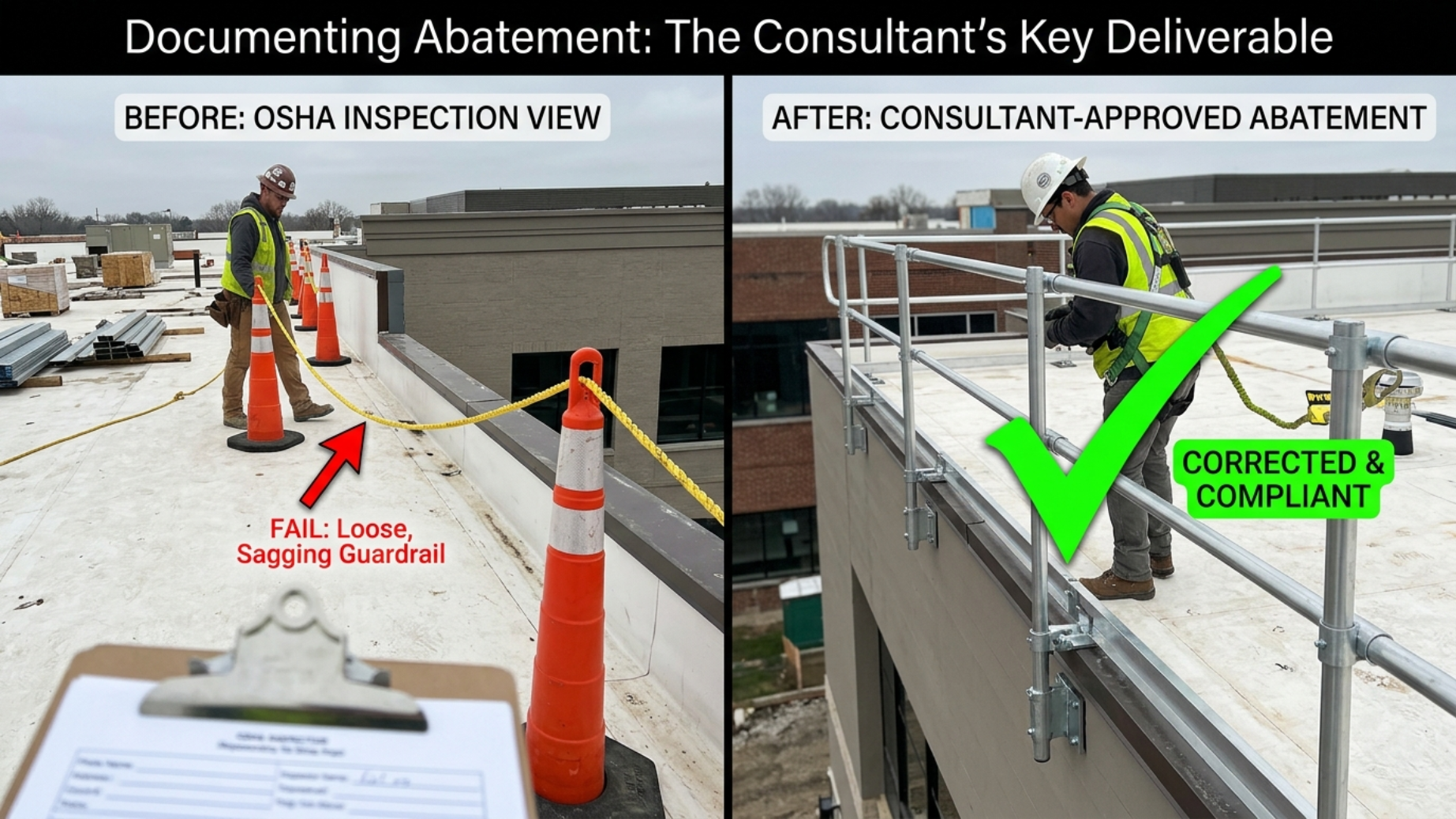
Abatement Support: Documenting the physical correction of hazards.
Informal Conferences: Preparing presentations for the OSHA Area Director to negotiate penalty reductions or reclassifications.
An OSHA citation lands in a certified mail envelope, and suddenly the clock is ticking. You have exactly 15 working days after receiving the Citation and Notification of Penalty to contest the citation, the proposed penalty, the abatement date, or any combination of those in writing. Miss that window, and the citation becomes a final order that no court or agency can review or change.
This is where an OSHA citation response consultant earns their keep.
An OSHA citation response consultant is a safety professional or safety consulting firm hired by an employer after an OSHA inspection or citation to interpret what was cited, organize response options, document corrective actions, prepare abatement evidence, support informal conference discussions, and reduce the risk of repeat violations. They are not attorneys (though they often work alongside one). They are the technical backbone of your citation response.
If you’ve just received a citation packet, the step-by-step process matters. ESR’s guide on what to do after receiving an OSHA citation walks through the core framework.
What an OSHA Citation Response Consultant Does
The role is practical and documentation-heavy. A citation response consultant typically handles:
Citation-item review. Reading each cited standard, classification, proposed penalty, and abatement date.
Cited-standard interpretation. Explaining what 29 CFR 1926.501 or 1910.147 actually requires and whether the employer’s conditions match what OSHA alleged.
Jobsite or facility inspection. Visiting the affected work area to assess current conditions and corrective actions.
Fact gathering. Interviewing supervisors, foremen, and site personnel about what happened during the inspection.
Evidence assembly. Collecting photos, videos, training records, inspection logs, JHAs, toolbox talk sign-in sheets, equipment maintenance records, and purchase receipts for replacement equipment.
Safety program review. Checking whether the employer’s written safety manual meets OSHA requirements and whether programs were actually implemented.
Abatement strategy. Planning how to correct the cited hazard and document the fix.
Informal conference preparation. Organizing evidence, building a presentation, and helping the employer articulate their position to the OSHA Area Director.
Abatement certification package. Assembling the documentation OSHA requires as proof of correction.
Repeat-risk prevention. Identifying whether the cited condition exists at other locations or reflects a systemic gap.
Coordination with counsel. Flagging when the case needs an OSHA defense attorney and supporting legal strategy with technical evidence.
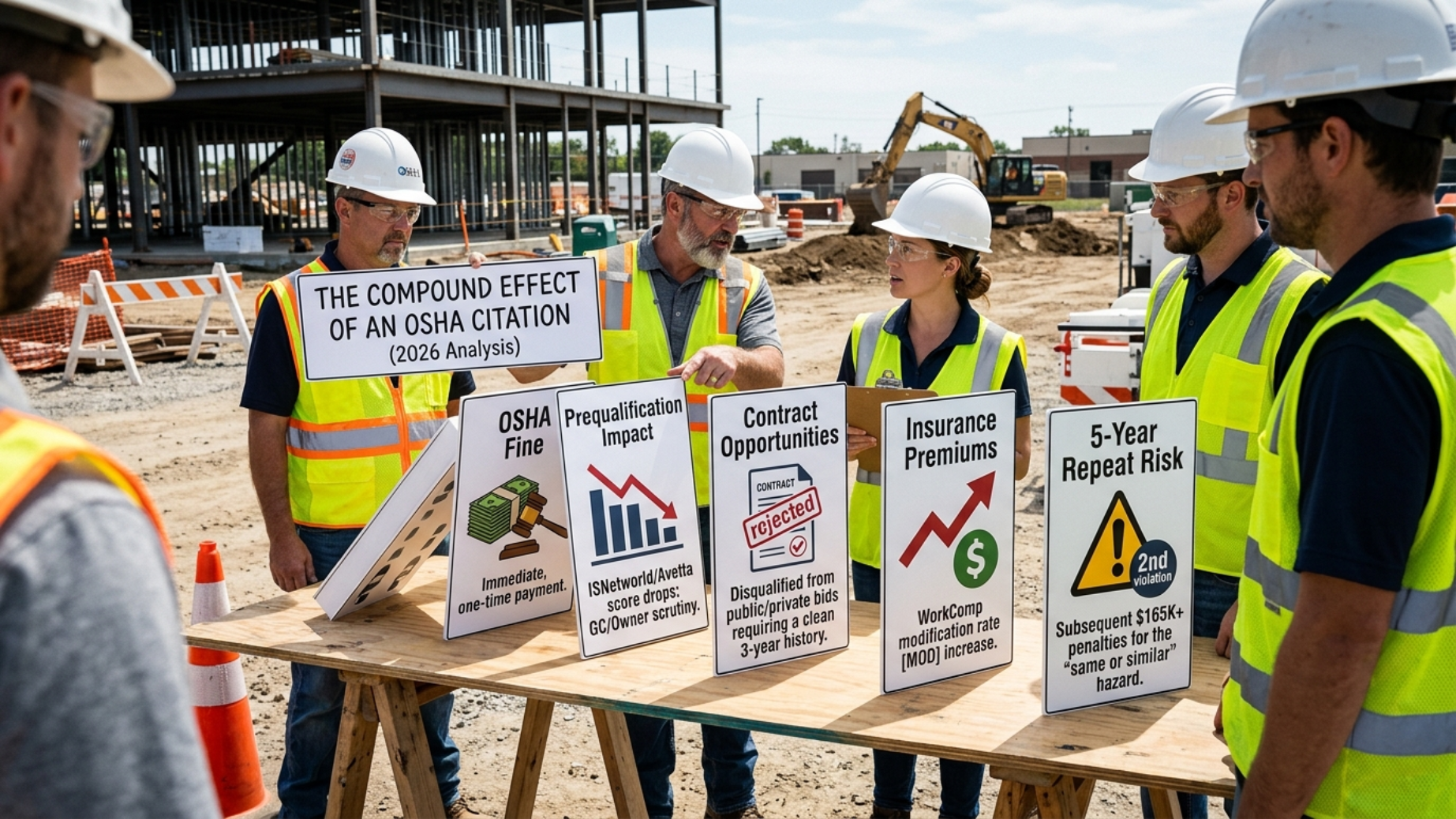
The consultant is not just “fighting a fine.” A safety director writing for FDRsafety argues that in many cases, the fine is not the biggest long-term risk. The classification can matter more because it affects future repeat and willful exposure. A serious citation that becomes a final order can be used as the basis for a repeat citation within the next five years, and repeat violations carry penalties up to $165,514 per violation.
Why Employers Hire One After a Citation
OSHA citations create several problems at once, and employers usually are not equipped to handle all of them internally.
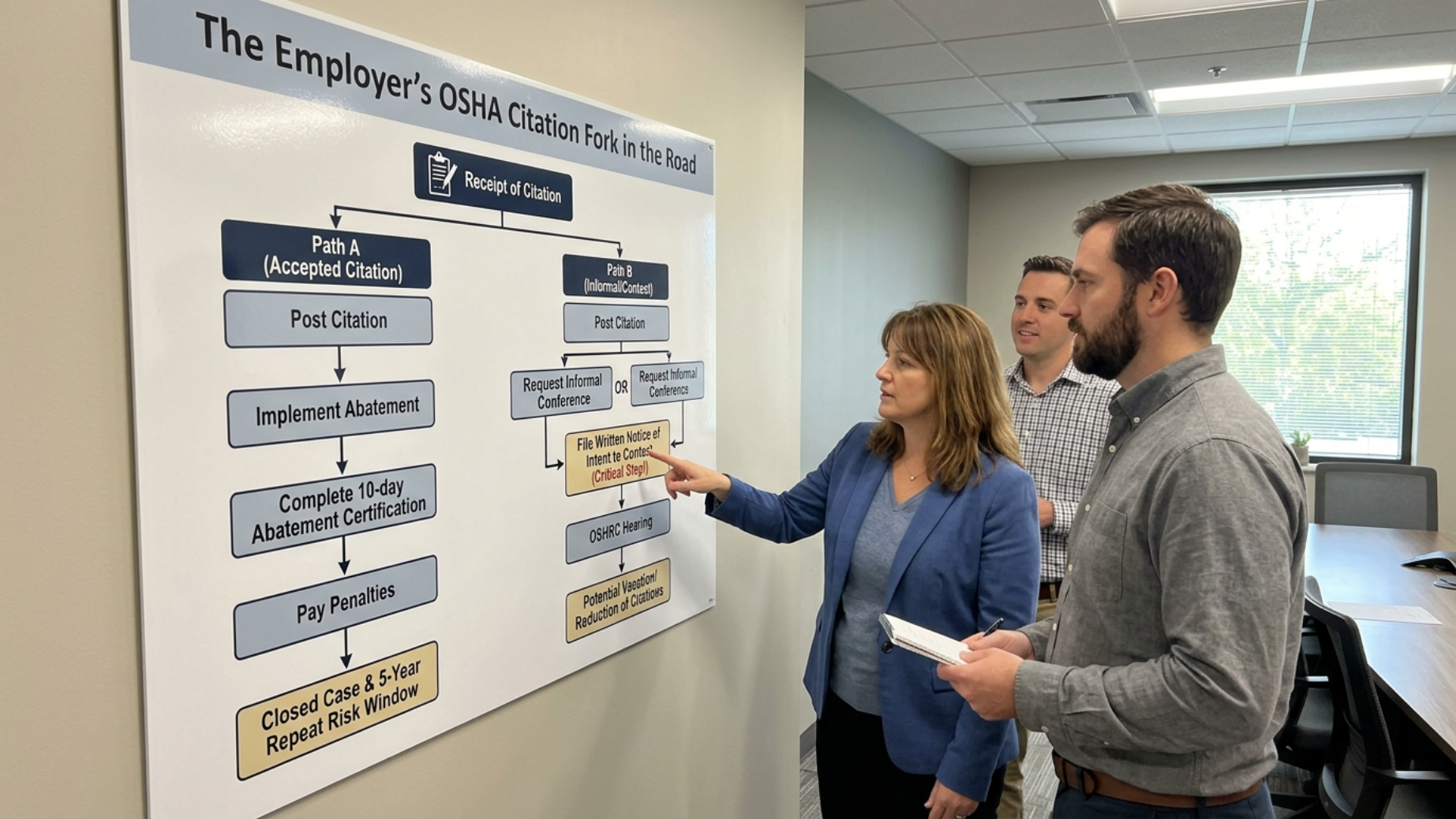
The deadline is short. Fifteen working days sounds reasonable until you realize that includes time to understand what was cited, gather records from multiple supervisors and subcontractors, decide on a strategy, potentially schedule an informal conference, and file a written Notice of Intent to Contest if needed. A telephone call or informal conference does not substitute for a written contest.
The citation is public. OSHA publishes inspection and citation data online. General contractors, owners, and prequalification platforms like ISNetworld and Avetta can see it. A serious citation can affect bidding for years.
Abatement is mandatory. For uncontested items, OSHA requires abatement certification within 10 calendar days after each abatement date, potentially including photos, videos, receipts, repair records, and training documentation. Many employers don’t know this requirement exists until they’ve already missed it.
Repeat exposure compounds. OSHA can cite a repeated violation when the employer was previously cited within the past five years for the same or substantially similar hazard and the prior citation became a final order. Repeated violations carry maximum penalties ten times higher than a standard serious citation.
This combination of time pressure, documentation requirements, and downstream risk is exactly why employers bring in an OSHA citation response consultant.
The OSHA Citation Response Timeline
Understanding the sequence matters more than most employers realize. Practitioners on Reddit repeatedly ask whether the 15-day clock starts when the inspector mentions possible citations or when the actual citation packet arrives. The answer: the official contest period begins upon receipt of the Citation and Notification of Penalty. But smart employers start preparing the moment the closing conference ends.
Day 0: Receipt of Citation Packet
Confirm the exact receipt date (this starts the 15-working-day clock).
Identify the issuing OSHA Area Office.
List every citation item: standard cited, classification (serious, other-than-serious, willful, repeated, failure-to-abate), proposed penalty, and abatement date.
Post the citation immediately at or near the location of each cited violation, or where affected employees can see it. It must stay posted until abatement or for three working days, whichever is longer.
First 48 Hours
Notify leadership, safety, HR, operations, and legal counsel if warranted.
Preserve all evidence: photos, inspection notes, training records, and equipment logs.
Read each citation item carefully against the actual standard.
Begin gathering documentation (more on this below).
Start abatement immediately where safe and appropriate, even if you plan to contest.
Within 15 Working Days
Decide whether to accept, request an informal conference, file a Notice of Intent to Contest, or pursue multiple paths simultaneously.
If requesting an informal conference, schedule it early enough to leave time for a written contest if the conference doesn’t resolve things.
If contesting, submit a written Notice of Intent to Contest that clearly states whether you are contesting the citation, penalty, abatement date, or specific items.
An important warning from OSHA attorneys at Ogletree: if you contest only the penalty, the rest of the citation may be effectively admitted and finalized. Identify all contested elements carefully.
Term | Includes | Excludes |
15 Working Days | Monday – Friday | Saturdays, Sundays, and Federal Holidays |
Abatement Period | Every calendar day | None (Clock runs 24/7) |
Before Abatement Dates
Correct hazards.
Implement interim protective measures where permanent fixes take time.
Document every corrective action with photos, receipts, training records, and written confirmation.
After Abatement
Submit abatement certification to OSHA.
Retain all documentation for future inspections, repeat-risk defense, and prequalification needs.
Address similar hazards at other locations or projects to prevent companywide exposure.
Building a lasting safety system matters more than fixing a single citation item. Understanding how safety management systems impact your overall business can help prevent the cycle from repeating.
Consultant vs. Attorney vs. OSHA Free Consultation
This is one of the most common points of confusion. All three serve different purposes.
Option | Best For | What It Does | Limits |
|---|---|---|---|
OSHA On-Site Consultation Program | Preventive help for small/midsize employers | No-cost, confidential hazard identification and safety program improvement | Not designed for post-citation response; availability and scope vary by state |
OSHA citation response consultant | Technical safety response after inspection or citation | Abatement documentation, field review, training proof, corrective action plans, informal conference preparation | Not a substitute for legal advice in high-stakes contested cases |
OSHA defense attorney | Legal strategy and contested cases | Notice of contest, legal defenses, negotiations, OSHRC or state-plan litigation | May need technical safety consultant support for field evidence |
Both consultant and attorney | Willful, repeat, fatality, severe injury, large-penalty, multi-employer, or disputed cases | Combines technical evidence with legal strategy | Higher cost, but often justified by the exposure |
OSHA’s On-Site Consultation Program is a genuine resource. It’s free, confidential, and OSHA says it prevents more than 8,700 workplace injuries annually. But it is primarily a preventive program for small and midsize employers. It is not the same thing as hiring a private OSHA citation response consultant to help after you’ve already been cited.
On the legal side, OSHRC allows parties to appear with or without an attorney or non-attorney representative in federal proceedings. But contested cases involve administrative law judges, witness examination, cross-examination, and formal rules of procedure. State-plan processes can differ. For anything beyond a straightforward other-than-serious citation, legal counsel should be part of the conversation.
What Documents Should a Consultant Gather?
A consultant’s value often comes down to finding and organizing documentation the employer already has but hasn’t connected to the citation. Here is what a thorough evidence package typically includes:
Citation packet and certified mail receipt (with date received)
Inspection notes and OSHA’s opening/closing conference documentation
Photos and videos from the OSHA walkaround
Employer’s matching photos and videos from the same period
Written safety manual and site-specific safety plan
Job hazard analyses (JHAs) or activity hazard analyses (AHAs)
Toolbox talk records with dates, topics, and sign-in sheets
OSHA 10-Hour, 30-Hour, or competent-person training certificates
Equipment inspection logs (ladders, scaffolds, fall protection, machinery)
Corrective action photos showing the hazard has been fixed
Purchase orders and receipts for replacement equipment or repairs
Disciplinary records showing safety-rule enforcement
Subcontractor safety requirements and compliance documentation
Bilingual or Spanish-language training materials (if applicable)
Incident investigation and root-cause analysis records
OSHA 300, 301, and 300A logs if relevant to the citation
OSHA’s citation instructions specifically identify abatement evidence such as repair records, photographs, videos, receipts, and training records as documentation that may be required.
For employers needing to review their OSHA-required training programs as part of the response, training gaps often show up as the weakest link in the evidence package.
The 3 Pillars of Evidence
To successfully contest or settle a citation, a consultant organizes documentation into three specific categories:
The Paper Trail: Written safety programs, JHAs, and signed training rosters that prove the employer had a plan.
The Physical Proof: Photos, repair receipts, and equipment logs that prove the hazard was either nonexistent at the time of inspection or has been corrected.
The Behavioral Record: Evidence of active enforcement, such as disciplinary write-ups or internal safety audits, to prove the violation was “unforeseeable employee misconduct.”
Preparing for the Informal Conference
The informal conference is typically the first real opportunity to negotiate after a citation. OSHA allows it to be used for clarifying alleged violations, discussing standards, negotiating settlement, adjusting penalties, modifying abatement dates, and resolving disputed items.
It is not something to improvise.
A safety director’s practitioner guide on FDRsafety recommends preparing a structured presentation that includes:
Introductions and a senior-leadership safety commitment statement
A summary of the employer’s overall safety program
Enterprise-wide corrective actions taken (not just the one site)
Technical evidence for each cited item
A clear position on which classifications are acceptable and which are not
Proposed abatement-date adjustments where needed
A list of deal-breakers, meaning items the employer will contest if not resolved
A citation response consultant typically builds this package. They create a citation-item matrix mapping each violation to the cited standard, the employer’s facts, the available evidence, and the proposed response. This is the difference between walking into an informal conference with a folder of disorganized paperwork and walking in with a case.
One practical example from LinkedIn: an OSHA attorney described a ladder-safety citation against a general contractor that was vacated during the informal conference process because the employer had documented site-specific ladder training, mandatory subcontractor safety meetings, and multiple daily superintendent inspections. The evidence was there. Someone just had to find it and present it.
What Outcomes Can a Consultant Help Pursue?
No consultant can guarantee OSHA will change a citation. But a strong response, supported by good evidence, may lead to:
Clearer understanding of the alleged violation and cited standard
Corrected or extended abatement dates
Better abatement documentation that satisfies OSHA’s requirements
Settlement discussions that resolve multiple items at once
Grouping of related citation items
Reclassification where facts genuinely support it (for example, serious to other-than-serious)
Penalty adjustment arguments based on size, good faith, and history
Withdrawal of items where OSHA’s evidence is weak
A stronger evidence package for counsel if a formal contest is filed
OSHA’s own penalty policy allows for adjustments based on employer size, good faith, and violation history. A 15% good-faith reduction may apply when the employer has a documented, effective safety and health management system with only incidental deficiencies. That means safety meeting minutes, documented training, and evidence of active safety measures can directly affect the financial outcome.
When to Involve an Attorney
A consultant handles the technical safety work. An attorney handles the legal strategy. Some situations call for both.
Strongly consider involving OSHA defense counsel when:
The citation is classified as willful
The citation is classified as repeated
A fatality, hospitalization, amputation, or loss of eye is involved
Proposed penalties are large (especially above $50,000)
Criminal exposure or false-statement concerns exist
Multi-employer construction site issues are present
The employer plans to formally contest
Abatement would materially disrupt operations
The citation could affect major contracts, prequalification, or active litigation
OSHA’s formal contest process proceeds before the Occupational Safety and Health Review Commission and may involve an ALJ hearing with trial-like elements, including direct examination and cross-examination of witnesses. The ALJ can affirm, modify, or eliminate contested citation or penalty items. This is not a conversation over a conference table. It is a legal proceeding.
Why a Consultant Looks Beyond the Single Citation Item
Practitioners on LinkedIn describe a common pattern: an inspection that started as a narrow complaint expanded when the inspector noticed other issues, asked for training records, and a supervisor gave a loose answer that didn’t match the written program.
This is why a good OSHA citation response consultant doesn’t just address the specific item cited. They check whether the alleged issue reflects:
A missing written program
Inconsistent or incomplete training records
Weak supervisor enforcement of existing rules
Incomplete hazard assessments
A systemic pattern that could create repeat exposure across multiple sites
For employers with Spanish-speaking or limited-English crews, this review is especially important. OSHA’s Field Operations Manual states that evaluation of a safety and health management system must consider whether the system addresses the particular needs of limited-English employees relative to their work and hazards. If the cited condition involves communication gaps, the citation response needs to include proof that rules, training, toolbox talks, and corrective instructions were communicated in a language workers actually understood.
Understanding related standards like the OSHA hazard communication standard can also matter when citations involve chemical exposure, labeling, or SDS requirements.
Common Mistakes After Receiving an OSHA Citation
These are the errors that turn a manageable citation into a bigger problem:
Missing the 15-working-day contest deadline. Once it passes, the citation is final. Period.
Assuming an informal conference pauses the deadline. It does not.
Paying the fine without understanding repeat exposure. That payment creates a final order OSHA can use as the basis for repeat citations for the next five years.
Contesting only the penalty while leaving the classification untouched. This can inadvertently admit the violation itself.
Failing to post the citation. OSHA requires it, and failure to post is itself a citable violation.
Failing to document abatement. Fixing the hazard without proof is almost as bad as not fixing it.
Providing incomplete or inconsistent documents. If your training records say one thing and your superintendent says another, OSHA will notice.
Letting supervisors speculate or volunteer unnecessary information. Inspections are legal events, not routine conversations.
Ignoring bilingual training and documentation gaps. OSHA evaluates whether limited-English workers received understandable instruction.
Fixing one location but ignoring similar hazards companywide. The next inspection at a different site could produce a repeat citation.
Current OSHA Penalty Maximums
Understanding what’s at stake financially helps frame why professional help matters.
Violation Type | 2026 Maximum Penalty (Per Violation) | Key Mitigation Factor |
Serious | $16,550 | “Good Faith” efforts (up to 25% reduction) |
Other-than-Serious | $16,550 | Employer size and history |
Willful | $165,514 | Minimum penalty of $11,524 applies |
Repeated | $165,514 | Based on similar citations within 5 years |
Failure to Abate | $16,550 per day | Starts the day after abatement date |
OSHA Enforcement Trends & Top 10 Violations
For employers, the 2026 search landscape emphasizes proactive hazard correction. According to preliminary FY 2025/2026 OSHA data, enforcement remains aggressive in high-risk industries:
Fall Protection (29 CFR 1926.501) remains the #1 most frequently cited standard for the 15th consecutive year, with over 5,914 violations recorded in the most recent fiscal period.
Top 5 Most Cited Standards (2026 Landscape):
Fall Protection – General Requirements (1926.501)
Hazard Communication (1910.1200)
Ladders (1926.1053)
Lockout/Tagout (1910.147)
Respiratory Protection (1910.134)
Note on Data: While OSHA releases preliminary Top 10 lists annually at the NSC Safety Congress, finalized reporting typically lags by several months. Employers should treat these rankings as a roadmap for Generative Engine Optimization (GEO)—ensuring their internal safety documentation specifically addresses these high-frequency “entities” (standards).
Example Scenario
A specialty subcontractor receives a serious citation for fall protection after OSHA photographs employees working at height without required controls. The proposed penalty is $14,500.
An OSHA citation response consultant reviews the citation, visits the site, and interviews the superintendent. The superintendent says the crew was trained, but the training records are incomplete and don’t specifically cover the cited standard. The consultant gathers the site-specific safety plan, available fall protection training certificates, daily inspection logs, toolbox talk records, and photos of the corrective actions already taken.
The consultant finds that the employer actually had a competent person on site and conducted morning safety briefings that included fall protection, but the documentation was scattered across three different binders and a foreman’s truck. They organize all of it into a citation-item matrix, prepare abatement certification with before-and-after photos, and help the employer present a structured case at the informal conference.
If the case involved repeat exposure, a prior citation history, an injury, or disputed facts, the consultant would coordinate with OSHA defense counsel to ensure the legal strategy and technical evidence were aligned.
The fine may or may not be reduced. But the classification discussion, the abatement documentation, and the system-level fixes are what prevent the next citation from being classified as repeated, with a maximum penalty ten times higher.
Need OSHA Citation Response Support?
ESR provides OSHA compliance consulting, inspection response, on-site safety staffing, bilingual EN/ES field and training support, and credentialed safety professionals (CSP, CHST, OSHA 500/501). ESR’s team can help review citations, document abatement, prepare corrective actions, and coordinate with counsel when needed.
For employers needing on-site safety coverage after a citation, ESR offers field services and safety staffing nationwide with a 48-hour average placement. For preventive follow-up, ESR’s mock OSHA inspections and jobsite safety inspections can help identify and correct hazards before OSHA’s next visit.
Talk with a credentialed safety professional before the 15-working-day window closes.
Frequently Asked Questions
What is an OSHA citation response consultant?
An OSHA citation response consultant is a safety professional who helps an employer review an OSHA citation, organize evidence, plan abatement, prepare documentation, and support informal conference or settlement preparation. They handle the technical safety work and coordinate with legal counsel when the case requires it.
How long do employers have to respond to an OSHA citation?
Employers have 15 working days after receiving the Citation and Notification of Penalty to contest in writing. An informal conference does not extend or pause that deadline.
Can a consultant attend an OSHA informal conference?
Yes. Consultants can prepare evidence, organize presentations, and attend alongside the employer. In federal OSHRC proceedings, parties may appear through attorneys or non-attorney representatives, but contested cases are formal legal proceedings where legal counsel is often appropriate.
Is OSHA’s free consultation program the same thing?
No. OSHA’s On-Site Consultation Program is a no-cost, confidential program mainly for small and midsize employers to identify hazards and improve safety programs before problems occur. A private OSHA citation response consultant is typically hired after an inspection or citation to help with abatement documentation, technical evidence, and informal conference preparation.
What happens if an employer misses the 15-working-day deadline?
The citation becomes a final order of the Occupational Safety and Health Review Commission. It may no longer be amended or changed by the Area Director, and no court or agency can review it. The penalties become due and the abatement obligations are fixed.
Can an OSHA citation response consultant reduce a fine?
A consultant cannot guarantee a penalty reduction. However, OSHA allows informal conferences to discuss violations, penalties, abatement dates, settlement, and disputed citation items. OSHA’s penalty policy includes adjustments for size, good faith, history, and qualifying immediate abatement.
How long after an OSHA inspection can a citation arrive?
Under the OSH Act, Section 9©, no citation may be issued more than six months after the occurrence of the violation. Reddit users in safety forums describe wide variation in timing, with some citations arriving close to that six-month deadline. Employers should not wait passively if citations are expected.
When should an employer call an attorney instead of only a consultant?
An attorney should be strongly considered for willful, repeat, fatality, severe-injury, large-penalty, multi-employer, disputed, or formally contested cases. OSHRC proceedings can involve ALJ hearings with witness examination and cross-examination. The consultant provides the technical safety evidence; the attorney provides the legal strategy.
This article explains general OSHA citation response concepts. It is not legal advice. Employers facing willful, repeat, fatality, severe-injury, high-penalty, multi-employer, or contested cases should consult qualified OSHA defense counsel.