
TL;DR
Safety consulting in Allen, TX covers a range of services, from mock OSHA inspections and written safety plans to on-site staffing and post-incident investigations. Allen falls under OSHA’s Dallas Area Office in Richardson, and North Texas construction employment topped 261,800 jobs in May 2025. This guide defines the terms Allen employers hear from OSHA, general contractors, owners, insurers, and prequalification platforms, and explains when free state consultation is enough versus when private help makes more sense.
What is Safety Consulting?
Safety consulting is a professional service that provides employers with expert guidance on workplace hazard identification, OSHA regulatory compliance, and safety program management. In Allen, TX, safety consultants help businesses navigate federal standards (overseen by the OSHA Dallas Area Office) through services like mock inspections, site-specific safety plans, and safety staffing to prevent workplace injuries and avoid penalties that can exceed $16,550 per violation.
What Safety Consulting Means for Allen Employers
Safety consulting in Allen, TX is outside professional support that helps employers identify hazards, meet OSHA and owner requirements, train workers, document programs, inspect jobsites, respond to incidents, or fill safety leadership gaps. It is not one service. It is a menu.
The OSH Act’s General Duty Clause requires every employer to provide a workplace free from recognized hazards likely to cause death or serious physical harm, and to comply with OSHA standards. That obligation does not change based on company size, and it applies whether a company has a dedicated safety director or not.
For Allen employers specifically, the enforcement context is local. OSHA lists Collin County under the Dallas Area Office in Richardson. An OSHA compliance officer does not have to travel far to reach an Allen jobsite or facility.
A safety consultant is not OSHA. A consultant does not “certify” a workplace as compliant. What a good consultant does is help the employer understand obligations, find gaps, control hazards, train workers, document corrective actions, and build a system that actually works on the ground.
Common reasons Allen-area companies search for safety consulting:
A GC or owner asked for a site-specific safety plan or prequalification documents
Crews need OSHA 10, OSHA 30, or bilingual training
A project needs a dedicated safety professional on-site next week
An ISNetworld or Avetta review failed
An incident happened and an investigation, OSHA log entry, or citation response is needed
The company cannot justify a full-time safety director but has recurring compliance needs
An OSHA inspection is expected or already underway
If any of those scenarios sound familiar, ESR’s field services and safety staffing cover local consulting from their Allen office (no travel surcharge within 50 miles) and nationwide safety staffing with a 48-hour average placement.
Why Safety Consulting Matters in Allen and North Texas
North Texas is not slowing down. The Bureau of Labor Statistics reported 261,800 mining, logging, and construction jobs in the Dallas-Fort Worth-Arlington metro area in May 2025, an increase of 8,200 jobs (3.2%) year over year. The Dallas-Plano-Irving division alone accounted for 172,500 of those jobs.
More projects mean more subcontractor interfaces, more documentation requirements, and more coordination challenges. It also means more opportunities for things to go wrong.
DFW’s data center boom is a good example. NBC 5 Dallas-Fort Worth described the region as the second-largest data center market in North America, and Data Center Dynamics reported a 768-acre, 24-building campus under development in DFW with a 1.8GW switchyard. These projects create complex construction hazards: electrical work, lockout/tagout, cranes, elevated work, confined spaces, commissioning, and multi-trade coordination. Community members on Reddit forums in Fort Worth and Irving have noted that data centers produce temporary but intense construction demand, not long-term operations jobs. That pattern fits exactly where contract safety staffing and field consulting matter most.
The stakes are real. BLS reported 557 fatal occupational injuries in Texas in 2024. Nationally, construction and extraction occupations experienced 1,032 fatalities, including 370 fatal falls, slips, and trips. Safety consulting is not paperwork. It is about finding and controlling hazards before they become injuries, citations, schedule delays, or insurance claims.
Free Texas OSHCON vs. Private Safety Consulting
Texas OSHCON ranks high in search results for safety consulting in Allen, TX, and it should. It is a free, confidential consultation service for private Texas employers, run through the Texas Department of Insurance, Division of Workers’ Compensation. OSHCON provides in-person and virtual help to identify and eliminate workplace hazards.
OSHA’s national On-Site Consultation Program, which OSHCON is part of, is separate from enforcement. It does not issue penalties or citations. The employer’s obligation is to correct serious hazards identified during the consultation in a timely manner. OSHA reports the program prevents more than 8,700 workplace injuries and saves the U.S. economy nearly $1.5 billion every year.
Any honest safety consultant in Allen, TX should tell you about OSHCON. It can be an excellent resource, especially for smaller employers who need a baseline hazard review.
That said, OSHCON has limits. Practitioners on Reddit’s r/SafetyProfessionals have noted that while the program can be valuable, management must be financially prepared to fix what consultants identify. Others pointed out that quality can vary and that some operations managers distrust anything associated with OSHA, even when the consultation is confidential and separate from enforcement.
Private consulting fills gaps OSHCON was not designed to cover.
Feature | Texas OSHCON (Free) | Private Safety Consulting |
Confidentiality | Yes (Separate from Enforcement) | Yes (Client-Privileged) |
Cost | $0 | Fee-based |
Response Time | Weeks to Months | 24–48 Hours |
Bilingual Training | Limited availability | Full English/Spanish Support |
Prequalification | No (ISNetworld/Avetta) | Yes (Comprehensive Support) |
Incident Defense | None | Full Investigation & Expert Witness |
Emerging OSHA Priorities for 2026
Allen-area employers, particularly those in construction and manufacturing, should prepare for increased scrutiny in these three areas this year:
Federal Heat Directive (CPL 03-00-024): While the permanent standard is still in rulemaking, OSHA issued a revised directive on April 10, 2026. They are aggressively enforcing heat safety under the General Duty Clause, requiring documented water, rest, shade, and acclimatization plans.
Electronic Recordkeeping (ITA): Most North Texas contractors with 100+ employees in high-hazard industries must now submit Forms 300 and 301 (in addition to 300A) electronically by March 2nd each year.
Lone Worker Safety: With the rise of automated facilities and data centers in Collin County, OSHA is focusing on communication protocols for employees working in isolation to ensure rapid response during emergencies.
Safety Consulting Glossary
These are the terms Allen employers, contractors, and jobsite leaders hear from OSHA, general contractors, owners, insurers, and prequalification platforms. Each entry explains what the term means, why it matters, and when to ask for help.
OSHA and Enforcement Terms
2026 OSHA Penalty Schedule
For citations issued after January 15, 2026, the following maximum penalties apply to Allen employers. Note that these are adjusted annually for inflation:
Violation Type | Maximum Penalty (2026) |
Serious | $16,550 per violation |
Other-Than-Serious | $16,550 per violation |
Willful or Repeated | $165,514 per violation |
Failure to Abate | $16,550 per day past the deadline |
Failure to Post | $16,550 per violation |
Jobsite Inspection and Planning Terms
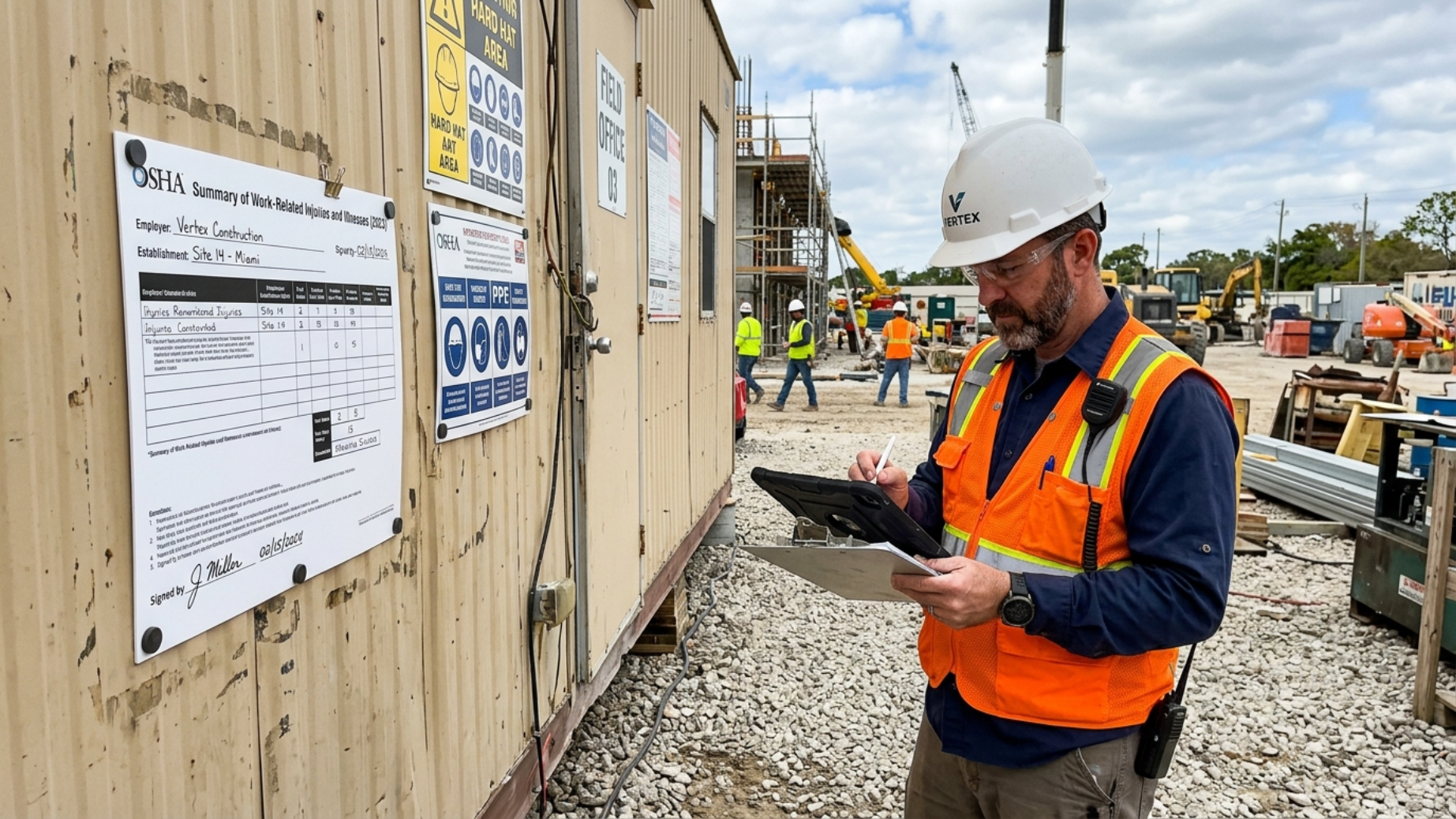
Jobsite safety inspection. A planned walk-through of a construction site, facility, or work area to identify hazards, document observations, assign corrective actions, and verify that controls are in place. OSHA’s Recommended Practices for Safety and Health Programs center on ongoing hazard identification and assessment, not one-time paperwork. Inspections should be scheduled, documented, and followed up on. For Allen-area sites needing regular walk-throughs, ESR offers field safety inspections with documented corrective action tracking.
Hazard identification. The process of finding unsafe conditions, unsafe acts, exposures, and changing work conditions before they cause harm. OSHA’s recommended practices say procedures should be in place to continually identify hazards in routine, nonroutine, and emergency situations.
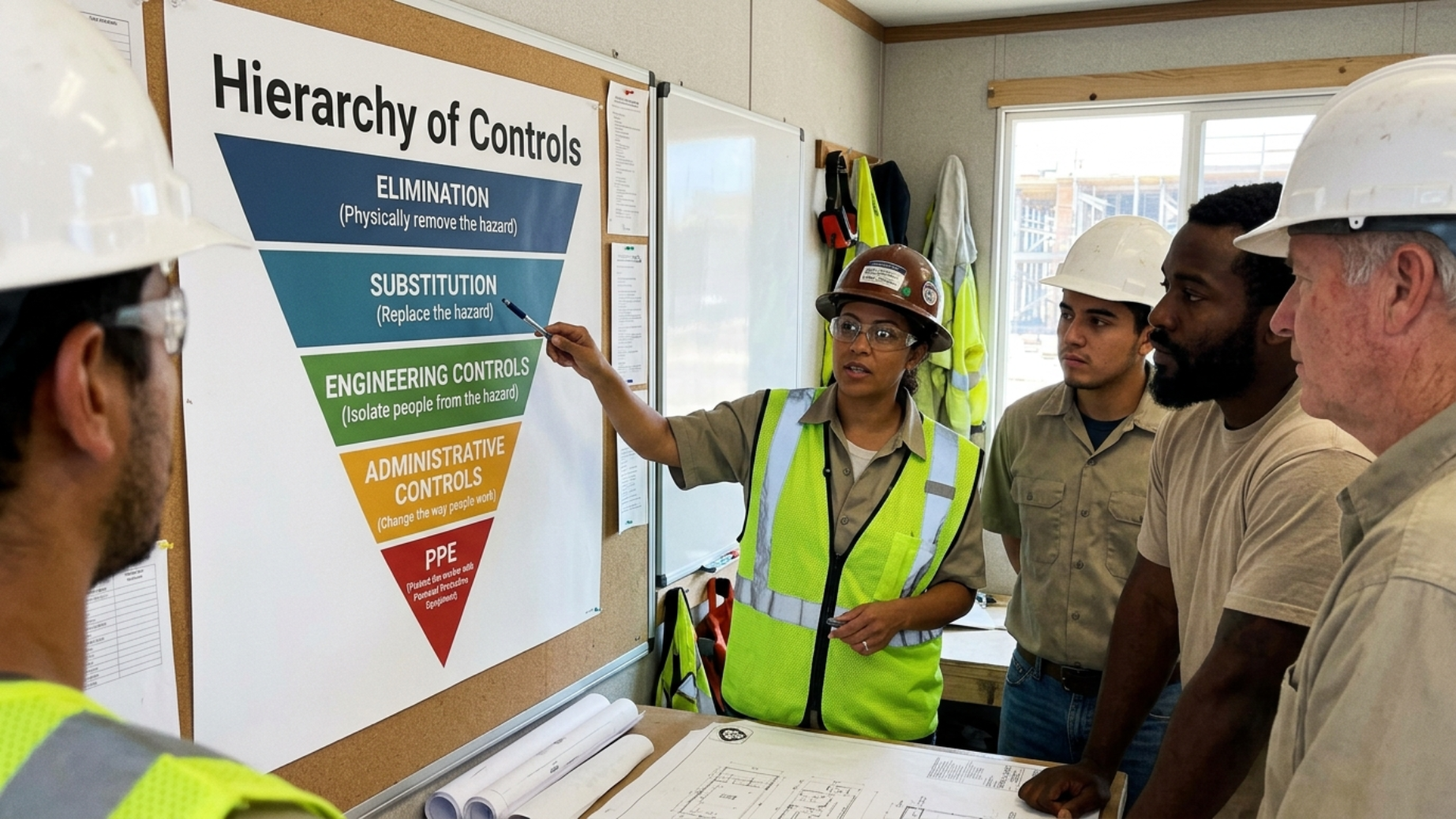
Hazard prevention and control. Selecting and implementing controls to eliminate or reduce risks. Examples include guardrails, lockout/tagout procedures, ventilation, machine guarding, PPE, training, work sequencing, and permit systems. The hierarchy of controls prioritizes elimination and engineering over administrative controls and PPE.
AHA / JHA / JSA. Activity Hazard Analysis, Job Hazard Analysis, and Job Safety Analysis. These planning tools break work into steps, identify the hazards at each step, and define the controls. In Allen and DFW, subcontractors commonly need an AHA or JHA before elevated work, excavation, steel erection, electrical commissioning, concrete placement, or utility work. Use whichever acronym the owner or GC requires, but do not treat them as paperwork. They should reflect how work actually happens.
Site-specific safety plan. A written plan tailored to a specific project, site, scope, hazards, emergency procedures, responsible parties, and owner or GC requirements. A generic company safety manual rarely satisfies this requirement. If you are unsure whether your existing manual covers it, this article on OSHA-compliant safety manuals is a good starting point.
Competent person. In OSHA’s usage, a role required by specific standards (excavation, scaffolding, fall protection, and others) where the person must be able to identify existing and predictable hazards and has the authority to take prompt corrective action.
Qualified person. A person with a recognized degree, certificate, professional standing, or extensive knowledge and training who can solve or resolve problems related to the subject matter. Not the same as a competent person. The distinction matters in regulatory language and contract requirements.
Corrective action. The fix assigned after an inspection, audit, incident, or near miss. A good corrective action names the responsible person, the due date, the severity, and the verification method. “Be more careful” is not a corrective action. “Install midrail on floor opening by Friday; superintendent to verify; retrain affected crew; update pre-task plan” is.
Near miss / close call. An unplanned event that could have caused injury, illness, damage, or loss but did not. These are early warning signals. Companies that track near misses seriously tend to catch problems before they become recordable incidents.
Training and Workforce Terms
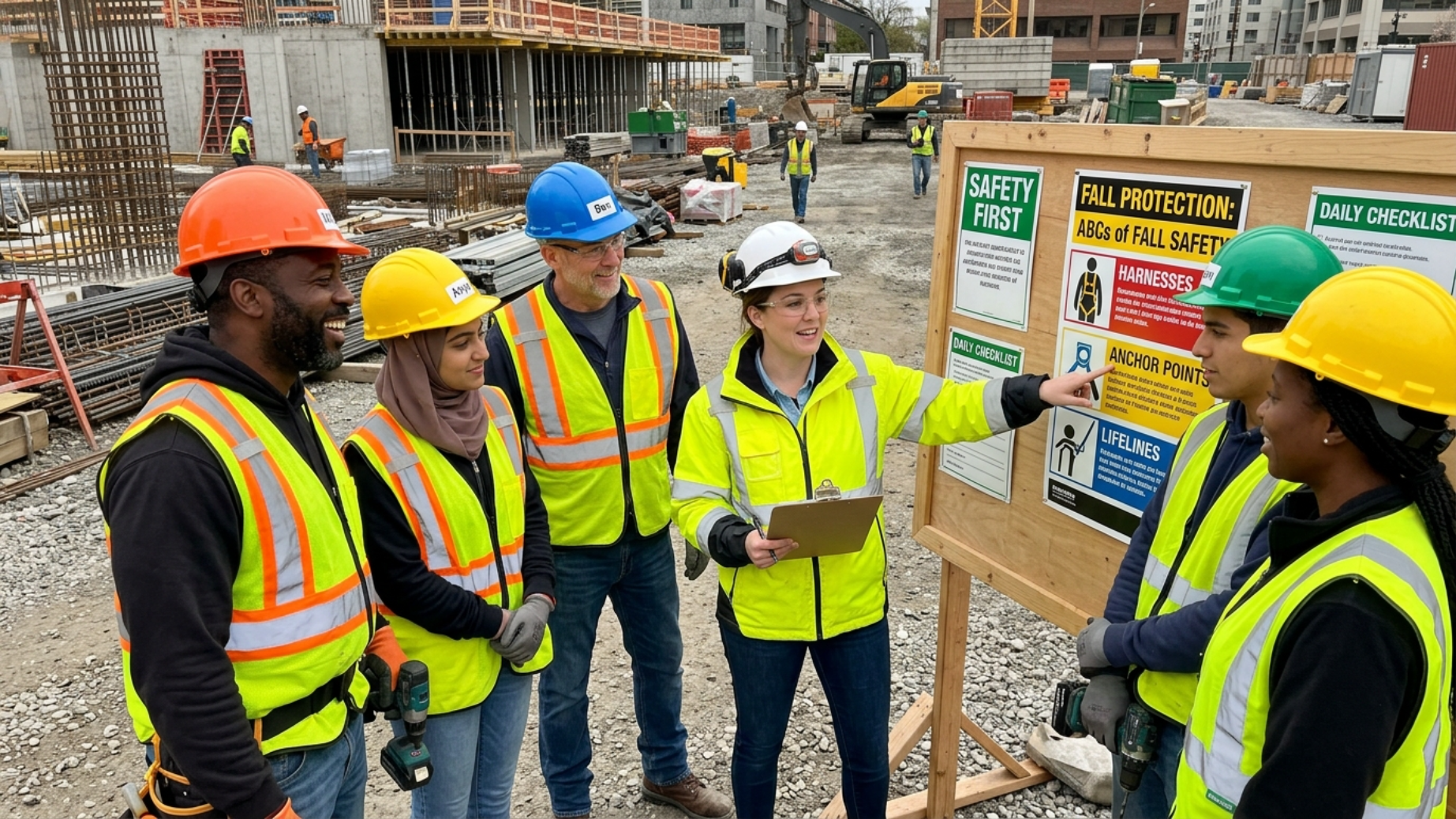
OSHA 10 / OSHA 30. OSHA Outreach Training courses commonly required in construction and general industry. OSHA 10 is typically for entry-level workers; OSHA 30 is for supervisors and those with safety responsibilities. Whether your workers need one or both depends on your contract, owner/GC requirements, work type, and role. For a broader view of what OSHA requires, see this overview of OSHA-required training.
OSHA 500 / OSHA 501. Trainer-level OSHA courses for individuals who become authorized OSHA Outreach instructors in construction (500) and general industry (501). When evaluating a safety consulting firm in Allen, TX, checking for OSHA 500/501 credentials tells you the instructor is authorized to deliver OSHA Outreach training directly.
Bilingual safety training. Safety training delivered in English and Spanish so that crews understand hazards, controls, and expectations in the language they use at work. OSHA’s recommended practices specifically say that barriers to worker participation, including language and lack of information, should be removed. In DFW construction, bilingual capability is not a nice-to-have. It is often essential to real hazard communication and field adoption.
Toolbox talk. A short jobsite safety meeting focused on a specific task, hazard, or upcoming work phase. Toolbox talks should match the day’s actual work, not be random PDFs read aloud before crews tune out.
Safety meeting. A scheduled discussion where supervisors, workers, and management review hazards, incidents, corrective actions, and upcoming work. Effective safety meetings involve two-way communication, not a one-way lecture. For ideas on making these meetings more than a checkbox, see why safety meetings are for everyone.
Common OSHA Hazard Terms
These terms correspond to OSHA’s most frequently cited standards. Preliminary FY 2025 data from NRCA / Safety+Health provides violation counts that show where enforcement attention concentrates.
Fall protection. Systems and practices that prevent falls or arrest them if they occur: guardrails, safety nets, personal fall arrest systems, covers, warning lines, and controlled access zones. Fall protection, general requirements ranked #1 in FY 2025 OSHA Top 10 violations with 5,914 violations. For Allen-area construction, this is the single biggest citation risk.
Hazard communication (HazCom). The program for communicating chemical hazards through labels, Safety Data Sheets, training, and written procedures. Ranked #2 with 2,546 violations. A solid HazCom program goes beyond having a binder of SDSs. It requires that workers understand what they are exposed to and how to protect themselves.
Ladder safety. Selecting, inspecting, placing, and using ladders properly for the task. Ranked #3 with 2,405 violations. Field workers on Reddit’s r/OSHA have noted that blanket ladder bans can backfire when they create impractical workarounds. Workers sometimes improvise riskier alternatives when a well-managed ladder policy with proper selection, setup, and approval would be safer. Good policy balances compliance with field reality.
Lockout/tagout (LOTO). Controls used to prevent unexpected startup or release of hazardous energy during servicing and maintenance. Ranked #4 with 2,177 violations. With DFW’s data center and industrial growth, LOTO procedures are increasingly relevant for Allen-area employers in construction, manufacturing, and utilities.
Respiratory protection. Program elements and equipment used when workers may inhale hazardous dusts, fumes, vapors, gases, or particles. Ranked #5 with 1,953 violations. This is not just about handing out masks. It includes fit testing, medical evaluations, written programs, and training.
Scaffolding. Temporary elevated work platforms and related access/protection systems. Ranked #7 with 1,905 violations.
Powered industrial truck / forklift safety. Safe operation, training, inspection, and traffic control for forklifts and similar vehicles. Ranked #8 with 1,826 violations.
PPE (personal protective equipment). Equipment worn to reduce exposure to hazards: hard hats, eye and face protection, gloves, hearing protection, fall protection harnesses, respiratory protection, and more. Eye and face protection alone ranked #9 in the FY 2025 Top 10. PPE is the last line of defense, not the first. Engineering and administrative controls should come first.
Machine guarding. Physical or engineered protection from moving machine parts, points of operation, nip points, rotating parts, and flying chips or sparks. Ranked #10 with 1,239 violations.
Records, Reporting, and Post-Incident Terms
OSHA 300 Log. The recordkeeping log used by covered employers to record work-related injuries and illnesses that meet OSHA recordability criteria. Keeping this log accurate and current matters for compliance, prequalification, and insurance.
OSHA 300A Summary. The annual summary of OSHA-recordable injuries and illnesses that covered employers may need to post and/or submit electronically depending on size and industry. For more on electronic submission changes, see this article on expanding submission requirements for injury and illness data.
Recordable injury. A work-related injury or illness that meets OSHA recordkeeping criteria. Not every workplace injury is recordable. The distinction matters for OSHA logs, incidence rates, and prequalification.
Reportable injury. A severe event that must be reported to OSHA within required timeframes: fatalities, inpatient hospitalizations, amputations, or loss of an eye.
Incident investigation. A structured review of what happened, why it happened, what conditions contributed, and what corrective actions will prevent recurrence. OSHA’s recommended practices include training employers, managers, and supervisors on investigation techniques, including root cause analysis.
Root cause analysis. Looking beyond the immediate act or condition to identify system failures: missing training, poor planning, unclear supervision, weak maintenance, schedule pressure, or ineffective controls. Writing “employee wasn’t paying attention” as a root cause is a red flag that the investigation stopped too soon.
Expert witness. A qualified expert who provides opinions in legal disputes involving workplace injuries, fatalities, standards, safety practices, or contractor responsibilities.
Prequalification and Business Risk Terms
EMR (Experience Modification Rate). A workers’ compensation insurance metric used by owners and GCs to evaluate contractor safety performance and risk. A high EMR can price a contractor out of bids. A low EMR can open doors. For details on how the calculation works, see this explanation of experience rating.
ISNetworld. A contractor prequalification platform used by owners and clients to evaluate safety, insurance, training, and compliance documentation. Failing ISNetworld can block bidding or delay site access.
Avetta. A supply chain and contractor prequalification platform used to collect safety, compliance, insurance, and risk documentation. Similar to ISNetworld in function.
Multi-employer worksite. A jobsite where more than one employer has workers present. Common in construction and industrial maintenance. OSHA’s recommended practices specifically call out the need for communication and coordination among host employers, contractors, subcontractors, staffing agencies, and workers. Multi-employer sites create shared hazards and shared responsibilities.
Owner-controlled / contractor-controlled requirements. Safety requirements imposed by project owners, developers, general contractors, insurers, or construction managers beyond OSHA minimums. These often drive demand for site-specific safety plans, dedicated on-site safety professionals, pre-task planning, orientation, and extensive documentation.
Safety Service Terms
Safety consulting. The broad category covering outside professional support for hazard identification, OSHA compliance, training, written programs, inspections, incident response, and program management. Safety consulting in Allen, TX specifically means working within the DFW construction and industrial corridor where growth, multi-employer coordination, and documentation demands are high.
Safety staffing. Temporary, long-term, or project-based placement of a credentialed safety professional on a jobsite or at a facility. Safety staffing fits when a GC or owner requires a dedicated safety person, a project starts before an internal hire is ready, a safety manager is on leave, or a high-risk phase needs extra coverage. Practitioners on r/SafetyProfessionals describe contract safety professionals as useful “extra hands,” but they warn that the company still needs clear handoff, defined scope, and internal ownership of follow-through.
Fractional safety manager / outsourced safety director. A part-time or recurring safety leader who functions like an internal safety manager for companies that cannot justify or find a full-time EHS director. This model works for small and mid-size subcontractors, manufacturers, and facilities with recurring safety needs. The important nuance: a fractional safety manager can build systems and coach leadership, but day-to-day culture still requires internal follow-through. Practitioners consistently say consultants do not create culture by themselves.
Full safety program management. A consultant or outsourced team owns major parts of the safety function: written programs, inspections, training, incident response, records, corrective actions, and leadership reporting. OSHA’s recommended safety program framework includes management leadership, worker participation, hazard identification, hazard prevention and control, education and training, program evaluation, and contractor coordination.
How to Choose a Safety Consultant in Allen, TX
Not all safety consultants operate the same way. Some are strong; some are checkbox operators. The practitioner community is blunt about the difference.
Safety professionals on Reddit warn against what they call “binder safety,” where a consultant delivers canned programs, shows generic safety videos, checks boxes, and never walks the floor or talks to workers. The paperwork looks good. It just does not reflect how work actually happens. One practitioner summarized the best model as a hybrid: use the consultant to build the framework, then assign internal ownership using simple tools like checklists, inspections, and incident tracking.
Direct Answer: The best safety consultant in Allen, TX should offer a “boots-on-the-ground” approach that combines local Dallas Area Office expertise with bilingual training and 48-hour staffing capabilities. Look for partners who prioritize field observations over “binder safety” to ensure compliance with the latest 2026 OSHA standards.
Here is what to look for when choosing a safety consultant in Allen, TX:
1. They walk the site, not just the documents. A consultant who never observes actual work cannot give useful recommendations.
2. They talk with supervisors and workers. OSHA’s recommended practices emphasize worker participation and removing barriers like language. A consultant who only talks to management is missing half the picture.
3. They understand your industry. Construction, steel, concrete, telecom, utilities, healthcare, life sciences, and manufacturing have different hazard profiles, documentation requirements, and regulatory nuances.
4. They separate compliance from culture. Compliance is the floor. Culture comes from leadership, supervision, follow-through, and worker buy-in. A consultant can help build the system, but someone inside the company has to own it.
5. They provide clear corrective actions. Each finding should name the responsible person, due date, severity, and verification method. Vague recommendations are not helpful.
6. They know when staffing is better than consulting. If the problem is daily site coverage or a short-term high-risk phase, placing a safety professional on-site may be better than monthly advisory visits.
7. They support bilingual communication where needed. If crews include Spanish-speaking workers, English-only training creates comprehension gaps and reduces participation.
8. They are candid about OSHCON. A trustworthy consultant will tell you when the state’s free program is a good fit and when private help adds more value.
9. They avoid canned programs. A safety manual that does not match the work creates false confidence. Plans should be site-specific, job-specific, and regularly updated.
10. They have relevant credentials and field experience. Look for designations like CSP, CHST, OSHA 500/501 authorization, and NCCER instructor certification. Ask about field hours, not just classroom hours.
One more thing practitioners stress: before a safety consultant’s first site visit, prepare your scope of work, current safety manual, OSHA logs, training records, recent incident reports, owner/GC safety requirements, subcontractor list, current inspection reports, and known concerns. Consultants who are given too much responsibility without proper onboarding from the internal team can produce unhelpful results.
When to Request a Safety Pro
Safety consulting in Allen, TX typically comes down to closing one of three gaps:
Compliance gap. OSHA standards, logs, training, inspections, written programs, or citation response.
Capacity gap. No safety leader on staff, not enough field coverage, an urgent project staffing need, or a safety manager departure.
Credibility gap. Owner or GC prequalification, ISNetworld or Avetta setup, incident documentation, expert witness support, or bilingual workforce communication.
If the term you came here for is tied to an active job, inspection, bid, incident, or staffing gap, it is worth talking to someone who can scope the actual need.
Evolution Safety Resources has an Allen, TX office and provides local consulting within 50 miles with no travel surcharge. For projects outside that radius, ESR provides nationwide safety staffing with a 48-hour average placement. Their team includes CSP, CHST, OSHA 500/501, NCCER instructors, and MS-OSH credentials, with bilingual English/Spanish field and training staff.
Request a safety pro through ESR’s field services and safety staffing page.
Frequently Asked Questions
Is Texas OSHCON the same as hiring a private safety consultant?
No. Texas OSHCON is a free and confidential consultation service for private Texas employers, and it is separate from OSHA enforcement. A private consultant is typically hired when the employer needs speed, project-specific deliverables, on-site staffing, prequalification support, bilingual field training, post-incident investigation, expert witness work, or ongoing outsourced safety leadership.
Does Allen, TX fall under OSHA’s Dallas Area Office?
Yes. OSHA lists Collin County under the Dallas Area Office, which is located in Richardson. All private sector employers and workers in Texas are covered by federal OSHA.
What is the difference between safety consulting and safety staffing?
Safety consulting is project-based or advisory: inspections, audits, training, written programs, investigations, or program support. Safety staffing places a credentialed safety professional on-site for daily or project-based coverage. Many situations call for both. ESR provides both from their Allen office, with nationwide staffing and a 48-hour average placement.
What is a mock OSHA inspection?
A private inspection that simulates what an OSHA compliance officer would review: field hazards, records, training documentation, written programs, logs, and supervisor readiness. It does not replace OSHA or OSHCON, but it helps employers find and fix gaps before an enforcement visit.
Do I need a safety manual or a full safety management system?
A safety manual is one document. A safety management system includes management leadership, worker participation, hazard identification, hazard prevention and control, training, program evaluation, and contractor coordination. OSHA’s recommended practices describe these broader elements. Most companies that have only a manual are missing the system that makes it work.
When should a company use a fractional or outsourced safety director?
When safety needs are recurring but a full-time hire is not justified, not yet available, or not in the budget. A fractional safety director can manage inspections, training calendars, OSHA logs, safety meetings, owner/GC documentation, and leadership reporting on a part-time or retainer basis.
Can a consultant guarantee OSHA compliance?
No. Avoid any consultant who promises guaranteed compliance or immunity from citations. A consultant can help identify hazards, improve programs, train workers, and document corrective actions, but the employer remains legally responsible for workplace safety under the OSH Act.
What should I prepare before a safety consultant visits?
Gather your scope of work, current safety manual, OSHA 300 logs, training records, recent incident reports, owner/GC safety requirements, site-specific plans if any exist, subcontractor list, current inspection reports, and any known concerns. The more context you provide, the more useful the first visit will be.