
TLDR
On-site safety staffing is the placement of a qualified safety professional at a jobsite or facility to handle daily hazard identification, documentation, crew coaching, and compliance support. Companies use it when contracts require dedicated safety coverage, when internal staff can’t fill the role, or when the risk profile of the work demands a full-time field presence. It differs from safety consulting (which targets a specific deliverable) and from general temp staffing (which rarely accounts for safety credentials, OSHA standards, or site-specific hazards).
A general contractor wins a nine-month commercial project. The owner’s contract requires a dedicated site safety professional with a CHST credential and five years of construction experience. The GC’s internal safety director is already spread across three other projects. The clock is ticking before mobilization.
This is the most common entry point for on-site safety staffing. Not a textbook exercise, but a real gap between what the contract demands and what the company has available right now.
On-site safety staffing is the practice of placing a credentialed safety professional at a jobsite, facility, shutdown, or project location to manage daily safety activities in the field. The person conducts inspections, reviews job hazard analyses, coaches crews, documents conditions, supports OSHA compliance, and coordinates safety communication between workers, supervisors, subcontractors, and management. In plain terms, it means bringing in a safety professional to work at the site, not just advise from an office.
ESR (Evolution Safety Resources) provides nationwide safety staffing with a 48-hour average placement and bilingual English/Spanish field support, along with local consulting within 50 miles of offices in Raleigh, Charlotte, Wilmington, Alexandria, and Allen/DFW.
What Is On-Site Safety Staffing?
On-site safety staffing is a temporary, long-term, project-based, or shift-based placement of a safety professional at the physical work location. It can support construction, manufacturing, industrial, utilities, power generation, telecom, healthcare, life sciences, and other safety-sensitive operations.
The critical distinction from general staffing: the provider must understand safety credentials, OSHA standards, site hazards, and project documentation requirements. One discussion in r/SafetyProfessionals pointed out that staffing agencies can place safety professionals on projects, but the agency’s reputation depends on not sending people into roles beyond their experience (source).
You may also see this service described as site safety staffing, EHS staffing, construction safety staffing, temporary safety staffing, contract safety professional placement, or project safety staffing. The underlying idea is the same: a qualified person on the ground, every shift the work requires it.
What Does an On-Site Safety Professional Do?
Many company pages list broad duties without showing what the work actually looks like day to day. Here is what a typical shift involves:
Attend or lead the morning coordination meeting.
Review JHAs, AHAs, or pre-task plans before work begins.
Walk active work areas, checking fall protection, ladders, scaffolds, excavations, hot work, lockout/tagout, respiratory protection, PPE, traffic control, and housekeeping.
Monitor high-risk activities like steel erection, crane lifts, confined space entry, or energized work.
Coach foremen and crews on hazard controls, often privately and in the moment.
Lead or support toolbox talks and safety orientations.
Verify training records, SDS/hazard communication materials, permits, and equipment inspection logs.
Document daily observations, corrective actions, and open items with photos.
Attend subcontractor coordination meetings.
Support incident and near-miss investigations when they happen.
Send an end-of-day report with findings, photos, and recommendations.
The hazards these professionals monitor are not abstract. OSHA’s FY 2025 most-cited standards include fall protection, hazard communication, ladders, lockout/tagout, respiratory protection, scaffolding, fall protection training, powered industrial trucks, eye and face protection, and machine guarding (source). An on-site safety professional spends most of their day on exactly these issues.
A thread in r/SafetyProfessionals offered practical advice for a new safety officer: build credibility by listening first, learning the site plan, partnering with superintendents and foremen, staying visible through walkthroughs, managing high-risk work permits, documenting observations, coaching privately, and praising safe behavior publicly (source). The best staffed safety professionals are resources, not enforcers. That distinction matters when you’re evaluating how a provider selects and supports their people.
The documentation piece deserves special emphasis. In a r/SafetyProfessionals thread about OSHA complaints, a commenter with inspection experience stressed the importance of training records, proof of policy enforcement, inspection documentation, disciplinary records, and evidence of continuous improvement (source). A safety professional who helps you build a functioning safety management system is doing more than checking boxes. They’re creating defensible records that matter if OSHA shows up.
Common On-Site Safety Staffing Roles
Job titles in this space are confusing. A “safety coordinator” on one project might carry the same responsibilities as a “safety manager” on another. Here is how the most common roles break down:
Role | Typical Use | Notes |
|---|---|---|
Site Safety Coordinator | Daily field coordination, inspections, orientations, reports | Common on mid-size construction projects |
Site Safety Manager | Senior project safety lead with subcontractor oversight | Often required on large or multi-trade projects |
Safety Technician / Specialist | Inspections, documentation, supplemental field support | Good for augmenting an existing safety team |
EHS Manager / Advisor | Broader environment, health, and safety coverage | Fits manufacturing, utilities, and life sciences sites where environmental and industrial hygiene scope sits alongside safety. |
CHST | Construction Health and Safety Technician | Frequently requested credential for construction projects |
CSP | Certified Safety Professional | Fits higher-risk, leadership, or program-level roles |
SSHO | Site Safety and Health Officer | Tied to federal/USACE-style work under EM 385-1-1 |
Industrial Hygienist | Exposure monitoring for noise, air quality, chemicals, silica | Useful for specific health hazard assessments |
Confined Space / Fire Watch / Rescue Personnel | Specialized hazard coverage | Common during shutdowns, tank work, or industrial projects |
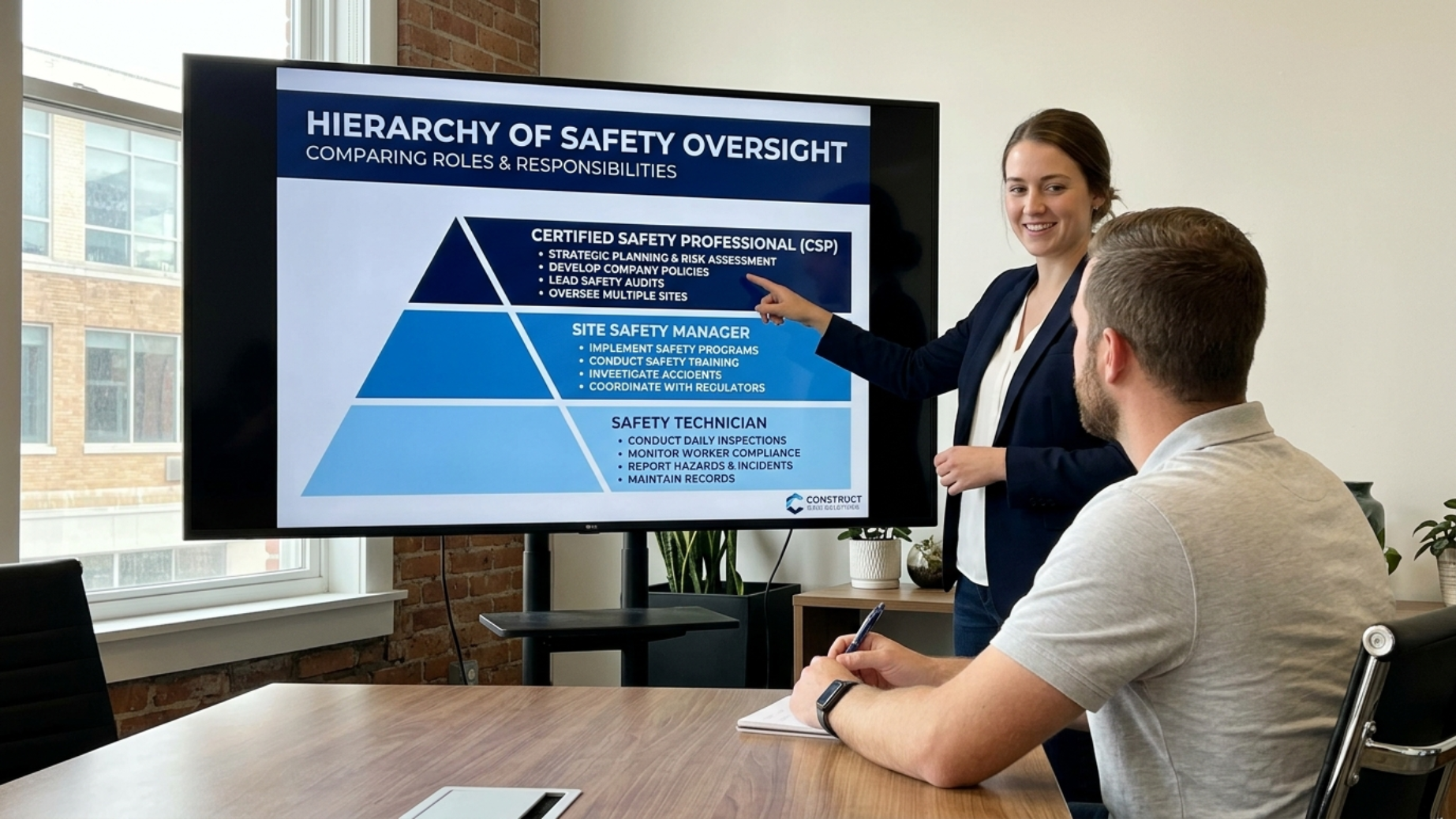
Medcor’s safety staffing page lists site safety managers, coordinators, technicians, industrial hygienists, HSE managers/advisors, CSPs, and CHSTs as common placements (source). The point is that “on-site safety professional” is a category, not a single role. Which one you need depends on your project’s risk, contract language, and documentation requirements.
When Do You Need On-Site Safety Staffing?
Most companies don’t research this topic out of curiosity. They research it because something specific triggered the need. Practitioners on Reddit consistently describe the staffing trigger as contract-driven: a GC, owner, or project spec requires a dedicated safety person, and the company doesn’t have one available (source).
A practical framework for deciding whether you need site safety staffing:
Risk. The scope includes high-risk work like steel erection, excavation, confined space entry, energized electrical work, demolition, hot work, roofing, crane operations, or plant shutdowns. These phases demand continuous field oversight.
Contract. The owner, GC, OCIP/CCIP program, federal agency, or municipal authority requires dedicated safety coverage. This is the single most common trigger. Procore’s construction safety staffing guide notes that contract specifications frequently drive staffing decisions, not OSHA regulations (source).
Scale. Multiple crews, multiple shifts, multiple sites, or a headcount that exceeds internal supervision capacity. You cannot manage safety on three concurrent projects with one person.
Capability gap. No internal safety leader. A vacant role. The internal person lacks a required credential. Spanish-speaking crews need bilingual safety communication and your team doesn’t have it.
Incident or inspection pressure. A serious incident, a near-miss trend, an OSHA complaint, a citation, or a failed owner audit. If you’ve received an OSHA citation and need to demonstrate corrective action, putting a qualified safety professional on site is one of the fastest ways to show good faith. When the trigger is urgent—an injury this morning, an OSHA inspector at the gate, or a key safety staffer who just quit—see our emergency safety staffing guide for what 48-hour mobilization actually looks like.
Start with the contract. Then layer on OSHA exposure, site risk, schedule pressure, and internal capacity. If two or more of these factors apply, on-site safety staffing is worth pursuing.
Is On-Site Safety Staffing Required by OSHA?
This is one of the most common misconceptions. OSHA does not set one universal rule requiring every construction project to have a dedicated safety professional for a specific number of workers. Procore’s safety staffing guide explains that staffing standards simply do not exist for many common types of construction work, and that contract requirements are more frequent drivers of dedicated coverage (source).
That said, OSHA standards still apply. Employers remain responsible for providing a safe workplace under the General Duty Clause and applicable OSHA regulations, whether or not a dedicated safety person is on site.
There are important exceptions. Federal and USACE-style projects may require a Site Safety and Health Officer (SSHO) under EM 385-1-1. The SSHO role is a full-time, non-collateral responsibility. Under EM 385-1-1, the SSHO must be physically present at the project site at all times while work is being performed. They must have immediate access to all major work operations during the shift to maintain compliance. Do not treat “site safety coordinator” and “SSHO” as interchangeable on federal work. The qualification requirements are different, and failing to meet them creates contract and compliance exposure.
State and local jurisdictions may also impose their own requirements. New York City, for instance, requires site safety managers or coordinators on certain project types. Always check the contract and local rules first.
Staffing Does Not Erase Employer Responsibility
This point is underemphasized across the industry. OSHA states that staffing agencies and host employers are joint employers of temporary workers and may share responsibility for training, hazard communication, recordkeeping, and safe working conditions (source). Bringing in a third-party safety professional supports compliance, documentation, and hazard control, but it does not make safety “someone else’s problem.”
The safest approach: define each party’s responsibilities in the contract and maintain clear communication before work begins. OSHA recommends exactly this.
On-Site Safety Staffing vs. Safety Consulting
These are related services, but they solve different problems.
Service Type | Best For | Typical Cadence | Main Output |
|---|---|---|---|
On-site safety staffing | Daily or shift-based field coverage | Full-time, part-time, short-term, or long-term | Inspections, documentation, coaching, compliance support |
Safety consulting | A specific deliverable or issue | As-needed | Audit, written program, training, investigation, inspection |
Fractional safety director | SMB needs safety leadership but not a full-time hire | Weekly or monthly advisory | Program strategy, policy, audits, management coaching |
Outsourced safety department | Company wants an external team to own the safety function | Ongoing | Full safety program management |
Direct-hire recruiting | Company wants a permanent employee | One-time search | Candidate sourcing and placement |
If you need someone walking the site every day, that’s staffing. If you need a mock OSHA inspection or a safety manual rewrite, that’s consulting. If you’re a 50-person contractor without a safety director and need ongoing strategic guidance, a fractional safety director might be the right fit—see our breakdown of the role’s scope, weekly cadence, and typical cost structure. ESR provides all of these under one roof, from project consulting and safety staffing to fractional and outsourced safety departments and full program management.
Not sure which service fits? Sometimes the answer is a combination. A company might need a staffed safety coordinator on their largest project and periodic field safety inspections on two smaller ones.
What Qualifications Should You Look For?
Credentials matter, but context matters more. An OSHA 30 card does not make someone a safety manager. Practitioners on Reddit have been blunt about this: one r/ConstructionManagers discussion described contractors who give someone an OSHA 30 and call them a safety manager just to check a contractual box (source). That’s not safety staffing. That’s a compliance fiction.
Here is a practical credential guide:
OSHA 30-Hour. A useful baseline for construction supervisors and safety-aware field personnel. It demonstrates hazard awareness but not safety management capability. It’s a starting point, not an endpoint.
OSHA 500/501. Indicates the person can teach OSHA Outreach courses and has deeper knowledge of OSHA standards. Useful when training authority is part of the role.
CHST (Construction Health and Safety Technician). A strong construction-specific credential from the Board of Certified Safety Professionals. Frequently requested for mid-level construction safety roles.
CSP (Certified Safety Professional). A senior credential for practitioners with safety leadership responsibility. BCSP describes CSP candidates as professionals who may implement safety management systems, analyze data, assess risk, investigate incidents, and influence safety culture (source). Best fit for complex sites, program-level oversight, or high-hazard environments.
SSHO / EM 385-1-1. Required for federal/USACE-style projects. The person must meet specific training and experience requirements outlined in the contract.
HAZWOPER. Required when hazardous waste operations, emergency response, or chemical exposure is part of the scope.
Bilingual English/Spanish. Not a credential in the traditional sense, but critically important where Spanish-speaking crews are doing the work. If the safety professional can’t communicate directly with the crew, the value of having them on site drops significantly.
Industry-specific experience. A safety professional who has spent ten years in manufacturing may not be the right fit for a steel erection project, and vice versa. Match the person to the hazards.
For a broader look at what OSHA expects employers to provide in terms of training, this overview of OSHA-required training is a good starting point.
LinkedIn job posts from safety staffing providers reinforce what the market values: OSHA 30, OSHA 500/501, CHST or BCSP credentials, five or more years of construction safety experience, and bilingual English/Spanish listed as a plus. Recent job postings in this space show pay rates roughly in the $35 to $55 per hour range depending on role complexity, shift requirements, and credentials. Note this is what the professional earns, not what a staffing engagement bills you; a bill rate also carries payroll taxes, workers’ comp, liability coverage, recruiting, and the provider’s margin.
What Should Be Included in the Engagement?
Before signing an agreement, make sure these items are defined:
Scope of work and specific duties.
Start date and estimated duration.
Shift schedule and hours of coverage.
Required credentials and experience.
Industry and hazard-specific background.
Daily and weekly reporting cadence.
Report format and documentation ownership.
Orientation and training responsibilities (who handles what).
Stop-work authority (does the staffed professional have it?).
Escalation process for serious hazards or incidents.
Replacement coverage if the assigned person is unavailable.
Insurance and payroll handling.
Travel costs or per diem if applicable.
On-site contact and reporting line.
Contract language defining host employer and provider responsibilities.
CORE Safety Group highlights administrative benefits of third-party staffing including payroll taxes, workers’ compensation, benefits, professional liability insurance, continuity/replacement coverage, credential verification, drug screening, and background checks (source). These are real operational advantages, but they only work when the engagement scope is clearly defined upfront.
The 2026 Impact Gap: Why ‘Good Enough’ Safety No Longer Works
In 2026, the gap between a “check-the-box” safety program and a high-performance staffing model has widened due to three factors:
Documentation Depth: Generic “site looks good” entries do not survive scrutiny. A safety professional who logs specific, named conditions (crane lift plans reviewed, trench boxes inspected, permits verified) makes your project defensible in legal and regulatory audits.
Regulatory Tightening: With maximum penalties now exceeding $165k per willful violation, the cost of a single oversight is equivalent to roughly a year of full-time staffing.
Labor Scarcity: The BLS projects a 12% growth in safety roles through 2034. On-site staffing solves the scarcity problem by providing immediate access to specialists that are otherwise difficult to recruit permanently.
How to Choose an On-Site Safety Staffing Partner
Not every provider is the same. Some are general staffing agencies that happen to place safety people. Others specialize exclusively in safety and EHS roles. The difference shows up in placement quality, credential verification, field support, and what happens when something goes wrong.
Use this framework when evaluating providers:
Verified credentials. Ask how the provider confirms OSHA cards, BCSP certifications, EM 385 training, HAZWOPER, and other credentials. “Trust me” is not verification.
Experience match. Match the person to the industry and hazard profile, not just the job title. A safety coordinator with ten years in pharmaceutical manufacturing is not automatically a fit for a bridge demolition project.
Time to mobilize. Ask for a realistic placement timeline and a backup plan if the first candidate doesn’t work out. The safety labor market is tight: BLS projects 12% employment growth for occupational health and safety specialists from 2024 to 2034, with about 18,300 openings per year (source). Finding qualified people quickly is not trivial.
Team support. Does the staffed professional have senior safety leadership behind them? If they encounter a complex problem (a serious incident, a novel hazard, an OSHA inspection), can they call someone?
Evidence quality. Ask for a sample daily report, inspection log, and corrective-action tracker. The quality of documentation is one of the clearest indicators of provider seriousness.
Dependability. Ask about replacement coverage, communication cadence, payroll and insurance handling, and the escalation process.
ESR’s strongest differentiator is speed: a 48-hour average placement for nationwide safety staffing. But speed without fit is useless. A fast placement only helps if the person matches the site’s hazards, contract requirements, language needs, and documentation expectations. ESR’s credentialed team includes CSP, CHST, OSHA 500/501, NCCER instructors, and MS-OSH holders, with bilingual English/Spanish field and training staff.
Need an on-site safety professional? Request a safety pro from ESR.
Why On-Site Safety Staffing Matters Now
The numbers make the case clearly enough.
Workers in construction and extraction occupations suffered 1,032 fatal injuries in 2024, according to the BLS Census of Fatal Occupational Injuries. Fatal falls, slips, and trips accounted for 370 of them, more than a third.
The National Safety Council estimates the total cost of work injuries in 2023 was $176.5 billion, including wage and productivity losses, medical expenses, administrative costs, and employers’ uninsured costs (source).
Violation Type | 2026 Maximum Penalty (OSHA) | Impact on Project Budget |
Serious / Other-Than-Serious | $16,550 | High (Per violation basis) |
Willful or Repeated | $165,514 | Critical (Severe financial risk) |
Failure to Abate | $16,550 (Per Day) | Compounding daily costs |
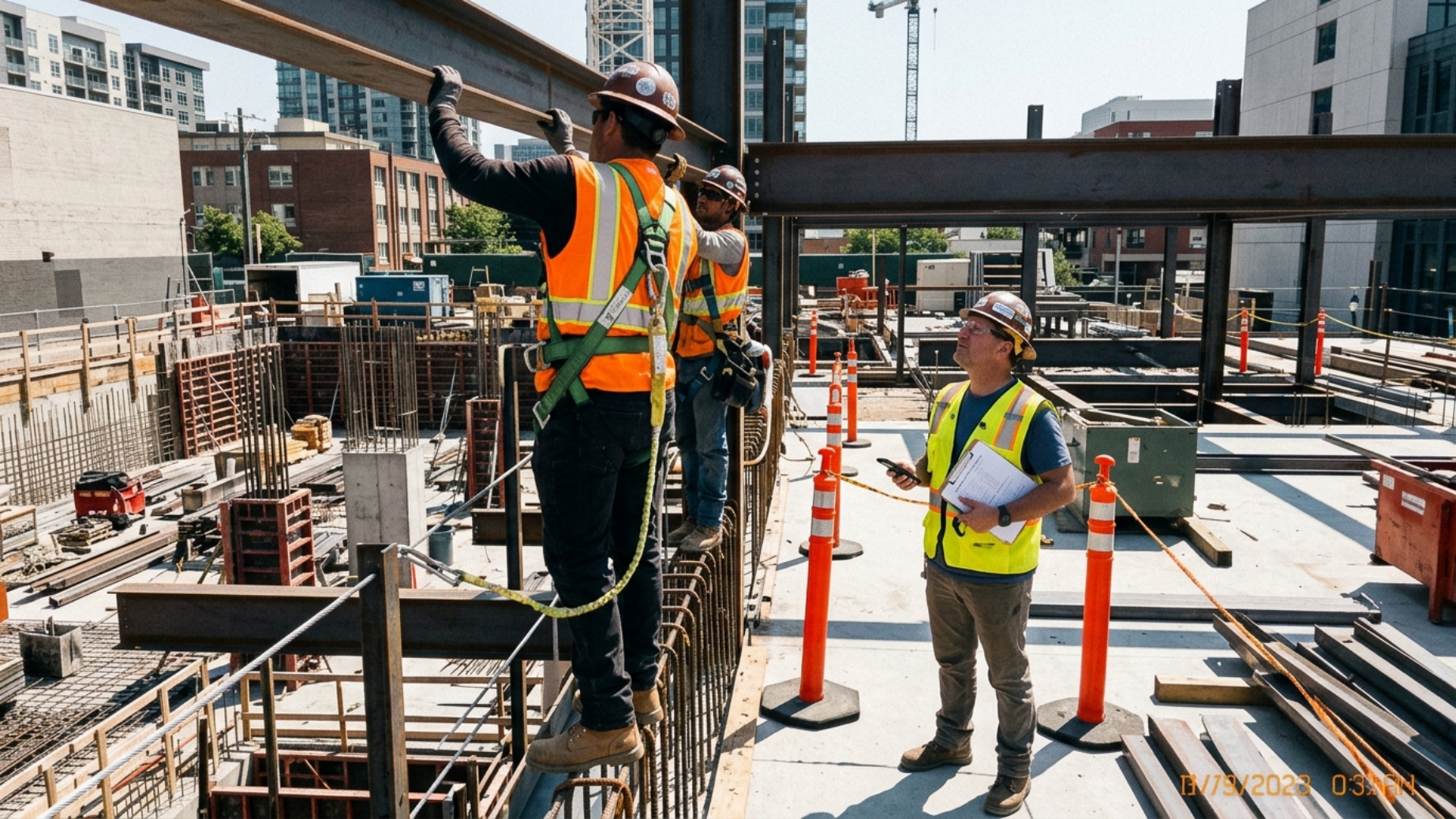
None of this means that hiring one safety professional will automatically reduce costs by a predictable amount. But having someone in the field every day who can identify hazards before they become incidents, document corrective actions, and keep safety visible to crews and leadership is a meaningful investment. OSHA’s Recommended Practices for Safety and Health Programs emphasize that proactive hazard-finding and hazard-fixing is more effective than waiting until an injury, illness, or outside inspection forces action (source).
For a deeper look at quantifying this, evaluating safety’s return on investment provides a useful framework.
Before You Call: A Scoping Checklist
Most providers will give you a better, faster match if you come prepared. Gather these details before requesting a safety professional:
Where is the site?
What is the start date and expected duration?
What shifts need coverage?
What industry and scope of work?
What hazards are present or anticipated?
What does the contract say about the safety role?
Is an OSHA 30 sufficient, or do you need OSHA 500/501, CHST, CSP, SSHO, HAZWOPER, or other specific credentials?
Does the person need stop-work authority?
What reports are expected daily and weekly?
Who will the safety professional report to on site?
Does the provider need to supply insurance, payroll, and replacement coverage?
Are there owner, GC, OCIP/CCIP, ISNetworld, Avetta, or municipal prequalification requirements?
Answering these questions up front prevents the most common staffing mismatch: getting a warm body instead of the right person.
Frequently Asked Questions
What is on-site safety staffing?
On-site safety staffing is the placement of a qualified safety professional at a jobsite or facility to support daily safety oversight, hazard identification, training, documentation, and compliance coordination. The person works in the field alongside supervisors, workers, subcontractors, and project leadership.
Does OSHA require a safety manager on every construction site?
No. There is no universal OSHA rule requiring one dedicated safety professional for a specific number of workers on every construction project. Staffing requirements more often come from contract specifications, owner requirements, GC requirements, federal project rules, or the hazard profile of the work (source).
Who is responsible for safety when using a staffing provider?
Both the host employer and the staffing agency share responsibility. OSHA says they are joint employers of temporary workers and may both be responsible for training, hazard communication, recordkeeping, and providing safe working conditions (source). The contract between the parties should clearly define each side’s obligations.
What credentials should an on-site safety professional have?
It depends on the project. Common requirements include OSHA 30, OSHA 500/501, CHST, CSP, SSHO/EM 385-1-1, HAZWOPER, First Aid/CPR/AED, and industry-specific experience. The right credential depends on the contract language, hazard profile, and level of authority the role requires. OSHA 30 alone is generally not sufficient for a safety management role.
Is on-site safety staffing the same as hiring a safety consultant?
Not exactly. Safety consulting usually addresses a defined deliverable, such as an audit, written safety program, training class, or incident investigation. On-site safety staffing provides a safety professional for continuous or recurring field coverage over a defined period of time.
How quickly can a safety professional be placed on site?
It varies by provider, location, and credential requirements. ESR provides nationwide safety staffing with a 48-hour average placement. For specialized roles (SSHO, industrial hygienist, bilingual EN/ES), lead time may vary depending on availability.
When should a company use temporary safety staffing instead of hiring?
Temporary safety staffing works well for short-term projects, high-risk work phases, shutdowns, turnarounds, vacant roles, contract requirements, multi-site coverage needs, and rapid mobilization. If the need is ongoing and permanent, direct hire or an outsourced safety department may be a better fit.
Do we need bilingual safety staffing?
If your field crews include Spanish-speaking workers, bilingual safety communication is not optional. Toolbox talks, orientations, hazard coaching, and incident reporting all require clear two-way communication. A safety professional who cannot speak directly with the crew loses much of their effectiveness.
Most companies don’t need “a safety person.” They need the right safety professional for the site’s specific risk, contract language, crew, schedule, and documentation burden. The right person understands the work, communicates with the crew, documents what matters, escalates issues early, and helps project leadership keep safety visible every day.
If you need on-site safety coverage quickly, request a safety pro from ESR. Nationwide safety staffing with a 48-hour average placement, bilingual English/Spanish field support, and a credentialed team that includes CSP, CHST, OSHA 500/501, and NCCER instructors.