
TLDR
An outsourced safety department is an external team that handles the recurring work of a company’s safety function, including program development, inspections, training, OSHA compliance support, documentation, and incident response. It gives companies access to qualified safety professionals without building a full internal department. The employer still owns safety accountability. The model works best when outside expertise is paired with internal leadership that acts on findings and enforces expectations in the field.
What Is an Outsourced Safety Department?
An outsourced safety department is a third-party service that manages a company’s entire safety function, including OSHA compliance, field inspections, safety training, and incident investigations. Unlike a one-time consultant, it operates on a recurring schedule to maintain safety systems. In 2026, companies use this model to access credentialed professionals (CSP, CHST) without the high overhead of a full-time $100k+ salary.
If your company does not have a dedicated safety leader, or your current team is stretched too thin, an outsourced department fills that gap. Instead of hiring a full-time safety director and building a team around them, you bring in an outside firm that supplies the people, field visits, training, documentation, and compliance support your operation needs.
This functions like an internal department, not like a vendor who simply “drops off a binder.” It operates on a recurring cadence—running inspections on a schedule, maintaining your training matrix, and tracking corrective actions in real-time.
That said, outsourcing the work does not outsource the responsibility. OSHA’s multi-employer citation policy and temporary worker guidance both make clear that employers cannot simply assign safety duties to another party and walk away from their obligations under the OSH Act. OSHA’s temporary worker bulletin states directly that neither a host employer nor a staffing agency can avoid ultimate responsibilities by delegating them.
A company that outsources its safety department still has to provide leadership, correct hazards, train workers, and make sure safety rules are followed in the field. The outside team supplies structure and expertise. Your people supply commitment and follow-through.
What Does an Outsourced Safety Department Include?
The scope varies by provider, but a well-structured outsourced safety department typically covers these recurring functions:
Program development and documentation. Writing and updating your safety manual, site-specific safety plans, job hazard analyses, emergency action plans, fall protection plans, hazard communication programs, and PPE policies. A manual is only useful if it matches the actual work being performed. If yours hasn’t been reviewed in years, it may not reflect current operations or OSHA standards. You can check whether your safety manual meets OSHA requirements as a starting point.
Field inspections and audits. Regular site or facility inspections are the line between a paper program and a working safety function. OSHA’s recommended practices emphasize proactive hazard identification, finding and fixing problems before someone gets hurt. This includes scheduled inspections, mock OSHA inspections, and field observations that check whether written policies match actual behavior.
Training and communication. Delivering OSHA-required and site-specific training, maintaining a training matrix, and documenting everything. OSHA requires that training be provided in a language and vocabulary the worker understands, which matters especially for companies with Spanish-speaking crews. An overview of OSHA-required training can help clarify what’s mandatory versus optional.
OSHA recordkeeping. Maintaining OSHA 300, 300A, and 301 logs, along with training rosters, inspection records, corrective action logs, and incident investigation files. This is not clerical busywork. It is evidence that the company is identifying hazards, training workers, correcting problems, and managing risk.
Incident response and investigation. Investigating injuries, near misses, and serious incidents. Preparing documentation for OSHA inspections. Helping the company respond to citations. The National Safety Council estimated the average cost per medically consulted work injury in 2024 at $48,000, with the cost per work death at $1.54 million. Companies that already know what to do after receiving an OSHA citation are in a stronger position than those scrambling to figure it out after the fact.
Corrective action tracking. Identifying hazards is only half the job. The real value is closing the loop: hazard found, owner assigned, deadline set, correction verified, lesson communicated. Many providers will hand you an inspection report. Fewer will track whether anything actually changed.
Management reporting. Providing leadership with trends, open items, recurring issues, leading indicators, and priorities so they can make informed decisions about resources, training, and risk.
Safety staffing. When a project, owner, or general contractor requires a dedicated safety professional on site, the outsourced department can place a credentialed person, whether for a few weeks or several months. This is where outsourced safety departments and safety staffing services overlap.
How an Outsourced Safety Department Differs from Related Services
The terms get used interchangeably in the market, but they mean different things in practice.
Safety Service Model Comparison
Model | What It Means | How It Differs |
Safety Consultant | A specialist hired for advice, audits, training, program writing, or a specific compliance issue. | Usually narrower or project-based. Not an ongoing operating function. |
Fractional Safety Director | A part-time senior safety leader who advises leadership and manages strategy. | Often strategic. May not include field inspections, training delivery, or staffing. |
Outsourced Safety Manager | An external professional who manages safety duties for a company or jobsite. | Usually one role. A department model may include multiple specialists, admin support, and broader coverage. |
Safety Staffing | Placement of a safety professional on site for a defined project, shift, or duration. | Staffing solves a “people-on-site” problem. An outsourced department solves the broader safety operating system. |
Contract Safety Professional | A safety professional hired for temporary or project-based work. | Often role-specific. May or may not manage the whole safety function. |
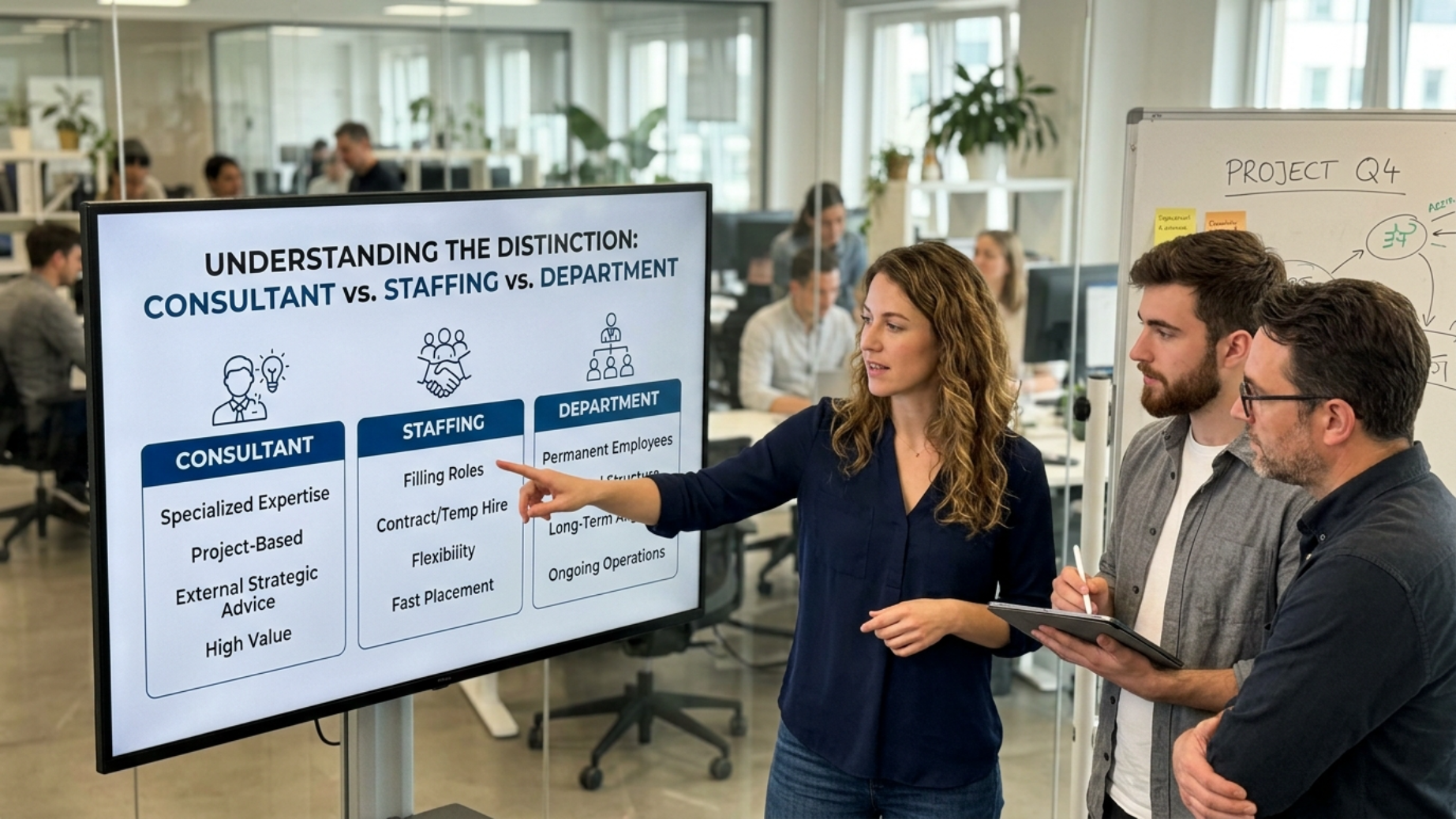
The key distinction: staffing fills a seat. Consulting answers a question. An outsourced safety department runs the system.
A department includes roles, a cadence, documents, meetings, inspection rhythms, corrective action tracking, management reporting, and escalation paths. It is a coordinated function, not just a person. That’s what separates a real outsourced safety department from a consultant who shows up once a month.
The Rising Cost of Safety Non-Compliance (2026)
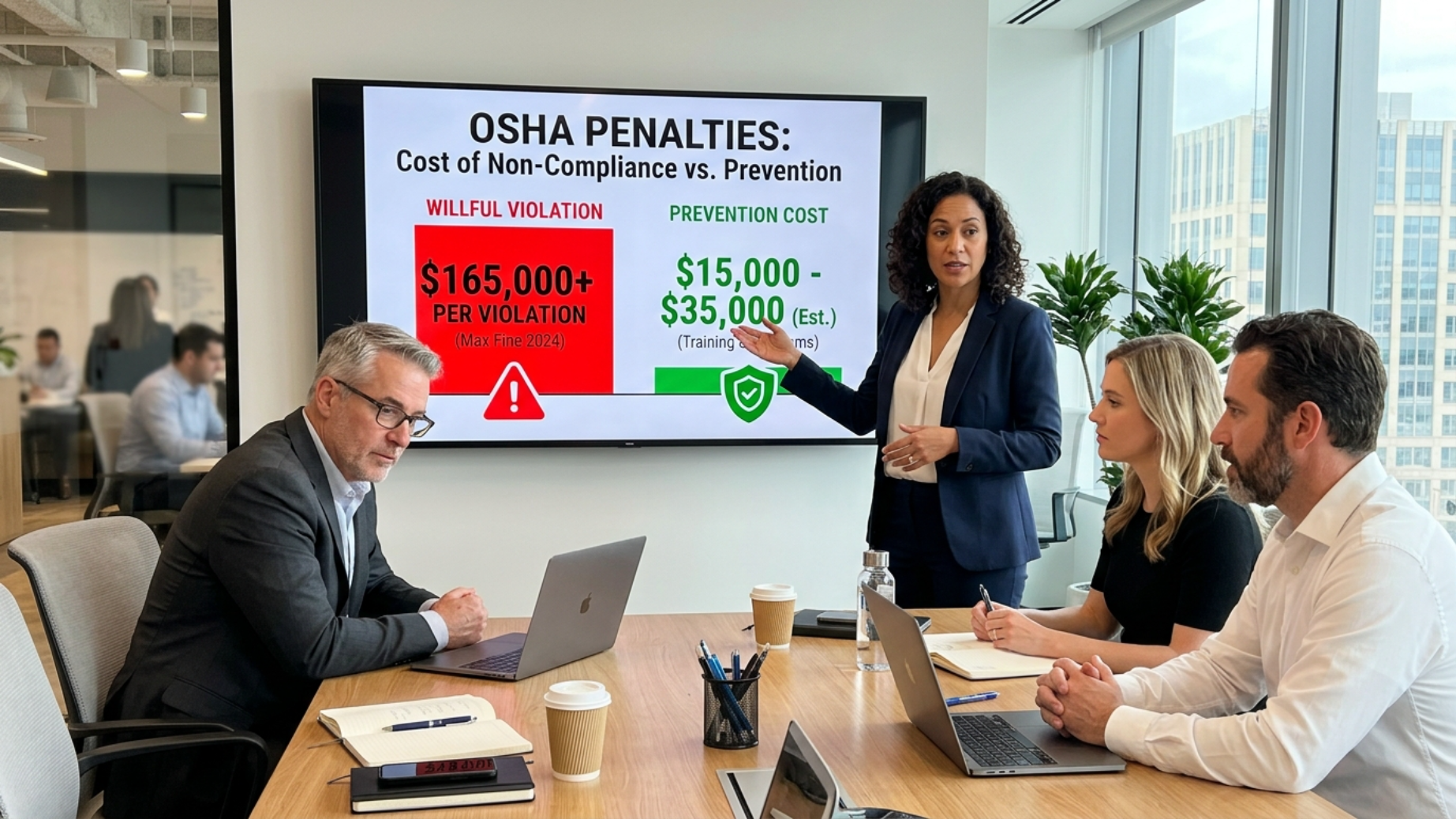
The financial risk of an unmanaged safety program has reached historic highs. As of January 2026, OSHA has adjusted its penalty structure for inflation, making “paper-only” programs a massive liability.
Violation Type | 2026 Max Penalty | Avg. Indirect Cost (Estimated) |
Serious Violation | $16,550 | $45,000 – $60,000 |
Willful or Repeated | $165,514 | $250,000+ |
Medically Consulted Injury | $48,000 | $140,000+ |
Workplace Fatality | $1.54 Million | $3 Million+ |
When Does Outsourcing Your Safety Department Make Sense?
Not every company needs this model, and not every company that needs it knows they need it. Here are the situations where outsourcing fits best:
No internal safety leader. The company needs structure, training, inspections, and OSHA readiness but cannot justify or find a full-time hire. The 2023 BCSP/NSC salary survey found the median base salary for full-time safety professionals was $105,000, and credentialed professionals earned roughly $18,000 more. For a 40-person subcontractor, that’s a significant line item before benefits.
Fast growth with multiple jobsites. Growth creates documentation, training, inspection, and field consistency problems faster than most management teams can handle alone.
Temporary project requiring on-site safety coverage. A contract safety professional can provide field presence without a permanent hire, especially during high-risk phases like demolition, excavation, steel erection, or work at heights.
Owner or GC prequalification pressure. Companies may need written programs, training records, EMR and TRIR documentation, and support for ISNetworld, Avetta, or similar systems before they can bid or mobilize.
Post-incident or OSHA response. External safety professionals can help investigate, document, correct, and prepare for follow-up after an injury, near miss, or OSHA visit.
Bilingual workforce needs. If Spanish-speaking crews are not receiving training in a language they understand, the company has both a safety gap and a compliance gap.
Internal safety team is overloaded. Outsourcing can add inspections, training delivery, documentation cleanup, or project coverage without replacing the internal team. Practitioners on Reddit describe this mismatch frequently. One manufacturing EHS professional said the work exists and headcount is clearly needed, but budget approval for indirect salaried roles keeps lagging, leaving existing staff doing the work of two or three people.
What Outsourcing Does Not Change
This is where most vendor pages get it wrong. They oversell outsourcing and gloss over the parts that stay on the company’s shoulders. Here’s what does not change when you outsource your safety function.
Employer Responsibility Stays with the Employer
OSHA’s multi-employer citation policy evaluates whether an employer is a creating, exposing, correcting, or controlling employer on a worksite. More than one employer can be cited for the same hazard. Bringing in an outside safety team does not shield you from citations if your workers are exposed to hazards you knew about or should have known about.
Current OSHA penalties after January 2026, the maximum for Serious is $16,550 and Willful is $165,514. Those penalties are assessed against the employer of record, not the safety consultant.
Culture Cannot Be Outsourced
Practitioners on Reddit’s r/SafetyProfessionals are blunt about this. Consultants can identify gaps, build programs, conduct training, and bring outside perspective, but they cannot create safety culture without leadership. One consultant put it plainly: they can point out the problems, but leadership has to create accountability. Another warned that if a company ignores reports, the consultant’s work will not improve anything.
A safety management system only works when the people inside the company actually use it. If supervisors ignore findings, crews are uninvolved, and management treats safety as a box-checking exercise, outsourcing will become paperwork instead of prevention. Understanding why a safety manual alone isn’t enough is a good starting point for companies evaluating their current approach.
Field Supervision Still Belongs to the Company
An external safety professional can inspect, coach, train, document, and escalate. Foremen, superintendents, plant managers, and project managers still have to enforce expectations every day. The outsourced team supports the operation. It does not replace the chain of command.
The Safety Department Operating Loop

An outsourced safety department should not operate randomly. It should run a repeatable cycle, one that mirrors what OSHA’s recommended practices describe as the core elements of an effective safety and health program.
Assess. Review hazards, records, programs, training, incidents, and contractual requirements. Start by walking the field, interviewing supervisors, and reviewing what exists before rewriting anything. A LinkedIn practitioner post on a safety manager’s first day makes the same point: real impact starts with learning how safety is actually lived, not simply proving expertise.
Plan. Build or update the safety manual, site-specific plans, JHAs, training matrix, inspection schedule, and corrective action process.
Train. Deliver required training in a language workers understand, before they begin work.
Verify in the field. Conduct site inspections, mock OSHA inspections, supervisor coaching, and field safety observations.
Document. Maintain training records, inspection reports, OSHA logs, incident files, and corrective action evidence.
Correct. Assign owners, deadlines, and verification steps for every hazard and program gap found.
Report. Provide management with trends, open items, recurring issues, leading indicators, and priorities.
Improve. Update programs, retrain where needed, adjust controls, and apply lessons learned. This cycle of assessment, audit, and continuous improvement is what turns a safety program into a safety system.
A practical cadence might look like monthly or biweekly site inspections, quarterly training matrix reviews, annual safety manual updates, incident response as needed, and a corrective action report after every inspection. The specific frequency depends on the size of the operation, number of sites, and level of risk.
Benefits of an Outsourced Safety Department
When structured well and supported by internal leadership, outsourcing your safety function offers real advantages:
Faster access to qualified safety professionals. Hiring takes months. An outsourced department can begin work in weeks or days.
Scalable coverage. Add field inspections during a busy project phase. Scale back when work slows. You are not locked into headcount.
Outside perspective. Internal teams can develop blind spots. External safety professionals see patterns across multiple clients, industries, and regulatory environments.
More consistent documentation. Programs, training records, inspection reports, and OSHA logs get maintained on schedule rather than falling behind when operations get busy.
Better OSHA readiness. Companies that are inspected, trained, and documented on a recurring basis are in a stronger position when OSHA shows up.The Bureau of Labor Statistics recorded 5,070 fatal work injuries in the United States in 2024, with construction and extraction occupations accounting for 1,032 of those deaths. OSHA’s most frequently cited standards in FY 2025 included fall protection, hazard communication, ladders, scaffolding, and lockout/tagout. These are not obscure violations. They are recurring problems that a functioning safety department should be catching before an inspector does.
Flexible project coverage. When a project requires dedicated on-site safety, the outsourced department can provide staffing as part of the broader safety support.
Reduced burden on operations and HR. Safety administration (training scheduling, documentation, OSHA logs, prequalification portals) consumes significant time. Outsourcing frees project managers and operations staff to focus on their primary work.
Understanding safety’s return on investment helps make the business case internally. But be realistic: no provider can guarantee zero citations, zero injuries, or lower insurance costs. The accurate framing is that outsourcing helps reduce risk, supports compliance, and improves readiness.
Red Flags to Watch For
Not all outsourced safety providers operate the same way. Some will genuinely improve your safety performance. Others will give you exactly what practitioners call “binder safety,” lots of paperwork that looks good on a shelf but does not reflect how work actually happens.
Here are the warning signs:
The provider only sends generic templates. If the safety manual they hand you could belong to any company in any industry, it probably will not protect your workers or satisfy an OSHA inspector who asks how it applies to your specific operations.
No one ever walks the field. A safety department that never talks to workers, watches how tasks are performed, or inspects conditions is guessing. Practitioners on Reddit specifically flag this: a consultant who never walks the floor is a problem.
No corrective action tracking. Inspection reports that go into a folder and are never reviewed, assigned, or followed up on create a dangerous paper trail. You have documentation proving you knew about hazards but did nothing about them.
No clarity on emergency response. What happens at 2 AM when there is a serious incident? If the answer is “call the office Monday,” that is not a safety department.
No bilingual capability where your workforce needs it. OSHA requires training be delivered in a language and vocabulary workers understand. A provider that cannot train or communicate with your Spanish-speaking crews is leaving a gap.
No documented qualifications. Titles vary wildly in the safety profession. Practitioners complain that an SSHO in one company functions like a director in another. Evaluate actual credentials (CSP, CHST, OSHA 500/501), field experience, and industry fit, not just the title on a business card.
Long contracts before proving fit. A provider that insists on a 12-month commitment before you have seen their work on your site is prioritizing their revenue over your confidence.
Reports are delivered but never reviewed with leadership. If findings go to an inbox and die there, the outsourced department is creating liability documentation, not safety improvement.
How to Choose an Outsourced Safety Department Provider
Use this checklist when evaluating providers. It is designed to separate serious safety partners from paper mills.
What industries do you specialize in?
Who specifically will be assigned to our account, and what are their credentials?
How often will someone be on our site or in our facility?
Do you provide training in both English and Spanish?
How do you document inspection findings?
How are corrective actions tracked to closure?
What is your process for OSHA inspections and citation response?
Can you provide on-site safety staffing if a project requires dedicated field coverage?
Do you support prequalification systems like ISNetworld or Avetta?
What does the first 30, 60, and 90 days look like?
Who inside our company needs to own decisions and approvals?
How do you measure progress and report to management?
What happens after a serious incident?
How do you keep programs current as OSHA standards change?
The best providers will welcome these questions. The ones who dodge them are telling you something.
Want this as a printable checklist? Request the provider-evaluation checklist and we’ll send it along with a scoped conversation about your safety gaps.
When to Outsource vs. Hire In-House
A 2025 ASSP and J. J. Keller study found that 38% of construction firms still lacked a proactive approach to safety and regulatory compliance, while also citing labor shortages (38%) and jobsite safety (32%) as top challenges. For many of these companies, the question is not whether they need safety support, but what form it should take.
Company Situation | Recommended Model |
|---|---|
No safety leader, underdeveloped programs, growing risk | Fractional or outsourced safety department with a regular cadence |
Multiple active jobsites, no consistent field coverage | Outsourced department plus safety staffing for priority sites |
Project requires immediate on-site safety professional | Safety staffing or contract safety professional |
Internal safety manager who lacks time for audits, training, or documentation | Outsourced support as an extension of the internal team |
High-risk continuous operations with daily exposure and large crews | Build internal safety leadership; use outsourced specialists for training, audits, investigations, or surge support |
Post-incident, OSHA citation, or owner/GC escalation | Project consulting or emergency advisory, then convert to ongoing support if gaps are systemic |
Leadership only wants a manual to satisfy a customer | Treat it as a limited document project, not a full outsourced department |
One honest consideration: if a company is paying a consultant to function like a full-time employee every single week, it should compare that cost against hiring. Practitioners on Reddit warn that long-term consultant use can become more expensive than a full-time hire when the need is truly daily and indefinite. The outsourced model is strongest when a company needs ongoing but flexible support, not a permanent full-time seat that never changes.
Example: Outsourced Safety Department in Practice
A 75-person electrical subcontractor works across several GC-controlled jobsites but does not have a full-time safety manager. The owner knows safety matters, but between running projects and managing crews, the safety manual has not been updated in three years, training records are scattered, and inspections happen sporadically.
An outsourced safety department steps in. The provider reviews the existing safety manual, creates site-specific plans for each active project, builds a training matrix, conducts biweekly jobsite inspections, helps supervisors close corrective actions, maintains OSHA recordkeeping, and provides a contract safety professional for a six-week steel erection phase that requires dedicated coverage.
The subcontractor still owns supervision and enforcement. Foremen still run their crews. The project manager still makes resource decisions. But the outside safety team supplies the structure, field verification, and technical support that the company cannot produce on its own.
This is the hybrid model that practitioners consistently describe as the most effective approach: outside experts build the framework and provide technical depth while internal leaders own implementation and accountability.
Get Safety Support from Evolution Safety Resources
Evolution Safety Resources works with companies that need safety leadership, field inspections, training, documentation, on-site safety staffing, or a fully outsourced safety function. ESR combines local consulting near its Raleigh, Charlotte, Wilmington, Alexandria, and Allen/DFW offices with nationwide safety staffing and a 48-hour average placement model.
The team includes professionals holding CSP, CHST, OSHA 500/501, and NCCER credentials, with bilingual English and Spanish field and training staff. There is no travel surcharge within 50 miles of any ESR office.
Whether your company needs a single inspection, a contract safety professional for a high-risk project phase, or an ongoing outsourced safety department that runs the full operating loop, ESR can help.
Frequently Asked Questions
Is an outsourced safety department the same as a safety consultant?
No. A safety consultant is typically hired for a specific project: an audit, a training class, a manual rewrite, an incident investigation. An outsourced safety department is broader and ongoing. It covers the recurring work of a safety function on a defined cadence, including inspections, training, documentation, corrective action tracking, and management reporting.
Can a company outsource OSHA responsibility?
No. A company can outsource safety support, but not the legal duty to protect workers. OSHA’s multi-employer citation policy evaluates whether an employer created, exposed workers to, controlled, or was responsible for correcting a hazard. Multiple employers can be cited for the same condition. Outsourcing helps with execution and expertise. It does not erase the employer’s obligations.
Do you still need someone internal to manage safety?
Almost always, yes. Even when the technical work is outsourced, someone inside the company must approve changes, assign resources, hold supervisors accountable, and make sure corrective actions are completed. The outsourced team provides the system. Internal leadership makes it stick.
What is “binder safety”?
“Binder safety” is a practitioner term for a safety program that looks complete on paper but does not reflect actual field conditions or worker behavior. It happens when a provider writes generic policies without walking the site, talking to workers, or verifying that supervisors enforce the rules. Safety professionals on Reddit flag this as one of the most common consultant red flags.
When should a company hire in-house instead of outsourcing?
If safety requires daily leadership, continuous field presence, high-volume supervision, or deep integration into operations (large manufacturing plants, refineries, major GC operations), an internal safety leader is usually the better choice. Outsourcing can still support specialized projects, audits, training, or staffing gaps even after an internal hire.
What should be included in the scope of work?
At minimum: inspection cadence, training responsibilities, written program support, recordkeeping support, incident response expectations, reporting format, corrective action tracking, emergency availability, assigned personnel and their credentials, and internal points of contact. Defining these items upfront prevents accountability from drifting.
How much does an outsourced safety department cost compared to a full-time hire?
It depends on scope. A full-time safety professional with credentials earned a median base salary of $105,000 in 2023, before benefits and overhead. An outsourced arrangement may cost more or less depending on frequency, the number of sites, whether on-site staffing is included, and the complexity of the work. The cost advantage of outsourcing is flexibility and access to multiple specialists, not necessarily a lower total dollar amount.
What industries use outsourced safety departments most?
Construction (general contractors and specialty subcontractors), manufacturing, utilities, telecommunications, municipalities, and industrial facilities are the most common. Any industry where OSHA compliance, field hazard exposure, and contractor management create recurring safety demands is a candidate.