
TL;DR
Safety consulting in Charlotte, NC covers everything from OSHA compliance and mock inspections to written safety plans and credential-backed training. Charlotte’s $3.7 billion construction pipeline and North Carolina’s state-run OSHA enforcement create a unique regulatory environment where penalties can reach $165,514 per willful violation. This glossary defines every term you’ll encounter when evaluating safety consultants, explains the credentials that separate qualified professionals from the rest, and gives Charlotte-area businesses the vocabulary they need to make informed hiring decisions.
Quick Takeaway: Charlotte Safety Compliance 2026
For Charlotte businesses, safety consulting is a high-stakes necessity driven by a $4 billion regional construction pipeline and North Carolina’s state-specific OSHA enforcement. As of January 2026, maximum penalties for willful violations reached $165,514. To secure bids and lower insurance costs, Charlotte contractors utilize mock OSHA inspections, site-specific safety plans (SSSP), and bilingual training to manage their Experience Modification Rate (EMR).
Why Charlotte Businesses Need a Safety Vocabulary
Charlotte’s growth remains record-breaking in 2026. According to recent Q2 2026 reports from Charlotte Center City Partners, the development pipeline has reached $4 billion in active or planned projects. This includes a surge in industrial and specialized “innovation districts,” alongside 2.1 million square feet of industrial space currently under construction. For local businesses, this volume of work brings heightened OSHA visibility and more complex subcontractor safety coordination.
All that construction means more active job sites, more subcontractor interactions, more general contractor safety requirements, and more OSHA exposure. North Carolina’s construction employment is growing at 3.0%, the fastest of any sector in the state.
For businesses navigating this environment, safety consulting in Charlotte, NC isn’t optional. It’s the difference between winning bids and losing them, between clean inspections and six-figure penalties. But the terminology can be confusing. This glossary breaks down every term you’re likely to encounter, from credentials and citations to compliance platforms and training programs, with specific context for Charlotte’s market.
Safety Consulting Services
Safety Consulting
Safety consulting is the practice of hiring an outside expert to assess, build, manage, or improve your company’s safety program. The scope varies widely: a consultant might write your safety manual, conduct site inspections, train your crews, manage your OSHA 300 Log, or serve as your full-time safety director on a fractional basis.
One safety practitioner draws a useful comparison: “Think of it like doing your taxes. You can certainly do them yourself, but a professional accountant brings a level of expertise that can save you from costly mistakes and find opportunities you might have missed.” A safety consultant has deep, specialized knowledge of complex regulations and can spot hazards your team might be used to seeing every day.
For Charlotte contractors specifically, safety consulting often centers on construction compliance, written program development, and pre-qualification support for platforms like ISNetworld and Avetta. The Charlotte construction boom has made these services table stakes rather than luxuries. Research suggests that construction companies save $4 to $6 for every $1 invested in a comprehensive safety program by reducing additional fees and medical costs.
To understand how outsourcing safety can work for smaller companies, the benefits and checklist for an outsourced safety department is worth reviewing.
Safety Consulting vs. Safety Staffing
These two services get conflated constantly, but they’re different engagement models.
Safety consulting means hiring a firm for their expertise: program development, audits, training, regulatory guidance, citation response. The consultant diagnoses problems and delivers solutions. Engagements might be project-based (a single mock inspection) or ongoing (quarterly audits plus advisory).
Safety staffing means hiring a firm to place a credentialed safety professional on your site. The person works on your project daily, conducts orientations, monitors compliance, and handles documentation. Staffing fills a seat. Consulting fills a knowledge gap.
Many Charlotte businesses need both. A general contractor running three simultaneous projects might use consulting for program development and staffing to put a qualified safety officer on each site. For a deeper look at the staffing side, this construction safety staffing guide explains how placements work.
Fractional / Outsourced Safety Director
A fractional safety director is a credentialed safety professional who serves as your company’s safety leader on a part-time or contract basis. Instead of hiring a full-time safety director at $90,000 to $140,000 per year plus benefits, you get the same strategic oversight for a fraction of the cost.
This model is built for small and mid-size businesses that can’t justify a full-time hire but still need someone to own safety program management, regulatory compliance, and incident response. In Charlotte’s construction market, subcontractors and specialty trades with 15 to 75 employees are the most common users.
The fractional director typically handles written programs, training schedules, audit preparation, OSHA correspondence, and insurance coordination. They’re not on-site every day, but they’re available when it matters. You can explore the full scope, role, and cost of a fractional safety director to see whether this model fits your operation.
Mock OSHA Inspection
A mock OSHA inspection is a simulated compliance inspection conducted by a safety consultant who follows the same protocols an actual OSHA compliance officer would use. The consultant walks your site, reviews documentation, interviews employees, photographs conditions, and produces a report identifying violations you’d be cited for in a real inspection.
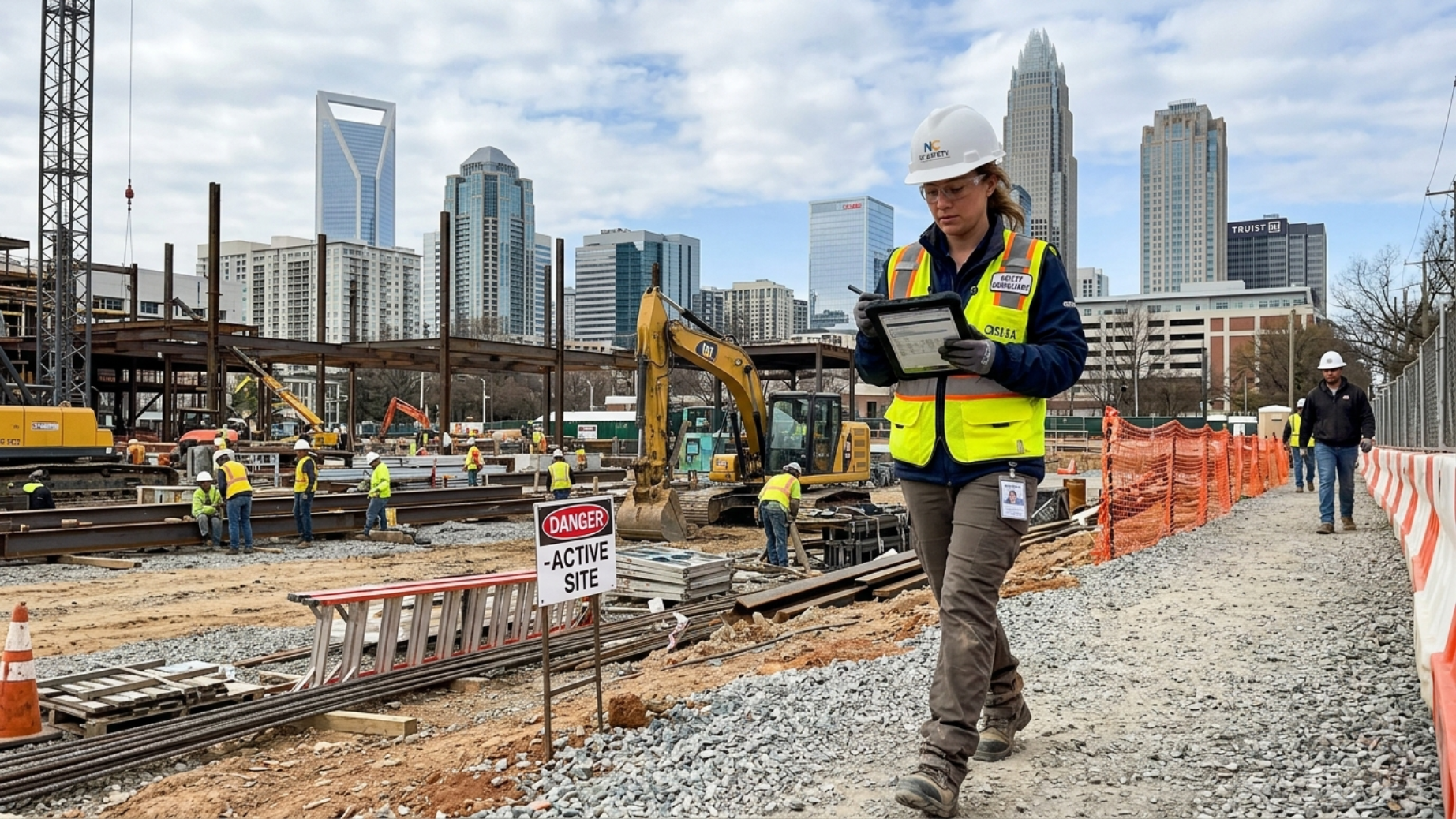
General contractors in Charlotte use mock inspections before project milestones, before owner walkthroughs, and as routine quality checks. Smart subcontractors request them before OSHA’s local emphasis programs ramp up. North Carolina has implemented a special emphasis program specifically for preventing struck-by incidents, which makes mock inspections particularly valuable for Charlotte job sites with heavy equipment, crane operations, and steel erection.
The key difference from a real inspection: a mock inspection gives you the chance to fix problems before they become citations. No penalties, no public record.
Site-Specific Safety Plan (SSSP)
A site-specific safety plan is a written document that identifies the hazards, controls, emergency procedures, and safety responsibilities unique to a particular project or job site. It’s not a generic company safety manual. It addresses the specific work being performed at a specific location.
Most general contractor contracts in Charlotte require subcontractors to submit an SSSP before mobilizing. If your SSSP is missing, incomplete, or clearly copy-pasted from another project, you risk being removed from the bid list.
A typical SSSP covers scope of work, hazard identification, fall protection plans, emergency action plans, PPE requirements, training documentation, and a site-specific hazard communication plan.
Safety Audit
The terms “audit,” “inspection,” and “assessment” get used interchangeably, but they mean different things.
A safety audit is a systematic, documented review of your entire safety program against a defined standard (OSHA regulations, ISO 45001, your GC’s requirements, or your own internal policies). Audits evaluate systems and processes.
A safety inspection focuses on physical conditions at a specific moment. Are guardrails in place? Is PPE being worn? Are fire extinguishers charged?
A safety assessment is broader and more diagnostic. It evaluates your overall safety culture, program maturity, and organizational readiness.
Charlotte contractors preparing for ISNetworld reviews or GC pre-qualification typically need audits. Those maintaining daily compliance need inspections. Companies wondering where to start need assessments. To evaluate whether your existing documentation meets the mark, check if your safety manual is actually OSHA-compliant.
Incident Investigation
Incident investigation is the formal process of determining the root cause of a workplace accident, near-miss, or property damage event. It goes far beyond filling out an accident report. A proper investigation involves witness interviews, scene documentation, timeline reconstruction, contributing factor analysis, and corrective action recommendations.
Third-party investigations are preferred over internal ones for a simple reason: objectivity. When your own supervisor investigates an incident on their own crew, the findings tend to protect the supervisor. An outside investigator has no stake in the outcome.
In Charlotte’s construction environment, incident investigations matter for two additional reasons. First, OSHA may open an inspection based on a reported fatality or hospitalization, and your investigation quality affects how that plays out. Second, your investigation report becomes a legal document that may surface in workers’ compensation hearings, civil litigation, or OSHA contested cases.
Expert Witness (Safety)
A safety expert witness is a credentialed professional who provides testimony in legal proceedings involving workplace safety. They might testify about whether industry standards were followed, whether a hazard was foreseeable, whether training was adequate, or whether OSHA regulations apply to a given situation.
Not every safety consultant qualifies as an expert witness. Courts evaluate education, certifications, years of experience, publication history, and prior testimony. The Certified Safety Professional (CSP) credential is typically the minimum expectation for expert witness work in construction safety litigation.
Credentials That Matter
When evaluating safety consulting in Charlotte, NC, credentials are the fastest way to separate qualified firms from unqualified ones. No ranking page for Charlotte safety consulting actually explains what these credentials mean, so here’s the breakdown.
CSP (Certified Safety Professional)
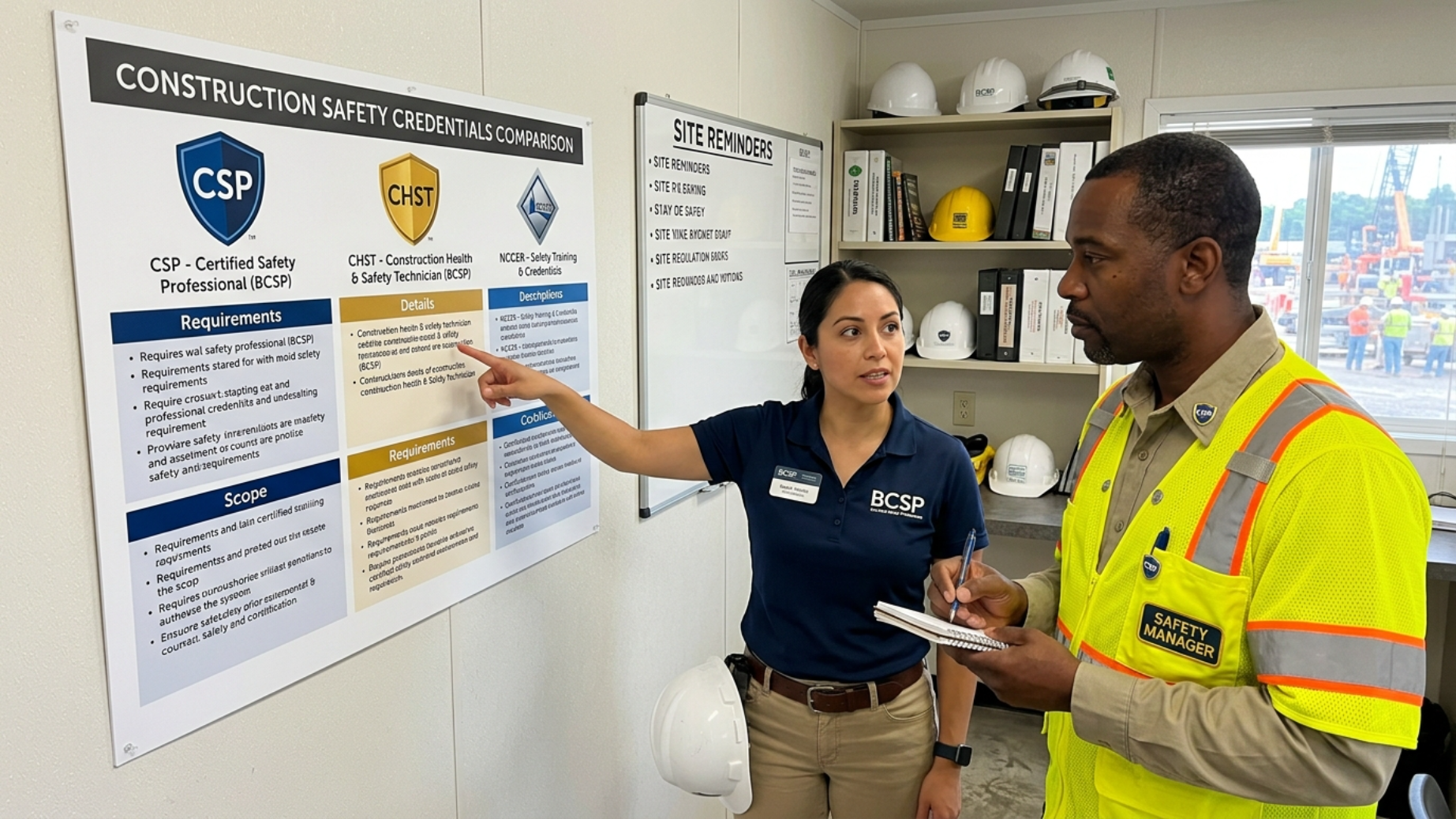
The CSP is the gold standard safety credential. It requires a bachelor’s degree, four or more years of professional safety experience, and passing a rigorous exam administered by the Board of Certified Safety Professionals (BCSP). This isn’t a weekend course. The CSP demonstrates that someone has met the highest requirements in the safety, health, and environmental profession.
When you’re hiring a safety consultant for program development, regulatory strategy, or expert witness work, a CSP on the team is a strong signal of competence.
CHST (Construction Health and Safety Technician)
The CHST targets construction-specific safety practitioners. It requires three or more years of construction safety experience and passing an exam, but unlike the CSP, it has no degree requirement. This makes it the primary credential for experienced field safety professionals who built their careers on job sites rather than in classrooms.
The CHST is highly respected in construction. Site safety managers, field safety officers, and construction safety technicians commonly hold it. If you’re hiring safety staffing for a Charlotte construction project, a CHST-credentialed professional is often the best fit for day-to-day site coverage.
OSHA 500 / OSHA 501
These are trainer authorization courses. OSHA 500 authorizes construction outreach training; OSHA 501 covers general industry. Completing these courses allows a safety professional to teach OSHA 10-Hour and 30-Hour classes and issue completion cards.
This is valuable, but understand what it is and what it isn’t. OSHA 500/501 authorizes someone to deliver OSHA training. It is not a broad safety credential. A person with OSHA 500 authorization and no other qualifications can teach OSHA classes but may not be equipped to write your safety program or represent you during an OSHA inspection.
OSHA 10-Hour / OSHA 30-Hour Training
OSHA 10 and OSHA 30 cards are proof of training completion, not certifications. This distinction matters because many Charlotte contractors think an OSHA 30 card makes someone a safety professional. It doesn’t.
The OSHA 10-Hour course covers basic safety awareness and is designed for entry-level workers. The OSHA 30-Hour course goes deeper and targets supervisors, foremen, and project managers. Both are valuable training, and most Charlotte GCs require OSHA 10 cards for all workers on their sites.
But completion of a 10- or 30-hour course does not qualify someone to manage a safety program, conduct audits, or respond to OSHA citations. For a full rundown of what OSHA requires in terms of training, see this overview of OSHA-required training.
NCCER (National Center for Construction Education and Research)
NCCER is a nonprofit education foundation that develops standardized construction training curricula and credentials. An NCCER Accredited Training Unit can deliver nationally recognized craft and safety training programs with portable credentials that follow a worker from employer to employer.
For Charlotte contractors, NCCER accreditation signals that a training provider meets national standards rather than winging it with homemade slide decks.
OSHA Regulations and NC-Specific Rules
OSHA Citation Types
An OSHA citation is a formal notice that your company violated a specific OSHA standard. Citations come in several classifications, each carrying different penalty ranges. As of January 15, 2025:
Serious violation: Up to $16,550 per violation. The employer knew or should have known about the hazard, and it could cause death or serious physical harm.
Other-than-serious violation: Up to $16,550 per violation. The violation has a direct relationship to safety but probably wouldn’t cause death or serious harm.
Willful violation: Up to $165,514 per violation. The employer intentionally and knowingly committed the violation.
Repeat violation: Up to $165,514 per violation. The employer was previously cited for a substantially similar violation.
Failure to abate: Up to $16,550 per day beyond the abatement deadline.
Violation Type | 2026 Maximum Penalty | Key Definition |
Serious | $16,550 | High probability of death or serious physical harm. |
Other-Than-Serious | $16,550 | Direct relationship to safety, but unlikely to cause death. |
Willful | $165,514 | Intentional disregard or “plain indifference” to the law. |
Repeat | $165,514 | Substantially similar violation cited within the last 5 years. |
Failure to Abate | $16,550 / day | Daily fine for every day a hazard remains past the deadline. |
Penalties are assessed per violation, not per inspection. A single inspection can produce multiple citations across different standards, and the costs compound fast. For a step-by-step response plan when citations arrive, the OSHA citation response guide walks through what to do immediately.
OSHA Penalty Reduction Factors
OSHA doesn’t always charge the maximum. Several factors can reduce penalties:
Clean inspection history: Employers with no serious, willful, repeat, or failure-to-abate violations in the past five years may receive a 20% reduction.
Size-based reductions: Very small employers (25 or fewer employees) may receive up to a 60% reduction. Mid-size employers (26 to 100) may receive up to 40%. Larger employers (101 to 250) may receive up to 20%.
Good faith: Demonstrated commitment to safety (written programs, training documentation, self-audits) can support additional reductions.
These reductions make a strong case for proactive safety consulting. Charlotte businesses that invest in documented safety programs before an inspection have concrete leverage to reduce penalties if violations are found.
NC OSH State Plan
This is critical context that no other Charlotte safety consulting page covers. North Carolina operates its own State Plan for occupational safety and health through the NC OSH Division, part of the NC Department of Labor. This means federal OSHA does not directly enforce workplace safety in North Carolina. The state does.
The NC OSH Division has adopted virtually all federal OSHA standards, but it handles its own inspections, citations, and enforcement priorities. Compliance officers from the NC OSH Division inspect workplaces for hazardous conditions and issue citations. Inspections may result from regular scheduling, imminent danger reports, fatalities, and worker complaints or referrals.
The practical implications for Charlotte businesses:
Penalty parity. NC maximum penalties match federal OSHA maximums and increase annually based on the Consumer Price Index. Effective July 1, 2025, NC civil penalties will increase again.
State emphasis programs. North Carolina runs its own special emphasis programs, including one specifically focused on preventing struck-by incidents, a leading cause of construction fatalities.
Free consultation. Small businesses in the private and public sectors can request free on-site safety and health compliance assistance through the NC Consultative Services Bureau. These consultations are confidential and separate from enforcement.
2026 NC Struck-By Safety Initiative
In March 2026, NCDOL Commissioner Luke Farley launched a Special Workplace Safety Initiative targeting “struck-by” hazards—which have now overtaken falls as the leading cause of workplace injury in North Carolina.
Charlotte businesses should prepare for:
Targeted Enforcement: Increased inspection frequency for sites with heavy equipment and high-traffic work zones.
Tech Integration: A push for “Very Narrow Aisle” (VNA) warehouse configurations and automated equipment speed controls.
Free Consultation: Access to specialized struck-by prevention training through the NC Consultative Services Bureau.
General Duty Clause
Section 5(a)(1) of the OSH Act requires every employer to provide a workplace “free from recognized hazards that are causing or are likely to cause death or serious physical harm.” This is OSHA’s catch-all provision. Even if no specific standard covers a hazard, OSHA can cite you under the General Duty Clause if the hazard is recognized and feasible abatement exists.
In practice, the General Duty Clause comes into play on Charlotte job sites for hazards like heat illness (no permanent federal heat standard yet), workplace violence, and emerging risks that specific standards haven’t caught up with. For a deeper understanding of how this clause works and when it applies, read this explanation of the General Duty Clause.
OSHA 300 Log
The OSHA 300 Log is the required injury and illness recordkeeping form. Most employers with more than 10 employees must maintain it, recording every qualifying workplace injury or illness throughout the calendar year. The summary (OSHA 300A) must be posted in the workplace from February 1 through April 30 each year.
Recent electronic submission rule changes have expanded which employers must submit their 300 Log data to OSHA electronically. Establishments with 100 or more employees in designated high-hazard industries, which includes most construction classifications, must now submit their full 300 Log, not just the 300A summary.
Accurate recordkeeping matters beyond compliance. Your OSHA 300 data directly feeds your Experience Modification Rate, which affects insurance premiums and bid eligibility.
Compliance and Pre-Qualification Tools
ISNetworld
ISNetworld is a third-party contractor management platform used by hiring clients (typically general contractors, owners, and operators) to verify that subcontractors meet minimum safety, insurance, and regulatory requirements before being allowed on a project.
If a Charlotte GC uses ISNetworld, you must create and maintain an account, upload your safety programs, training records, EMR data, and insurance certificates, and pass a review. Failing ISNetworld review doesn’t just mean a bad score. It means you can’t work on that project.
Setting up ISNetworld properly the first time requires understanding exactly what the reviewing client expects. Many Charlotte subcontractors hire safety consultants specifically for ISNetworld setup and ongoing maintenance.
Avetta
Avetta serves a similar function to ISNetworld but with a different client base and platform interface. Some GCs and owners use ISNetworld, others use Avetta, and some use both. The compliance requirements overlap significantly: safety programs, training documentation, insurance verification, and EMR reporting.
Charlotte contractors working across multiple GCs often need to maintain profiles on both platforms simultaneously.
Experience Modification Rate (EMR / E-Mod)
Your Experience Modification Rate is a number calculated by the National Council on Compensation Insurance (or your state’s equivalent) that compares your company’s actual workers’ compensation claims history to the expected claims for businesses of your size and industry.
An EMR of 1.0 is average. Below 1.0 means fewer claims than expected. Above 1.0 means more. Here’s why it matters for Charlotte contractors: most GCs won’t let you on a project if your EMR exceeds 1.0, and some set the threshold at 0.85 or lower. Your EMR also directly determines your workers’ comp premium. An EMR of 1.2 means you’re paying 20% more than the average contractor for insurance.

Safety consulting reduces your EMR over time by preventing the incidents that drive claims. To understand how experience rating works and how to improve yours, this guide to experience rating explains the mechanics.
Subcontractor Pre-Qualification
Subcontractor pre-qualification is the process by which general contractors evaluate and approve subcontractors before awarding work. Safety performance is a major component. GCs review your EMR, OSHA citation history, written safety programs, training records, and ISNetworld or Avetta scores.
A critical point that many Charlotte subcontractors miss: general contractors can be fined and penalized by OSHA for subcontractor safety violations. OSHA can fine both the subcontractor and the GC for the same violation. This dual-liability reality is why GCs are increasingly aggressive about pre-qualification. It’s not paperwork for paperwork’s sake. It’s risk transfer.
Worksite Safety Terms
Fall Protection
Fall protection is the #1 most cited OSHA standard in construction, and it has held that position for over a decade. In Charlotte’s vertical construction environment (high-rises, multi-story residential, commercial interiors), fall hazards are everywhere: leading edges, floor openings, roof work, scaffold platforms, and ladder access points.
OSHA’s construction fall protection standard (29 CFR 1926.501) requires fall protection at six feet for general construction. The standard covers guardrail systems, safety net systems, personal fall arrest systems, and positioning device systems. For a look at the most common violations including fall protection, see the top OSHA construction violations.
Activity Hazard Analysis (AHA)
An Activity Hazard Analysis is a detailed, step-by-step breakdown of a specific work activity that identifies hazards at each step and prescribes controls. AHAs are required by the U.S. Army Corps of Engineers’ EM 385-1-1 safety manual, which governs all federal construction projects. They’re also increasingly required by private-sector GCs in Charlotte.
An AHA is more granular than a JHA. Where a JHA might cover “concrete pouring” in general, an AHA would break that down into site prep, form setup, pour operations, finishing, and form stripping, with hazards and controls for each discrete step.
Job Hazard Analysis (JHA)
A Job Hazard Analysis is the more common, private-sector version of the AHA. It identifies the steps of a job, the hazards associated with each step, and the controls needed to mitigate those hazards. JHAs are practical tools used daily on Charlotte construction sites during pre-task planning meetings.
The difference between a JHA and an AHA is mostly one of detail and formality. JHAs are sufficient for most private-sector Charlotte projects. AHAs are required for federal work and some GCs who’ve adopted the EM 385 framework.
Hazard Communication (HazCom)
Hazard Communication, commonly called HazCom, is the OSHA standard (29 CFR 1910.1200) that requires employers to inform workers about chemical hazards in the workplace. It covers three main areas: Safety Data Sheets (SDS) for every hazardous chemical on site, proper labeling of chemical containers, and employee training on chemical hazards.
Charlotte construction and manufacturing sites deal with HazCom daily: silica-containing materials, solvents, adhesives, coatings, fuels. The standard follows the Globally Harmonized System (GHS) of classification and labeling, which standardizes how hazards are communicated worldwide. For a complete breakdown, read more about OSHA’s hazard communication standards.
Safety Management System (SMS)
A Safety Management System is the structured framework that governs how an organization manages safety. It includes policies, objectives, planning processes, implementation practices, auditing, and continuous improvement. Think of it as the operating system that makes individual safety activities (training, inspections, incident response) work together instead of happening in isolation.
ISO 45001 is the international standard for occupational health and safety management systems, and some Charlotte-area owners and GCs are beginning to require it or something similar. But you don’t need ISO certification to have an effective SMS. What you need is a documented system that connects your safety policies to your daily operations. This article on why a safety manual alone isn’t enough explains the difference between a binder on a shelf and a functioning system. For guidance on the audit and continuous improvement side, see assessments, audits, and continuous improvement for SMS.
Training and Workforce
Bilingual Safety Training
Charlotte’s construction workforce includes a large Spanish-speaking population. Bilingual safety training isn’t just a nice-to-have; OSHA requires that training be delivered in a language workers can understand. If your crew speaks Spanish and your toolbox talk is in English only, you’re out of compliance.
Effective bilingual training goes beyond translation. It requires trainers who are fluent in the language and understand the cultural context of how crews communicate on site. Safety consulting firms serving Charlotte, NC should have bilingual field staff and training capability as a baseline, not as an add-on.
As one practitioner noted in an online discussion, being local is important, but it doesn’t guarantee that a consultant knows how to prevent accidents or navigate safety regulations. That takes the right kind of background and hands-on experience. The same applies to bilingual capability: a Google-translated safety manual doesn’t count.
Safety Staffing
Safety staffing means placing a qualified safety professional on your site for a defined period. This might be a short-term need (covering a two-week shutdown), a project-length engagement (a 14-month hospital build), or a permanent placement.
The Charlotte construction market’s growth has created a severe shortage of qualified safety professionals. Finding someone with a CHST or CSP who’s available immediately is difficult. Safety staffing agencies maintain networks of pre-vetted, credentialed professionals and can typically place someone faster than you could recruit, interview, and hire on your own.
There’s also a meaningful distinction between a safety specialist and a safety consultant. A safety specialist is typically newer to the profession and can handle base-level tasks like orientations, inspections, and documentation. A safety consultant has the experience and credentials to manage complex situations like OSHA inspections, program development, and regulatory strategy. Understanding which level you actually need prevents overpaying or underprotecting your site.
Fractional Safety Director in Practice
For Charlotte-area businesses that fall into the gap between “too small for a full-time safety director” and “too exposed to go without one,” a fractional safety director provides the answer. This is especially relevant for specialty subcontractors, regional manufacturers, and growing contractors who’ve reached 20 to 100 employees but haven’t built an internal safety infrastructure yet.
The outsourced safety director model gives these companies access to CSP-level expertise without the full-time salary commitment. For a detailed comparison of the outsourced model versus hiring internally, the outsourced safety director guide on hiring and ROI breaks down the numbers.
How to Evaluate a Safety Consultant in Charlotte
Knowing the terminology is half the battle. The other half is knowing what to look for when hiring. Here’s a practical framework:
Check credentials first. At minimum, look for CSP or CHST on the team. Ask whether their trainers hold OSHA 500/501 authorization. If they claim NCCER training capability, verify their Accredited Training Unit status.
Confirm local presence. Safety consulting in Charlotte, NC requires someone who can be on your site when it matters. Ask about office location, travel charges, and response time. A firm 300 miles away with no local office will cost you in travel surcharges and delayed response.
Ask about NC-specific experience. North Carolina’s State Plan means your consultant needs to understand how the NC OSH Division operates, not just federal OSHA. Ask whether they’ve interacted with NC compliance officers, handled NC citations, or participated in the state’s consultative services program.
Evaluate bilingual capability. If your field crews include Spanish-speaking workers, your consultant must be able to train and communicate in Spanish. Ask whether they have bilingual field staff, not just office staff.
Request references in your industry. A consultant who’s excellent in manufacturing may struggle on a construction site, and vice versa. Charlotte’s market is construction-heavy, so if that’s your sector, look for firms whose credentials, experience, and staffing reflect it.
Understand the ROI. Safety isn’t just a cost center. Construction companies can save $4 to $6 for every $1 invested in safety. For a data-driven look at the financial case, evaluating safety’s return on investment lays out the math.
What’s at Stake for Charlotte Businesses
The numbers paint a clear picture. Over 20% of workplace fatalities occur in construction. A single serious OSHA violation now costs up to $16,550, and willful violations reach $165,514 each. Multiple citations from one inspection can push total penalties into six figures before you factor in project delays, increased insurance premiums, and the EMR impact that can lock you out of future bids.
Charlotte’s construction pipeline isn’t slowing down. With $3.7 billion in development underway or imminent and construction employment growing at 3.0%, the demand for qualified safety consulting in Charlotte, NC will only increase. Companies that build their safety infrastructure now, whether through a fractional safety director, project-based consulting, or on-site staffing, position themselves to win bids, reduce claims, and protect their workforce in one of the fastest-growing markets in the country.
If your Charlotte operation needs credentialed safety support, from a single mock inspection to a full outsourced safety department, start with a free audit from Evolution Safety Resources. ESR’s Charlotte office provides safety consulting with no travel charge within 50 miles, with a bilingual, CSP and CHST-credentialed team ready to deploy.
Frequently Asked Questions
What does a safety consultant actually do in Charlotte?
A safety consultant assesses your workplace hazards, develops written safety programs, conducts training, performs mock OSHA inspections, manages compliance documentation, and advises on regulatory strategy. In Charlotte’s construction market, this often includes site-specific safety plan development, ISNetworld and Avetta setup, fall protection planning, and bilingual crew training. The scope depends on your needs, from a one-time audit to ongoing fractional safety director services.
What are the maximum OSHA penalties in North Carolina for 2026?
As of the January 2026 inflation adjustment, the maximum penalty for a Serious violation is $16,550. For Willful or Repeat violations, the maximum penalty is $165,514 per violation. Under the NC State Plan, these amounts are adjusted annually to maintain parity with federal OSHA standards.
What’s the difference between a CSP and CHST?
The CSP (Certified Safety Professional) requires a bachelor’s degree, four years of professional safety experience, and a rigorous exam. It’s the gold standard credential for safety management and consulting. The CHST (Construction Health and Safety Technician) requires three years of construction safety experience and an exam but no degree. The CHST is ideal for experienced field safety professionals working on construction sites. Both are legitimate, respected credentials that serve different roles.
Does North Carolina follow federal OSHA rules?
North Carolina operates its own OSHA-approved State Plan through the NC OSH Division. The state has adopted virtually all federal OSHA standards and enforces them independently. NC compliance officers conduct inspections and issue citations. Penalties match federal maximums. The state also runs its own emphasis programs, including one targeting struck-by hazards in construction.
What is ISNetworld and why do Charlotte GCs require it?
ISNetworld is a third-party platform where general contractors verify that subcontractors meet minimum safety, insurance, and regulatory requirements. If a Charlotte GC uses ISNetworld, you must maintain an active, passing profile to work on their projects. Failing review means you’re locked out of those bids. Many safety consultants in Charlotte help subcontractors set up and maintain their ISNetworld accounts.
How does my EMR affect my ability to win bids?
Your Experience Modification Rate compares your workers’ comp claims history to the industry average. An EMR above 1.0 signals higher-than-average risk. Most Charlotte GCs set EMR thresholds for subcontractor pre-qualification, typically at 1.0 or lower. Some set the bar at 0.85. A high EMR also increases your workers’ comp premiums. Reducing incidents through professional safety consulting directly improves your EMR over time.
Is an OSHA 30 card the same as a safety certification?
No. An OSHA 30-Hour card proves you completed a 30-hour training course. It is not a professional certification. It doesn’t qualify someone to manage a safety program, conduct audits, or respond to OSHA inspections. Professional certifications like the CSP and CHST require years of experience and rigorous exams. The OSHA 30 is valuable training for supervisors and foremen, but it’s the starting point, not the finish line.
Why does bilingual safety training matter in Charlotte?
OSHA requires that safety training be delivered in a language workers understand. Charlotte’s construction workforce includes a significant Spanish-speaking population, and English-only training doesn’t meet this requirement. Effective bilingual training requires fluent trainers who understand both the technical content and the cultural context of how crews communicate on site.