
TL;DR
Safety consulting in Raleigh, NC covers everything from OSHA compliance and mock inspections to credential verification, safety staffing, and contractor prequalification. North Carolina runs its own OSHA-approved State Plan with the NC OSH Division headquartered right in Raleigh, meaning enforcement is local and penalties match federal maximums. This glossary defines 30+ terms that Raleigh-area contractors, facility managers, and business owners encounter when hiring a safety consultant, managing compliance, or responding to an inspection.
What is Safety Consulting in Raleigh, NC?
Safety consulting in Raleigh, NC, is a specialized professional service that helps Triangle-area businesses navigate workplace safety regulations enforced by the NC OSH Division. Key services include mock OSHA inspections, Site-Specific Safety Plan (SSSP) development, and safety staffing. Because North Carolina is a State Plan state, Raleigh businesses are regulated by the NC Department of Labor rather than federal OSHA, though 2026 penalty amounts (up to $165,514 for willful violations) remain consistent with federal levels.
Why Raleigh Businesses Need a Safety Consulting Glossary
Here’s a fact most Raleigh-area employers don’t know: the NC OSH Division, the agency that enforces workplace safety in North Carolina, is headquartered in Raleigh. That means the people who show up for unannounced inspections, issue citations, and set abatement deadlines work out of offices minutes from your jobsite.
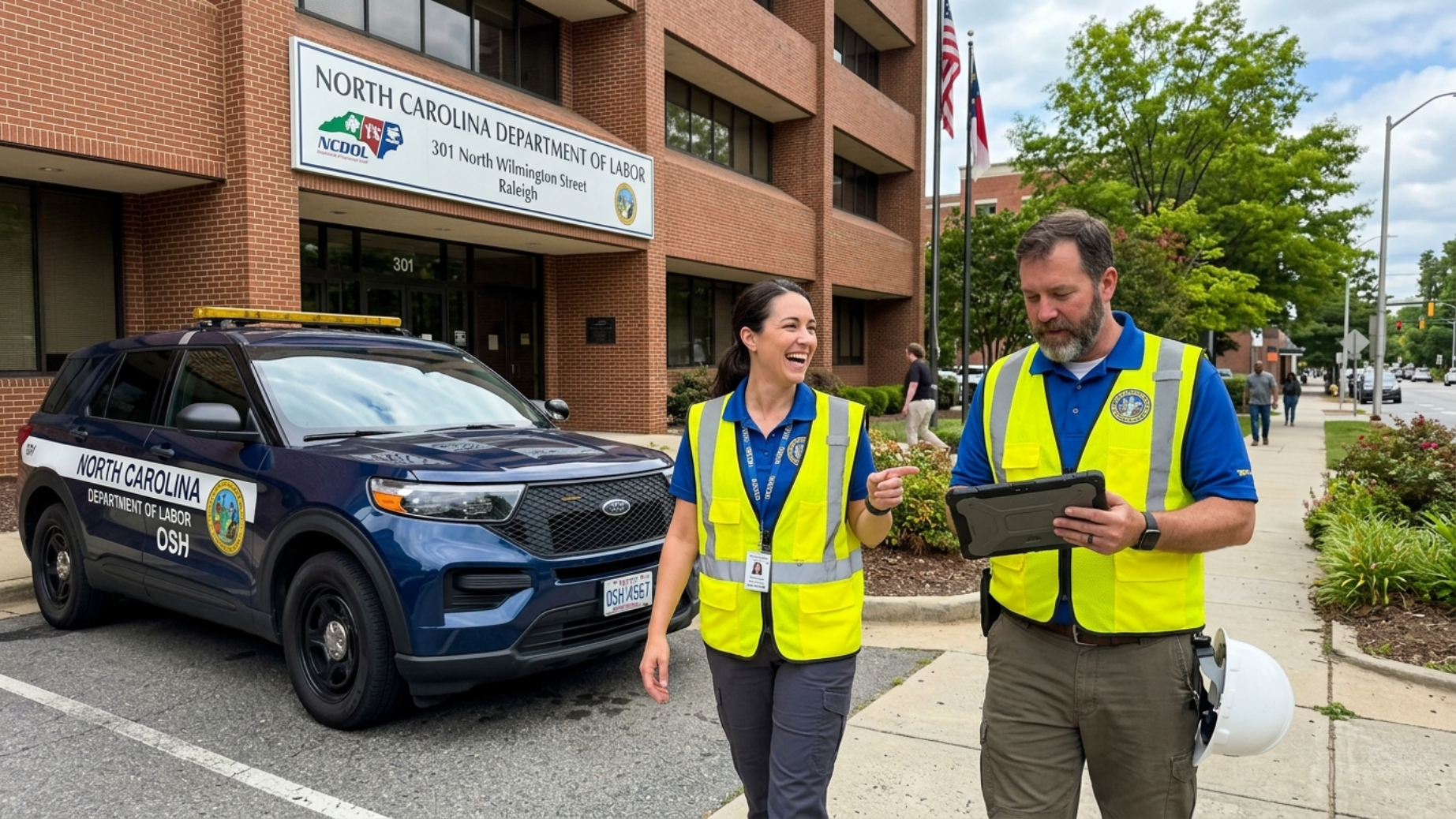
North Carolina is one of 22 OSHA-approved State Plan states that cover both private-sector and state and local government workers. With few exceptions, the NC Department of Labor adopts federal OSHA standards word for word, and maximum penalties increase every January to match federal amounts. A serious violation in Raleigh carries the same $16,550 fine as one in Houston or Chicago.
For general contractors, subcontractors, and facility managers in the Triangle, safety consulting in Raleigh, NC isn’t a luxury. It’s an operational necessity. OSHA can fine a GC for a subcontractor’s violation. A single inspection can produce multiple citations. And a poor safety record can lock you out of ISNetworld or Avetta prequalification, costing you bids before you even submit them.
Practitioners on Reddit and in industry forums consistently say that smaller companies benefit the most from outside safety consulting, because without a dedicated in-house safety department, things fall through the cracks. A consultant provides top-tier expertise without the overhead of a full-time hire.
This glossary covers the terms you’ll encounter when evaluating safety consulting firms, responding to NC OSH, or building a compliant safety program from scratch. It’s organized into four sections: regulatory and compliance terms, consulting service terms, credentials and training, and hazard and protection standards.
Understanding the return on investment that safety programs deliver starts with knowing the language.
Regulatory and Compliance Terms
OSHA (Occupational Safety and Health Administration)
The federal agency established in 1970 under the Department of Labor to ensure safe working conditions. OSHA sets standards, conducts inspections, and issues citations. In State Plan states like North Carolina, the state agency (NC OSH) handles enforcement rather than federal OSHA, though federal OSHA monitors state programs for effectiveness.
NC OSH Division
The North Carolina Occupational Safety and Health Division is the enforcement arm of the NC Department of Labor, headed by the Commissioner. It operates out of Raleigh and enforces workplace safety standards across the state for both private and public-sector employers. For Raleigh-area businesses, NC OSH is your primary regulator, not federal OSHA.
NC OSH also offers free consultative services for small and medium-sized employers. These on-site consultations are confidential and carry no risk of citations. The catch: wait times can be long, and the service doesn’t build complex safety programs or provide staffing. It’s a solid starting point, not a substitute for ongoing safety consulting in Raleigh, NC.
State Plan
A state-run occupational safety and health program approved by federal OSHA. North Carolina’s State Plan covers both private-sector and government workers. The state must adopt standards at least as protective as federal ones. In practice, NC adopts federal standards verbatim with limited exceptions.
General Duty Clause
Section 5(a)(1) of the OSH Act. This is OSHA’s catch-all: it requires employers to provide a workplace “free from recognized hazards that are causing or are likely to cause death or serious physical harm.” When no specific standard covers a hazard, inspectors cite the General Duty Clause. It’s broader than most employers realize. For a deeper explanation, read this breakdown of understanding the General Duty Clause.
OSHA Citation
A formal written notice issued after an inspector documents a violation. Citations specify the standard violated, the proposed penalty, and the abatement deadline. Employers have 15 working days to contest a citation. Missing that window means accepting the citation, the penalty, and the abatement obligation.
If your company receives a citation, knowing the 4-step process for responding to an OSHA citation can save you thousands in penalties and protect your safety record.
Serious Violation
A violation where the hazard could cause death or serious physical harm, and the employer knew or should have known about it. As of January 15, 2025, the maximum penalty is $16,550 per violation. Penalties are assessed per violation, not per inspection, so a single visit can produce tens of thousands in fines.
Willful Violation
Willful Violation: A violation the employer intentionally commits or commits with plain indifference to the law. As of January 2026, the maximum penalty is $165,514 per violation, with a minimum floor of $11,823 that applies even after reductions.
Violation Type | 2026 Max Penalty | 2026 Min Penalty |
Serious | $16,550 | N/A |
Other-Than-Serious | $16,550 | N/A |
Willful | $165,514 | $11,823 |
Repeat | $165,514 | N/A |
Failure to Abate | $16,550 per day | N/A |
Repeat Violation
A violation of the same or substantially similar standard within five years of a previous citation. Repeat violations carry the same $165,514 maximum as willful violations.
De Minimis Violation
A technical violation that has no direct relationship to safety or health. No penalty is assessed, and no abatement is required. These are rare and shouldn’t be confused with “other-than-serious” violations, which do carry penalties.
Abatement
The process of correcting a cited hazard within the deadline specified on the citation. Failure to abate can result in additional penalties of up to $16,550 per day past the deadline. Abatement verification often requires documentation, photos, or follow-up inspections.
Multi-Employer Worksite Doctrine
This is one of the most important and least understood concepts in construction safety, and no other safety consulting resource in the Raleigh NC market explains it adequately.
On multi-employer worksites, OSHA can cite more than one employer for the same hazard. The agency defines four employer types:
Creating employer: The employer that caused the hazardous condition. Citable even if only other employers’ workers are exposed.
Exposing employer: An employer whose own employees are exposed to the hazard.
Correcting employer: An employer responsible for correcting a specific hazard, usually one given responsibility for installing or maintaining safety equipment.
Controlling employer: An employer with general supervisory authority over the worksite, including the power to correct violations or require others to correct them.
General contractors almost always qualify as controlling employers. Practitioners in construction safety forums stress this point: GCs can get fined for subcontractor safety violations, and OSHA can fine both the sub and the GC for the same violation. This is a primary reason GCs in the Triangle invest in safety consulting.
Experience Modification Rate (EMR)
A multiplier applied to workers’ compensation premiums based on a company’s claims history compared to the industry average. An EMR of 1.0 is average. Below 1.0 means fewer claims than expected; above 1.0 means more.
North Carolina has a unique requirement: businesses with an EMR of 1.5 or higher must improve their workplace safety and health efforts, including establishing a safety committee. This NC-specific threshold makes EMR management a direct business concern, not just an insurance metric. Learn more about how experience rating works and why it matters for bidding and insurance costs.
OSHA 300 Log / 300A
The OSHA 300 Log is a running record of work-related injuries and illnesses. The 300A is the annual summary that must be posted in a visible location from February 1 through April 30 each year. Certain industries and employers with 10 or fewer employees are exempt, but most construction and general industry employers must maintain these records.
Informal Conference
A meeting between the employer and the OSHA area director (or NC OSH equivalent) after a citation is issued. It’s an opportunity to discuss the citation, present evidence, and potentially negotiate reduced penalties or modified abatement terms. Informal conferences must be requested within the 15-working-day contest period.
General Industry vs. Construction Standards
OSHA separates its standards into two main categories: 29 CFR 1910 (General Industry) and 29 CFR 1926 (Construction). The distinction matters because requirements differ. For example, the fall protection trigger height is 4 feet in general industry but 6 feet in construction. A safety consultant working with Raleigh-area businesses needs to know which set of standards applies, and on mixed-use sites, both may apply simultaneously.
Electronic Injury Reporting (ITA)
As of 2026, OSHA requires high-hazard industries to electronically submit injury data from Forms 300 and 301. For Raleigh businesses, the deadline for electronic submission via the Injury Tracking Application (ITA) is March 2 each year. Failure to submit is a frequent trigger for NC OSH inspections.
Special Emphasis Programs (SEP)
Targeted enforcement initiatives by the NC OSH Division. In 2026, active SEPs in Raleigh include Struck-By hazards, Amputations, and Heat Stress. If your business falls under an SEP, you are statistically more likely to receive an unannounced “programmed” inspection regardless of your incident rate.
Safety Consulting Service Terms
Safety Consulting
The practice of providing expert guidance on workplace safety compliance, hazard identification, program development, training, and regulatory response. Safety consulting in Raleigh, NC spans a wide range of engagements: one-time audits, ongoing advisory relationships, post-incident response, and everything in between.
A qualified safety consulting firm should offer credentialed professionals (CSP, CHST, or equivalent), local knowledge of NC OSH enforcement patterns, and the ability to scale from a single inspection to full program management. Experienced practitioners consistently recommend checking credentials first, then verifying field experience. Not all safety certifications carry the same weight.
Safety Audit / Mock OSHA Inspection
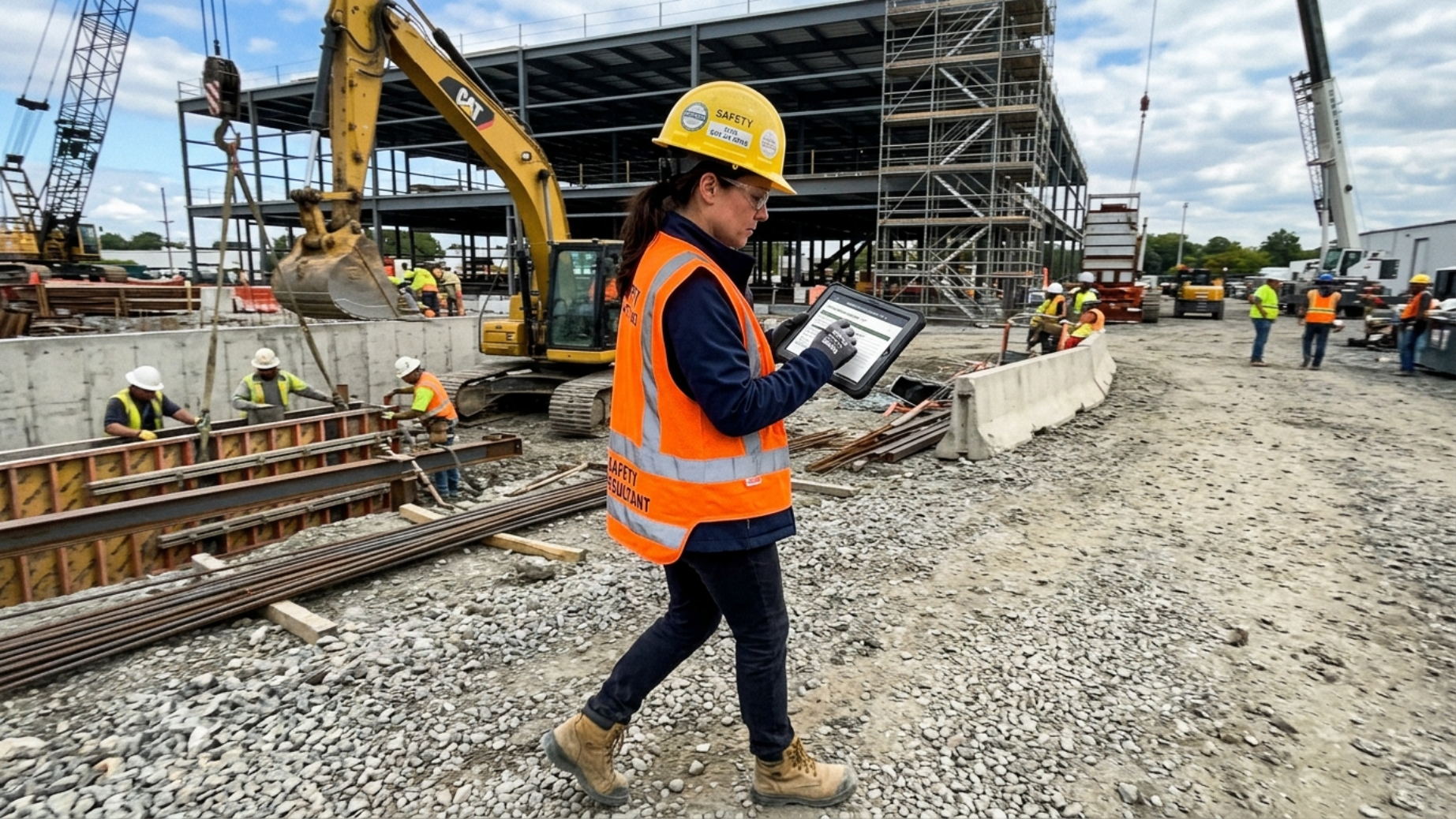
A systematic review of a workplace, jobsite, or safety program conducted to identify hazards and compliance gaps before a real inspection happens. A mock OSHA inspection follows the same protocols an inspector would use, including document review, walkthroughs, and employee interviews.
The goal is simple: find and fix problems on your terms, not OSHA’s. Companies that wonder whether their safety manual is actually OSHA-compliant often start with an audit.
Site-Specific Safety Plan (SSSP)
A written safety plan tailored to a particular project or jobsite. Many general contractors and project owners require subcontractors to submit an SSSP before work begins. It typically covers hazard analysis, emergency procedures, PPE requirements, competent person designations, and site-specific rules.
An SSSP is not a copy of your company safety manual. It addresses the unique hazards of that project, that location, and that scope of work.
Activity Hazard Analysis (AHA) / Job Hazard Analysis (JHA)
A task-level risk assessment that breaks a job into individual steps, identifies hazards at each step, and specifies controls. AHAs are standard in construction. JHAs serve the same purpose in general industry. Many GCs require AHAs for every high-risk activity before work begins.
Safety Management System (SMS)
A holistic, organization-wide framework for managing safety, not just a binder on a shelf. An SMS integrates policies, procedures, training, audits, incident investigation, and continuous improvement into a single system. It’s the difference between having a safety manual and having a safety culture. For a deeper look, explore how safety management systems impact your business.
Outsourced / Fractional Safety Director
A credentialed safety professional who serves as your company’s safety leader on a part-time or contract basis. This model is designed for small and mid-sized businesses that need senior-level safety oversight but can’t justify (or can’t find) a full-time hire.
Practitioners across construction forums note that many companies need a fractional safety person during their early growth stages and continue with the model as they scale. It provides executive-level safety leadership, program development, and regulatory response without a six-figure salary.
If you’re considering this model, the guide on fractional safety director scope and cost covers what to expect. You can also review the outsourced safety department benefits checklist to see how it compares to hiring internally.
Safety Staffing
Placing credentialed safety professionals on a client’s jobsite or facility for a defined period, from a few days to several months or longer. Safety staffing solves the speed problem: when you win a project that requires on-site safety presence and you don’t have anyone available, a staffing firm fills the gap.
The key differentiator among staffing providers is speed and credential quality. Some firms in the Raleigh market place professionals within 48 hours. Others take a week or more. When evaluating options, the construction safety staffing guide breaks down what to look for.
Incident Investigation
A structured process for determining the root cause of a workplace accident, near-miss, or injury. OSHA requires employers to investigate incidents, and the findings feed into corrective actions that prevent recurrence.
Good incident investigation goes beyond “the worker didn’t follow the rules.” It examines system failures, training gaps, equipment deficiencies, and management factors. A safety consultant experienced in incident investigation can also help manage the OSHA 300 Log entries and any resulting regulatory response.
Expert Witness (Safety)
A qualified safety professional who provides testimony in litigation, typically in personal injury, wrongful death, or OSHA contest cases. Expert witnesses must have credentials, field experience, and the ability to explain complex safety standards to judges and juries. This is a specialized service that sits at the far end of the safety consulting spectrum.
ISNetworld / Avetta Prequalification
Third-party contractor management platforms that hiring clients (owners, GCs, large operators) use to verify safety records, insurance, training, and compliance before awarding contracts. ISNetworld alone has over 90,000 active contractors and suppliers.
Here’s why this matters for safety consulting in Raleigh, NC: ISNetworld automatically uploads any OSHA citations, which directly affect your grade. A poor safety record doesn’t just cost you fines. It locks you out of work. Many contractors seek safety consulting specifically to build and maintain the programs, records, and metrics these platforms evaluate.
The prequalification process can be time-consuming and confusing. Firms that specialize in ISNetworld setup and Avetta compliance help contractors get qualified and stay qualified.
Credentials and Training Terms
CSP (Certified Safety Professional)
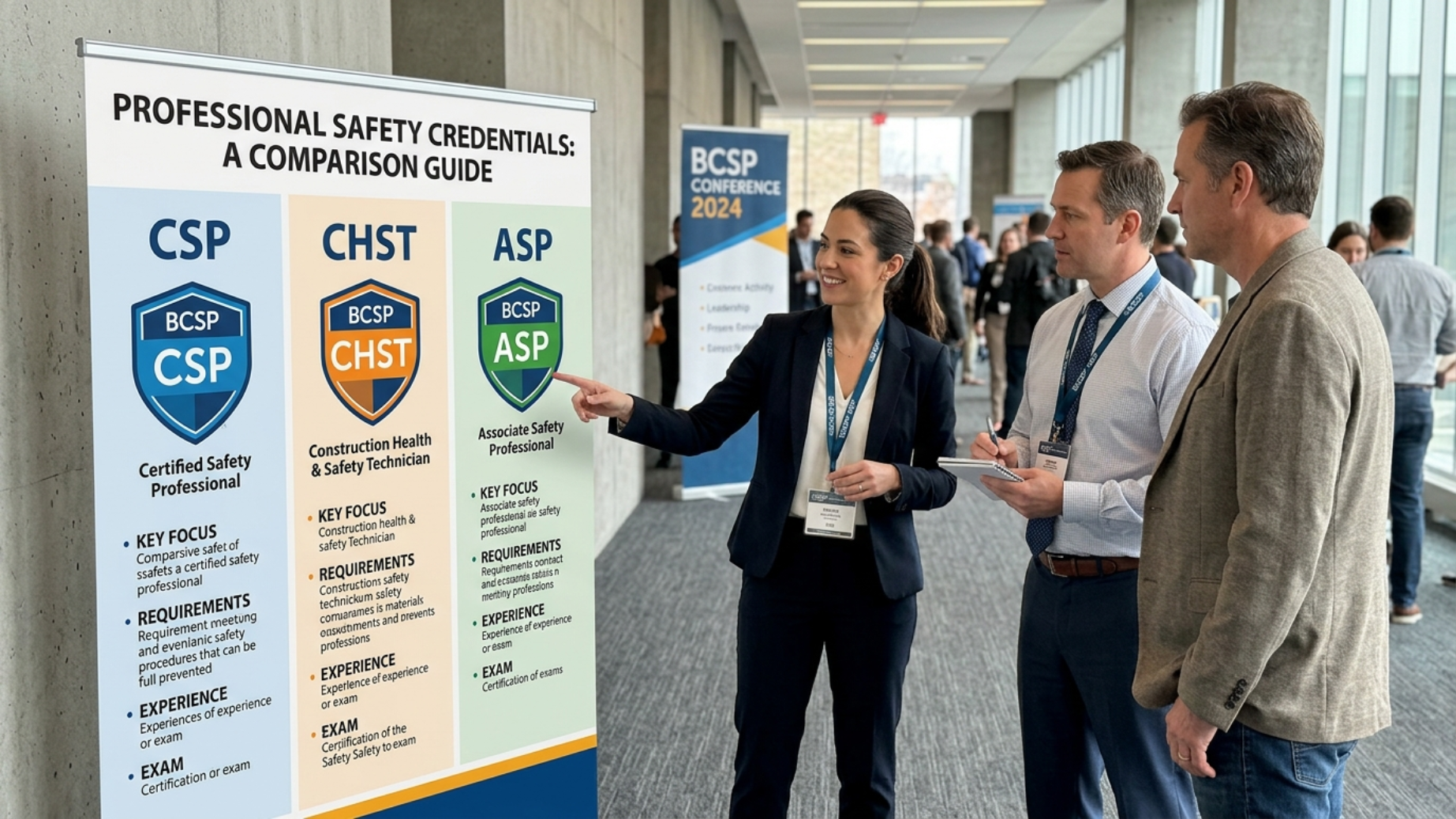
The gold standard in safety certification, accredited under ISO/IEC 17024 and held by over 24,000 active professionals. Earning a CSP requires a bachelor’s degree, at least four years of professional safety experience, and passing a comprehensive exam administered by the Board of Certified Safety Professionals.
When evaluating safety consulting firms in Raleigh, NC, the presence of CSP-credentialed professionals on staff is a strong indicator of depth. Practitioners across LinkedIn and industry forums consistently place the CSP at the top of the credential hierarchy for complex projects.
CHST (Construction Health and Safety Technician)
A credential designed for field-level safety practitioners in construction. The CHST requires three years of construction safety experience and passing the BCSP exam, but unlike the CSP, it has no degree requirement.
This distinction matters: the CHST is not a lesser version of the CSP. It targets a different career stage and role. Many experienced field safety professionals spend entire careers at the technician level without needing or wanting the CSP. When a consulting firm staffs a jobsite, the person walking the site daily is often a CHST holder.
ASP (Associate Safety Professional)
A stepping-stone credential on the path to the CSP. The ASP requires a bachelor’s degree and passing the ASP exam. It demonstrates foundational safety knowledge and commitment to the profession, though it does not carry the same weight as the CSP for senior advisory roles.
OSHA 500 / OSHA 501
Trainer authorization courses. OSHA 500 authorizes the holder to teach OSHA 10-hour and 30-hour courses in construction. OSHA 501 does the same for general industry. These are valuable and widely recognized, but they authorize training delivery rather than serving as broad safety credentials.
OSHA 10-Hour / 30-Hour Training
Worker-level (10-hour) and supervisor-level (30-hour) safety training programs developed by OSHA. Completion results in a wallet card, not a certification. Many GCs and owners require OSHA 10 or 30 cards as a condition of site access. While these courses provide solid foundational knowledge, they do not make someone a “certified” safety professional.
NCCER (National Center for Construction Education and Research)
An accredited training and certification body for construction craft professionals. NCCER programs cover everything from ironworking to electrical safety, with standardized curricula recognized across the industry. Firms with NCCER Accredited Training Unit status can deliver NCCER-certified instruction directly, which matters for companies that need training records their clients and prequalification platforms will accept.
Competent Person
An OSHA-defined term for someone who can identify existing and predictable hazards in the surroundings or working conditions and who has the authority to take prompt corrective action. OSHA requires a designated competent person for specific activities including excavation, scaffolding, fall protection, and confined space entry. This isn’t a certification you earn. It’s a role you’re designated to fill, backed by training and demonstrated knowledge.
OSHA Activity | Competent Person Required? | Standard Reference |
Excavation/Trenching | Yes | 29 CFR 1926.651 |
Scaffolding | Yes | 29 CFR 1926.451 |
Fall Protection | Yes | 29 CFR 1926.502 |
Confined Space | Yes | 29 CFR 1926.1203 |
Bilingual Safety Training
Safety training delivered in both English and Spanish (or other languages spoken by the workforce). OSHA requires that training be delivered in a language workers can understand. On construction sites across the Raleigh-Durham area, a significant portion of field crews are Spanish-speaking. Providing bilingual training isn’t just good practice. It’s a compliance requirement.
Safety consulting firms that employ bilingual staff can deliver toolbox talks, formal training, and site orientations without relying on informal translation, which often introduces errors and compliance risk.
Hazard and Protection Terms
Fall Protection
The number one most-cited OSHA standard, year after year. In construction (29 CFR 1926), fall protection is required at heights of 6 feet or more. In general industry (29 CFR 1910), the trigger is 4 feet. Fall protection systems include guardrails, safety nets, and personal fall arrest systems.
For a look at how fall protection fits into the broader citation picture, the breakdown of top OSHA construction violations provides useful context.
Hazard Communication (HazCom)
The OSHA standard (29 CFR 1910.1200) requiring employers to inform workers about chemical hazards in the workplace. HazCom requires Safety Data Sheets (SDS) for every hazardous chemical on-site, proper labeling, and worker training. The Globally Harmonized System (GHS) governs the format. For a complete overview, see this guide to OSHA hazard communication standards.
Lockout/Tagout (LOTO)
The standard (29 CFR 1910.147) requiring procedures to isolate hazardous energy sources during maintenance and servicing of equipment. LOTO prevents unexpected startup, which is one of the leading causes of serious injuries in manufacturing and industrial facilities. Every machine with stored energy needs a written LOTO procedure.
Confined Space
A space large enough to enter, with limited means of entry or exit, and not designed for continuous occupancy. Permit-required confined spaces also have a recognized serious hazard (atmospheric, engulfment, entrapment, or other). Entry into permit-required confined spaces demands a written program, atmospheric monitoring, attendant presence, and rescue planning.
PPE (Personal Protective Equipment)
Equipment worn to minimize exposure to workplace hazards: hard hats, safety glasses, gloves, high-visibility vests, fall harnesses, respirators, and more. OSHA requires employers to assess the workplace, determine what PPE is necessary, provide it at no cost to employees, and train workers on proper use.
North Carolina is fully enforcing the updated OSHA PPE Fit Rule (effective late 2025/early 2026), which mandates that PPE must properly fit each individual employee. Standardized “one-size-fits-all” inventory no longer meets compliance for diverse workforces.
Scaffolding Safety
One of the most frequently cited OSHA standards in construction. Requirements cover erection, dismantling, inspection, load capacity, guardrails, access, and competent person oversight. Scaffold-related violations regularly appear in OSHA’s annual top 10 list.
Struck-By Hazards
Injuries caused by flying, falling, swinging, or rolling objects. North Carolina has implemented a special emphasis program (SEP) specifically targeting struck-by prevention. This means NC OSH inspectors are actively looking for struck-by hazards during inspections across the state, and Raleigh-area jobsites are no exception. Common struck-by scenarios include workers hit by vehicles, falling tools or materials, and swinging crane loads.
Heat Illness Prevention
A growing enforcement priority at both the federal and state level. OSHA has proposed a federal heat rule that would establish specific requirements for heat exposure, including water, rest, shade, and acclimatization protocols. Even before the final rule takes effect, OSHA cites heat-related hazards under the General Duty Clause. North Carolina summers make this especially relevant for Raleigh-area construction and outdoor work.
Putting It All Together: From Glossary to Action
Knowing these terms puts you ahead of most employers in the Raleigh market. But knowledge without action is just vocabulary. The companies that avoid citations, win bids, and keep their EMR below 1.0 are the ones that turn these concepts into daily practice.
That requires the right people. When evaluating any safety consulting firm in Raleigh, NC, check for CSP and CHST credentials, verify field experience in your industry, confirm they understand NC OSH enforcement patterns, and make sure they can deliver training in the languages your crews speak.
Whether you need a one-time audit, ongoing fractional safety leadership, or a credentialed professional on your jobsite by Friday, the ESR services page outlines the full range of workplace safety consulting services available to Raleigh-area employers, with no travel charges within 50 miles of the Raleigh office.
Frequently Asked Questions
Does North Carolina follow federal OSHA standards?
Yes. North Carolina operates an OSHA-approved State Plan through the NC OSH Division, which is part of the NC Department of Labor. With limited exceptions, NC adopts federal OSHA standards verbatim. Penalties match federal maximums and increase annually. The NC OSH Division handles inspections and enforcement rather than federal OSHA.
How much can OSHA fine my business in North Carolina?
As of January 2025, the maximum penalty for a serious violation is $16,550 per violation. Willful or repeat violations can reach $165,514 per violation, with a minimum floor of $11,524 for willful violations. A single inspection can produce multiple citations, each carrying its own penalty. Businesses with 25 or fewer employees may qualify for penalty reductions of up to 70%.
What is the multi-employer worksite doctrine, and why should GCs care?
On multi-employer worksites, OSHA can cite more than one employer for the same hazard. General contractors typically qualify as “controlling employers” because they have supervisory authority over the site. This means a GC can be fined for a subcontractor’s violation even if no GC employees were exposed. This doctrine is a primary reason general contractors in the Raleigh construction market invest in safety consulting.
What credentials should I look for in a safety consultant?
The CSP (Certified Safety Professional) is considered the gold standard for senior advisory and complex projects. The CHST (Construction Health and Safety Technician) is the primary credential for experienced field safety personnel. OSHA 500/501 authorizations matter for training delivery. Look for firms whose staff hold multiple credentials and have actual field experience in your industry, not just classroom knowledge.
What is an Experience Modification Rate, and why does it matter in NC?
Your EMR is a multiplier on your workers’ compensation premiums based on your claims history versus the industry average. In North Carolina, businesses with an EMR of 1.5 or higher are required by law to take steps to improve workplace safety, including forming a safety committee. Beyond the legal requirement, a high EMR increases your insurance costs and can disqualify you from bidding on certain projects.
Do small businesses really need safety consulting in Raleigh, NC?
Small companies often benefit the most. Without a dedicated safety department, compliance gaps develop quickly, and a single OSHA citation can cost more than a year’s worth of consulting fees. Fractional or outsourced safety director arrangements give small businesses access to senior-level safety expertise at a fraction of the cost of a full-time hire.
What is ISNetworld, and how does it connect to safety consulting?
ISNetworld is a third-party contractor prequalification platform used by over 90,000 contractors and suppliers. Hiring clients use it to verify your safety programs, training records, EMR, and OSHA citation history before awarding work. ISNetworld automatically uploads any OSHA citations, which directly impact your grade. Maintaining strong safety programs through consulting isn’t just about avoiding fines. It protects your ability to win work.
Does NC offer free safety consultations?
Yes. The NC OSH Consultative Services program offers free, confidential on-site assessments for small and medium-sized employers. No citations result from these visits. However, wait times can be significant, and the service doesn’t build complex safety programs, provide ongoing advisory support, or staff safety professionals on your jobsite. It’s a useful starting point, not a comprehensive solution.