
TL;DR
ISNetworld is a third-party contractor management platform used by over 900 hiring clients to verify your safety, insurance, and operational compliance before you set foot on a jobsite. Your ISNetworld grade depends on a weighted combination of written safety programs (RAVS), safety metrics like TRIR and DART, insurance documentation, and questionnaire responses. Setting up an account on your own typically takes 3 to 6 months, and annual fees start around $875 for the smallest companies. This glossary breaks down every term, acronym, and scoring component so you can stop guessing and start passing.
2026 Quick Summary: How to Get ISNetworld Compliant
To become ISNetworld compliant, contractors must pass a multi-stage verification process involving safety programs, insurance, and incident data.
Primary Grading Factors: Written Safety Programs (RAVS
), TRIR/DART safety metrics, and EMR (Experience Modification Rate).2026 Cost: Subscriptions start at $875/year for small firms; mid-sized contractors pay between $1,700 and $5,000.
Compliance Timeline: DIY setup typically takes 3 to 6 months; professional consultants can reduce this to 3–10 business days.
Passing Grade: Most hiring clients require a letter grade of ‘A’ or ‘B’ for jobsite eligibility.
Getting told to “get ISNetworld compliant” with zero explanation of what that actually means is a shared frustration among contractors in construction, oil and gas, manufacturing, and utilities. You’re handed a login, a deadline, and a list of acronyms nobody bothered to define.
This guide exists to fix that. Below you’ll find every ISNetworld term you need to know, what it means for your grade, and where contractors commonly get stuck. If you’re searching for ISNetworld help for contractors, understanding the vocabulary is step one. Everything else, from document uploads to passing scores, flows from knowing what the platform is actually asking you to do.
ISNetworld Platform Basics
ISNetworld (ISN)
ISNetworld, often abbreviated ISN, is a third-party contractor management platform. Hiring clients (the companies that want to hire you) use it to verify that their contractors and suppliers meet specific safety, insurance, and operational standards. The platform serves roughly 900 hiring clients and over 90,000 contractors and suppliers, covering more than 14 million individuals at 18,000+ jobsites across 85+ countries.
The core value proposition for contractors is supposed to be efficiency: you submit your information once, and every hiring client on the platform can view it. In theory, this reduces the duplicative paperwork of qualifying separately with each client. In practice, the platform has a steep learning curve and can feel like it was designed for the hiring client’s benefit, not yours.
Hiring Client / Owner Client
These terms are used interchangeably. A hiring client (also called an owner client) is the company that requires you to join ISNetworld as a condition of doing business with them. They set the compliance criteria, choose which documents they want to see, and decide the grading thresholds you must meet. You don’t get a vote in this process.
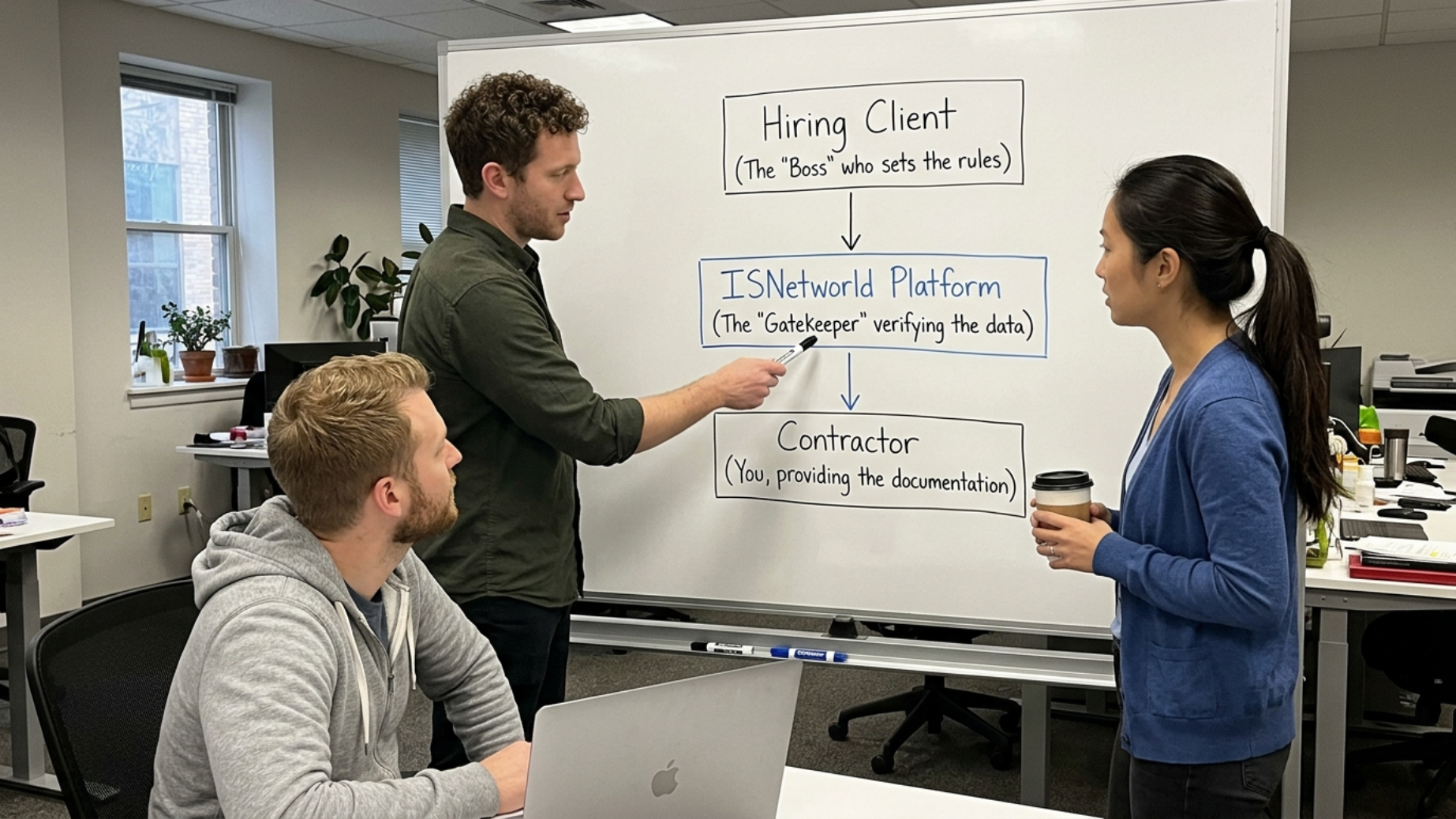
One critical detail: each hiring client can weight the grading components differently. You could have an A with one client, a B with another, and a C with a third, all based on the same underlying account data.
Contractor Client
That’s you. Your company’s role on the platform. You’re the one uploading documents, answering questionnaires, paying fees, and watching your grade fluctuate.
Subscription Fee and Setup Fee
Contractors pay an annual subscription fee plus a one-time account setup fee per country. Pricing is based on your three-year average employee count. For the smallest companies, fees typically start around $875 per year. Mid-sized commercial contractors generally pay between $1,700 and $5,000 annually.
For small contractors working with multiple general contractors who each use a different prequalification platform, the combined annual cost across ISNetworld, Avetta, and others can easily exceed $5,000 before a single bid is submitted. That’s real money, especially when the platform feels like an obstacle rather than a tool.
Reinstatement Fee
If your ISNetworld subscription lapses (you miss a renewal), you may face a reinstatement fee on top of your normal subscription cost. Letting your account lapse also means your grade disappears from hiring clients’ dashboards, which can disrupt active projects and damage relationships.
Dashboard / Scorecard
Your ISNetworld dashboard is where your compliance grade lives. It shows your letter grade (A through F) for each hiring client, along with the underlying documentation status. Think of it as your report card, visible in real time to every hiring client connected to your account.
Third-Party Administrator (TPA)
A TPA in the ISNetworld context is a consultant or firm that manages your ISN account on your behalf. They handle document uploads, questionnaire responses, RAVS submissions, insurance coordination, and ongoing monitoring. What commonly takes contractors 3 to 6 months to navigate on their own, a qualified TPA can often accomplish in days.
If your company doesn’t have a dedicated safety professional, an outsourced safety department can serve this function while also handling your broader safety program needs.
The MSQ and Questionnaires
MSQ (Management System Questionnaire)
The Management System Questionnaire is ISNetworld’s standardized questionnaire that appears in every contractor account. Hiring clients use your MSQ responses to evaluate your business operations, safety management practices, and administrative capabilities.
Here’s what intimidates most contractors: the MSQ can contain anywhere from 800 to 2,000 questions depending on how many hiring clients you have and what services you’ve indicated you provide. The MSQ accounts for roughly 10 to 15% of your overall ISN grade.
A common mistake is overstating your services or trades on the MSQ. If you say you do confined space work, you’ll trigger additional program requirements for confined space entry, rescue plans, and related training documentation. Only claim what you actually do.
For a deeper look at how your safety management structure feeds into questionnaire responses like these, assessments, audits, and continuous improvement explains the framework that ISNetworld is ultimately trying to evaluate.
EHS Questionnaire
Some hiring clients include additional Environment, Health, and Safety questions within or alongside the MSQ. These are client-specific and reflect that particular company’s risk priorities. You may see questions about drug testing policies, environmental management, or specific hazard controls relevant to their industry.
Gap Report
A gap report identifies missing or incomplete MSQ answers measured against a specific hiring client’s requirements. When you connect with a new hiring client, ISNetworld generates a gap report showing exactly what you still need to provide. It’s your to-do list, essentially. Ignoring it is one of the fastest ways to stall at a low grade.
RAVS and Written Safety Programs
RAVS (Review and Verification Services)
RAVS is ISNetworld’s system for reviewing the written safety programs you upload. ISN reviewers check whether your documents meet both OSHA regulatory requirements and the specific standards each hiring client has set. RAVS typically accounts for 30 to 40% of your grade, making it the single largest scoring component.

Each RAVS review cycle takes 10 to 15 business days. If your submission is rejected, you fix the issues and resubmit, which restarts that clock. Multiple rejections can push your qualification timeline out by months. Contractors on forums consistently identify this as one of the most frustrating bottlenecks in the entire process.
I-RAVS (Insurance RAVS)
I-RAVS is the insurance certificate review process, and it’s the number one compliance bottleneck according to practitioners who help contractors with ISNetworld setup. Your Certificate of Insurance must match your ISNetworld registration exactly, including company name, coverage limits, and specific endorsement language.
Common rejection reasons include:
The contractor name on the ISNetworld registration doesn’t match the name on the insurance certificate (even minor differences like “LLC” vs. “L.L.C.”)
Missing a clause about notifying the hiring client of policy cancellations or changes
Insufficient coverage limits for a specific hiring client’s requirements
One particularly painful scenario reported by users on review platforms: a contractor uploads renewed insurance documents on time, but ISNetworld drops their grades from A to F across all clients and notifies those clients before the review is complete. Even though nothing changed and the documents were in the system, the temporary grade drop can damage client relationships.
Top 5 Reasons for ISNetworld Rejection in 2026
Entity Mismatch: The company name on your COI must match your ISN profile exactly (e.g., “Company, LLC” vs. “Company LLC”).
Missing Waiver of Subrogation: Failing to include specific endorsement language required by the individual hiring client.
Generic Safety Manuals: Uploading “template” safety programs that haven’t been customized to your specific NAICS code.
Signature Failures: Uploading the OSHA 300A without the required executive signature or before the data is finalized.
Inadequate Policy Notice: Most clients require a 30-day notice of cancellation clause; standard policies often default to 10 days.
T-RAVS (Training Review and Verification Services)
T-RAVS is not required for every contractor, but if your hiring client has requested it, you must provide proof that your employees have completed specific training. This could include OSHA 10-Hour or 30-Hour courses, fall protection training, hazard communication, or other topics listed in the T-RAVS section of your account.
For an overview of what training OSHA actually requires, see this guide on OSHA training requirements. Knowing the regulatory baseline helps you distinguish between what’s legally required and what a specific hiring client has added on top.
If your field crews include Spanish-speaking workers, training documentation should reflect that reality. Bilingual training records strengthen your T-RAVS submission and demonstrate that your safety program actually reaches the people doing the work.
Written Safety Programs
These are the documents you upload for RAVS review: fall protection plans, hazard communication programs, confined space entry procedures, lockout/tagout programs, and others depending on your scope of work. ISNetworld requires these to be customized to your operations.
One of the most common mistakes is uploading a generic safety program downloaded from the internet or borrowed from another company. ISN reviewers will reject cookie-cutter programs, and even if a generic document somehow passes review, it won’t hold up during a field audit. If your safety manual hasn’t been reviewed recently, it’s worth confirming that your safety manual is actually OSHA compliant before uploading anything to ISNetworld.
A specific example: your hazard communication program must reflect your actual chemical inventory and workplace conditions, not a template list of chemicals you’ve never used.
RAVS Review Cycle
The 10 to 15 business day review window per submission. Plan for at least two rounds if you’re doing this yourself. Budget three rounds if your safety programs haven’t been professionally developed. Each rejection comes with reviewer comments explaining what needs to change, but the feedback can be vague, which is part of why contractors find the process so maddening.
Safety Metrics That Drive Your Grade
These numbers carry real weight. Your safety statistics make up roughly half your ISNetworld grade, and unlike written programs (which you can revise and resubmit), your incident history is what it is.
TRIR (Total Recordable Incident Rate)
TRIR measures the number of OSHA-recordable incidents per 100 full-time employees during a calendar year. The formula:
TRIR = (Number of recordable incidents × 200,000) ÷ Total hours worked
TRIR accounts for approximately 30% of your ISNetworld grade. Most hiring clients set maximum TRIR thresholds between 1.0 and 2.0, depending on their industry and risk tolerance. For context, the 2024 BLS average TRIR for construction was 2.3 per 100 full-time equivalent workers, meaning many contractors in the industry are above what hiring clients consider acceptable.
ISNetworld uses a 3-year rolling average, so a single bad year will haunt your grade for three years.
As of 2026, many high-risk hiring clients have lowered their acceptable TRIR threshold to 1.5, making it stricter than the 2.3 BLS average.
DART (Days Away, Restricted or Transferred)
DART narrows the lens to more serious injuries, specifically those resulting in days away from work, job restrictions, or job transfers. The formula is the same structure as TRIR but uses only DART-qualifying cases.
DART accounts for roughly 20% of your ISNetworld grade. Because it measures severity rather than just frequency, a single serious injury hits this metric harder than TRIR.
EMR (Experience Modification Rate)
EMR is a factor developed by insurance rating bureaus (like NCCI) that compares your workers’ compensation claim history to companies of similar size in your industry. An EMR of 1.0 means you’re average. Below 1.0 is better than average. Above 1.0 is worse.
For ISNetworld purposes, an EMR above 1.1 will hurt your grade. EMR accounts for roughly 10 to 15% of your compliance score. For a deep dive on how experience ratings work and why they matter beyond ISNetworld, see this explanation of experience modification rates.
OSHA 300 Log and OSHA 300A
Setting up your ISNetworld account requires providing your OSHA 300 logs (the detailed injury and illness records) for the past three years if you’re a U.S.-based company. ISNetworld uses this data to calculate your TRIR, DART, and other safety metrics.
Accuracy matters enormously here. Incorrectly recorded incidents can inflate your rates, and underreporting creates legal risk if the records are ever audited. OSHA has been expanding submission requirements for injury and illness records, so getting your 300 logs right serves double duty.
BLS (Bureau of Labor Statistics) Benchmarks
ISNetworld compares your safety rates against industry averages published by the Bureau of Labor Statistics. If your TRIR is 3.0 and the BLS average for your industry is 2.3, your grade reflects that you’re performing worse than your peers. These benchmarks are updated annually.
NAICS Code
Your North American Industry Classification System code determines which BLS benchmarks ISNetworld uses to evaluate you. Make sure your NAICS code accurately reflects your primary work. A misclassified NAICS code means your safety stats are being compared against the wrong industry, which could help or hurt you unfairly.
Insurance and Compliance Documentation
COI (Certificate of Insurance)
Your COI is issued by your insurance company or broker and verifies the existence and terms of your coverage. ISNetworld requires this document to match your registration details exactly. Company name, coverage types, policy limits, and effective dates all get scrutinized during the I-RAVS review.
Coordinate with your insurance broker before uploading. Many brokers are familiar with ISNetworld requirements, but you need to explicitly tell them what the platform needs. Don’t assume they’ll know.
Waiver of Subrogation
A waiver of subrogation is endorsement language that prevents your insurer from seeking reimbursement from the hiring client after paying a claim on your behalf. Many hiring clients require this language on your COI. It’s one of the most common rejection triggers because it requires a specific endorsement on your policy, not just a mention on the certificate.
Additional Insured Endorsement
Hiring clients often require that they be listed as an additional insured on your general liability policy. This gives them certain protections under your coverage. Like the waiver of subrogation, this needs to be set up through your insurance broker before your COI is issued.
Policy Cancellation Notice
Your COI must include language specifying how much advance notice will be given if your policy is cancelled or materially changed. Different hiring clients may require different notice periods (30 days is common). Missing this language is another frequent rejection reason during I-RAVS review.
Grades, Scores, and What They Mean
ISNetworld Grade (A through F)
Once all your documents are uploaded and reviewed, ISNetworld assigns a letter grade. Most hiring clients require an A or a B to keep you eligible for work. A C or below is a red flag, and depending on the client, it can get you removed from a project.
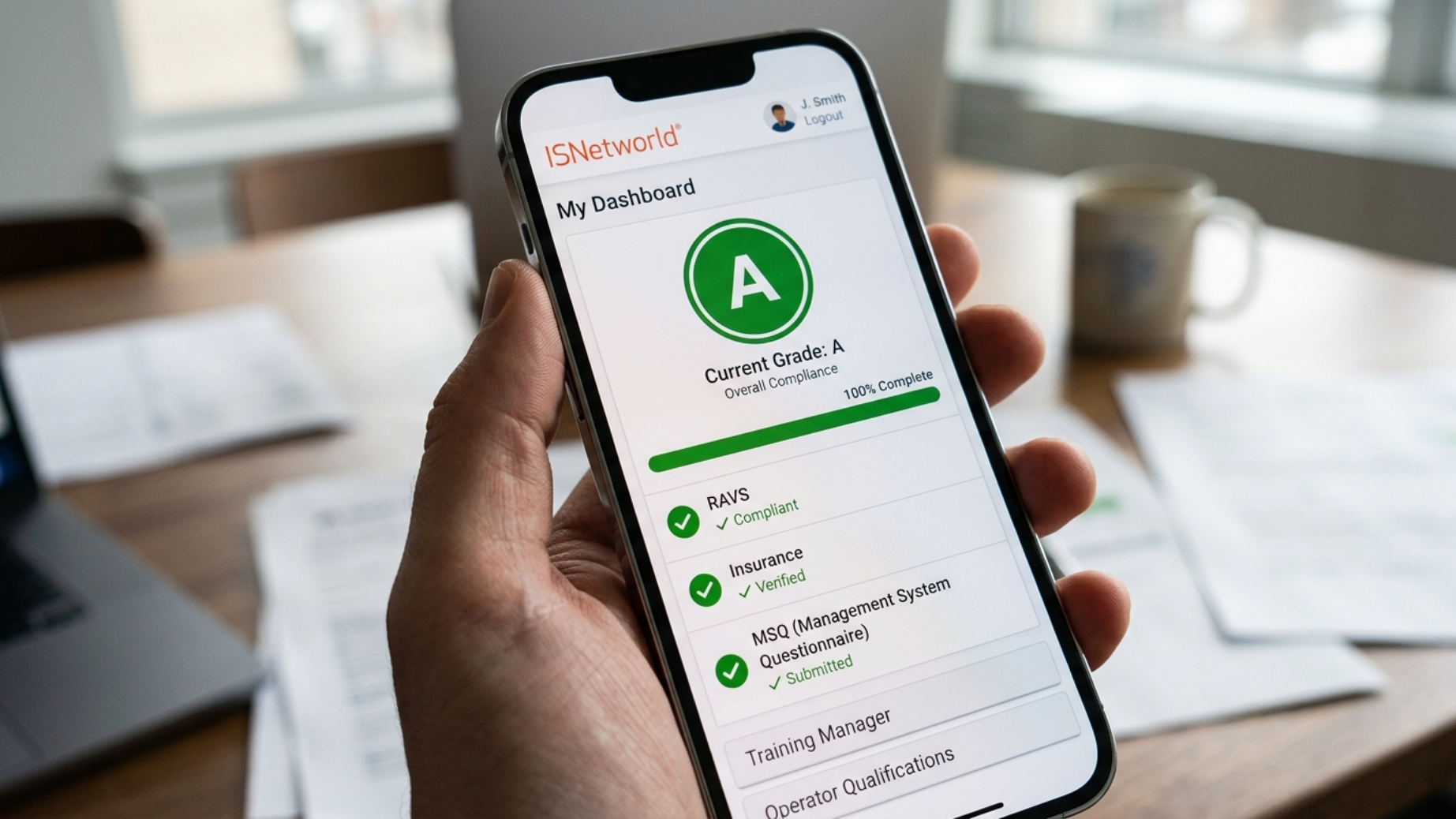
Your grade is visible to hiring clients in real time. There’s no hiding behind a pending review.
Here’s the approximate breakdown of what drives your grade (keeping in mind that each hiring client can adjust these weights):
Component | Weight (Approx.) | What it Measures |
RAVS | 30% – 40% | Compliance of your safety manual with OSHA and client standards. |
TRIR (3-Year Average) | ~30% | Total Recordable Incident Rate compared to BLS industry averages. |
DART Rate | ~20% | Severity of injuries (Days Away, Restricted, or Transferred). |
MSQ | 10% – 15% | Management System Questionnaire (800+ operational questions). |
EMR Score | 10% – 15% | Experience Modification Rate from your insurance carrier. |
Citations (OSHA/EPA) | 10% – 20% | Recorded federal/state safety violations within the last 3 years. |

Compliance Score
Behind the letter grade sits a numerical compliance score. This is the weighted calculation that produces your A, B, C, D, or F. Different hiring clients weight the components differently, which is why your grade can vary from one client to the next even though all the underlying data is the same.
Corrective Action
When ISNetworld or a hiring client flags a documentation gap, safety performance issue, or policy deficiency, you may be required to submit a corrective action plan. This is a written response explaining what happened, what you’re doing to fix it, and how you’ll prevent recurrence.
Federal Citation Search
ISNetworld automatically searches OSHA and EPA databases for citations against your company. Federal citations impact 10 to 20% of your grade, and they’re pulled directly from public records, so there’s no way to omit them.
If you’ve received an OSHA citation, understanding the 4-step response process can help you address it properly, both for OSHA’s purposes and for minimizing the damage to your ISNetworld grade. Companies that need professional guidance through this process may benefit from an OSHA citation response consultant who can manage the response while keeping your ISNetworld standing in mind.
“Note: As of January 2026, the maximum OSHA penalty for willful or repeated violations has increased to $165,514 per violation. These costs directly impact your financial risk assessment within the platform.”
Prequalification Beyond ISNetworld
Prequalification
Prequalification is the broader process of proving to a hiring client that your company meets their safety, insurance, financial, and operational standards before you’re allowed to perform work. ISNetworld is one platform that facilitates this process, but it’s not the only one.
Avetta
Avetta is a competing contractor management platform widely used in construction, telecommunications, and manufacturing. It places more emphasis on sustainability and workforce data compared to ISNetworld. The interface and requirements differ, but the underlying concept is the same: prove you’re qualified.
Veriforce
Veriforce is another competitor, heavily used in the pipeline and oil and gas sectors. It includes field audit tie-ins that ISNetworld doesn’t offer, making it more operationally integrated for certain industries.
Managing Multiple Platforms
Contractors don’t choose which platform to use. Your hiring client makes that decision. If you work with multiple clients across different industries, you may find yourself maintaining accounts on ISNetworld, Avetta, Veriforce, and others simultaneously. This is a significant administrative burden, especially for small and mid-size companies without dedicated compliance staff.
Getting Help: When to Bring in a Professional
The DIY Reality
The timeline data is stark: contractors navigating ISNetworld setup on their own commonly report the process taking 3 to 6 months. Each RAVS rejection adds 10 to 15 business days. Insurance rejections add more. Meanwhile, you’re paying your subscription fee and potentially missing project opportunities.
With professional help, that same process can be compressed to days, not months.
Feature | DIY Approach | Professional Consultant |
Time to Completion | 3 – 6 Months | 3 – 10 Business Days |
Success Rate | High Rejection (First Pass) | 95%+ First-Pass Approval |
Customization | Often Template-Based | OSHA-Compliant & Site-Specific |
Monitoring | Reactive (Catch errors late) | Proactive (Daily Dashboard Monitoring) |
Safety Compliance Consultant
A safety compliance consultant (in the ISNetworld context) is a firm or professional who manages your ISN account, writes or revises your safety programs, handles RAVS submissions, coordinates insurance documentation, and monitors your account for ongoing compliance.
Not all consultants are equal. Look for professionals with credentials like CSP (Certified Safety Professional), CHST (Construction Health and Safety Technician), or ASP (Associate Safety Professional). These designations indicate formal training in safety management, not just familiarity with the ISNetworld upload process.
Be wary of consultants who offer cheap, downloadable template safety programs. Although a template might pass RAVS review initially, it won’t reflect your actual operations and will fail an audit. A professional consultant provides customized safety plans and advises on implementation so that your safety record, not just your ISNetworld grade, improves.
Account Maintenance
Getting set up and earning a passing grade is the sprint. Maintaining compliance is the marathon, and many practitioners say it’s actually harder. Your account needs monitoring at least monthly to catch expired insurance documents, new hiring client requirements, OSHA citation postings, and grade fluctuations.
The most painful version of this: a contractor’s insurance renews, they upload the new documents promptly, but ISNetworld drops their grade to F across all clients while the documents sit in the review queue. If nobody is watching the dashboard, you might not know until a hiring client calls asking why you’re suddenly non-compliant.
For contractors who can’t justify a full-time safety hire, a fractional safety director can own ISNetworld compliance as part of their broader safety oversight role. This gives you credentialed, ongoing coverage without the cost of a full-time employee.
When Speed Matters
Sometimes a hiring client needs you on a jobsite next week, and your ISNetworld account is a mess. Or you need a site-specific safety plan written before a project kicks off. In these situations, having access to credentialed safety professionals who can mobilize quickly is the difference between winning work and watching it go to a competitor. ESR’s team holds CSP, CHST, OSHA 500/501, and NCCER credentials, and the firm maintains a 48-hour average placement timeline for construction safety staffing needs nationwide.
Frequently Asked Questions
How much does ISNetworld cost?
Annual subscription fees start around $875 for the smallest companies and range from $1,700 to $5,000 for mid-sized commercial contractors. Pricing is based on your three-year average employee count. There’s also a one-time setup fee. If your subscription lapses, expect a reinstatement fee on top of the normal renewal.
How long does it take to get ISNetworld certified?
Doing it yourself, plan for 3 to 6 months. Each RAVS review cycle takes 10 to 15 business days, and most contractors face at least one or two rejections. With professional help from a qualified consultant, the same process can be completed in 3 to 10 business days depending on the complexity of your account.
Can I use my current safety manual for RAVS?
Maybe, but probably not without revisions. Generic or template safety programs are one of the most common reasons for RAVS rejection. Your programs need to be customized to your specific operations, hazards, and workforce. If you downloaded a template online or borrowed another company’s manual, it won’t pass.
What happens if my ISNetworld grade drops?
Your grade is visible to hiring clients in real time. A grade drop, even a temporary one caused by a document review delay, can trigger notifications to your clients. In serious cases, a low grade can get you removed from active projects. Monthly monitoring is essential to catch and address issues before they escalate.
Do I need to be approved for every hiring client separately?
Yes. While your core documentation is uploaded once, each hiring client has their own requirements and grading criteria. You may need additional safety programs, different insurance limits, or specific training documentation depending on the client. Your grade is calculated separately for each hiring client connection.
Is ISNetworld worth it for small contractors?
That depends on your clients. You don’t get to choose whether to join; your hiring client mandates it. For a small contractor paying $1,000 to $2,000 a year for ISNetworld alone (and potentially similar amounts for other platforms), the costs are real. The question isn’t whether it’s worth it in the abstract; it’s whether the work you’re pursuing requires it. If it does, the cost of not being compliant is losing that revenue entirely.
What credentials should an ISNetworld consultant have?
Look for CSP, CHST, ASP, or OHST designations. OSHA 500 or 501 instructor certifications are also strong indicators. These credentials demonstrate that the consultant understands safety regulations at a professional level, not just the mechanics of uploading documents to a portal. Avoid firms that only offer template downloads without ongoing advisory support.
What’s the difference between ISNetworld, Avetta, and Veriforce?
All three are contractor prequalification platforms, but they serve slightly different markets. ISNetworld requires the most documentation upfront and is dominant in oil and gas, construction, and utilities. Avetta emphasizes sustainability and workforce data. Veriforce is heaviest in pipeline and oil and gas work with field audit integration. You don’t choose which platform to use; your hiring clients determine that based on their own vendor management preferences.