TL;DR
Mock OSHA inspection services are voluntary, privately commissioned safety evaluations that simulate a real OSHA compliance inspection without the risk of citations or penalties. A qualified safety consultant follows the same four-phase process an OSHA compliance officer would use, including document review, site walkthroughs, and employee interviews, then delivers a detailed report identifying violations before OSHA finds them. With maximum penalties reaching $16,550 per serious violation in 2025, and the average failed inspection costing small manufacturers between $35,000 and $90,000, these services exist to find and fix problems while the fixes are still voluntary.
Quick Summary: Why Conduct a Mock Inspection in 2026?
What is a mock OSHA inspection? A mock OSHA inspection is a proactive, private safety audit that simulates a formal OSHA compliance visit to identify hazards and documentation gaps. Unlike a real inspection, it carries no risk of citations or fines. In 2026, with OSHA serious violation penalties capped at $16,550 and willful/repeat violations reaching $165,514, mock inspections serve as a financial safeguard. They help employers earn up to a 25% “Good Faith” penalty reduction and up to 60%–70% in size-based reductions by documenting safety efforts before a real inspector arrives.
What Are Mock OSHA Inspection Services?
A mock OSHA inspection is a voluntary safety evaluation conducted by a private consultant who simulates the exact process an OSHA Compliance Safety and Health Officer (CSHO) would follow during a real enforcement visit. The consultant examines your facility, reviews your documentation, interviews your employees, and identifies violations, all without any connection to OSHA’s enforcement arm.
The results stay private. No citations get issued. No penalties get assessed. No record appears in any government database.
You might hear this service called different things: simulated OSHA inspection, pre-OSHA inspection, OSHA mock audit, courtesy inspection, or comprehensive safety evaluation. The names vary by provider, but the core purpose is the same. Find hazards, documentation gaps, and compliance failures before an OSHA inspector does.
The financial logic is straightforward. A mock inspection typically costs a fraction of what a single serious violation penalty would run. With OSHA’s 2025 penalty maximums set at $16,550 per serious violation and $165,514 per willful or repeated violation, and with penalties assessed per violation rather than per inspection, the math favors prevention.
How a Mock OSHA Inspection Works
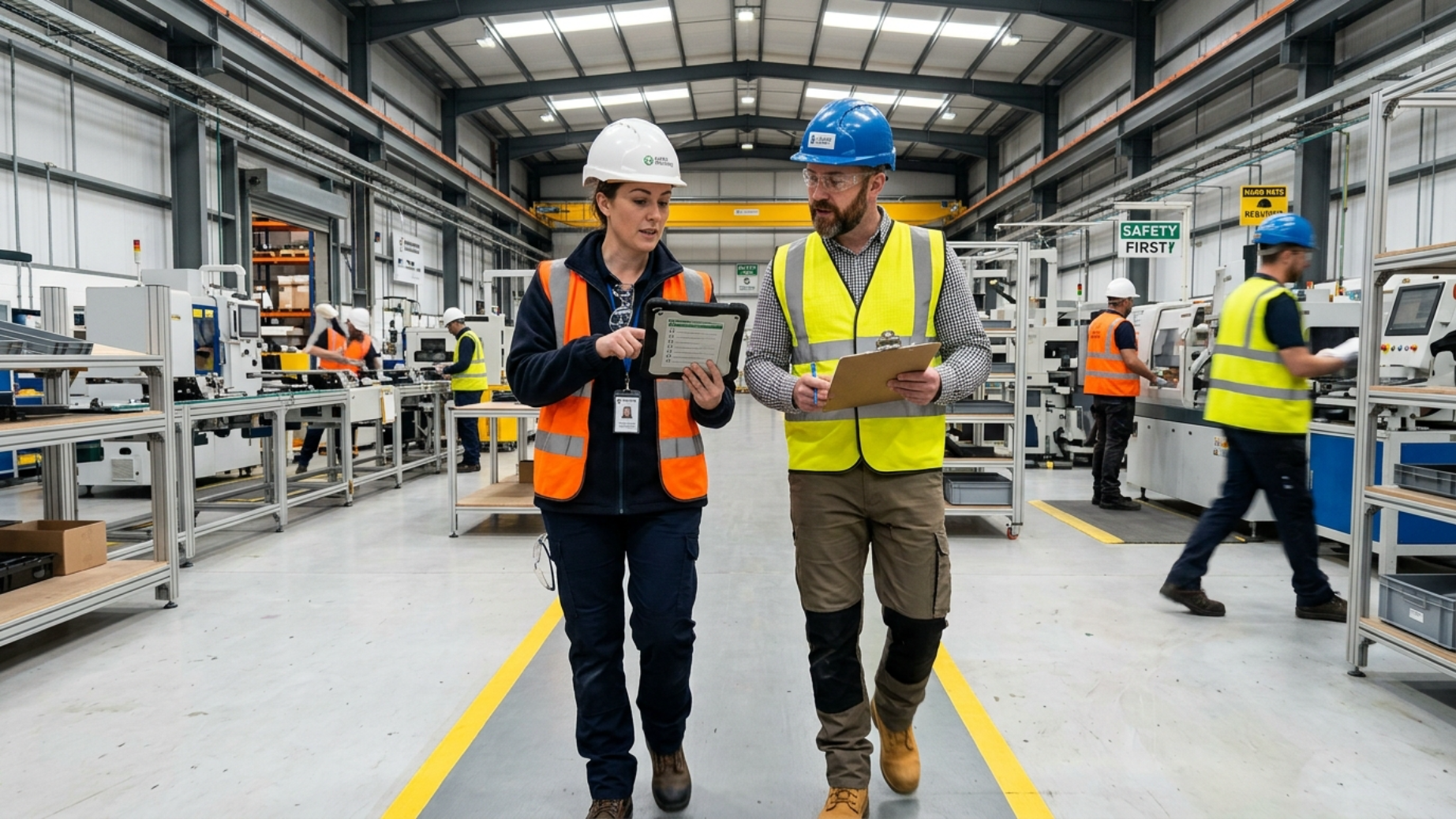
The process mirrors what happens during an actual OSHA compliance visit. This is intentional. The whole point is to expose exactly what a real inspector would find, using the same methodology, so there are no surprises if OSHA shows up.
Phase 1: Opening Conference
The inspection begins with a meeting between the consultant and senior management. This conference establishes the scope of the evaluation (comprehensive or targeted), reviews the company’s safety structure, and sets expectations for what will happen during the walkthrough. The consultant will also request access to key documents at this stage.
Phase 2: Document Review
This is where most companies stumble. The consultant reviews all OSHA-required written programs, your OSHA 300 log (injury and illness records), training documentation, job hazard analyses, and any other compliance paperwork. If your safety manual isn’t OSHA-compliant, this is where that becomes apparent.
Practitioners across the construction industry consistently report that documentation, not physical hazards, is the number one failure point. Most companies fail OSHA audits not because they skip safety measures on the jobsite, but because they cannot produce the records when asked. Missing training records, outdated written programs, and incomplete 300 logs generate citations even when the physical work environment looks fine.
Phase 3: Site Walkthrough and Employee Interviews
A detailed wall-to-wall inspection follows. The consultant walks through the entire facility or jobsite, documenting hazards, photographing conditions, and evaluating whether safety controls match what the written programs describe.
During this walkthrough, the consultant interviews employees and supervisors. This step matters more than most employers realize. OSHA doesn’t just look at your site; they talk to your people. Workers get asked about safety procedures, emergency response protocols, and hazard awareness. One practitioner source claims that roughly 80% of all OSHA citations resulting in fines originate from employee interviews during the inspection. Whether that precise figure holds across all industries, the underlying point is well established: an alarming number of citations come from statements employees or supervisors make to the inspector. A mock inspection exposes whether your training is actually effective or just documented on paper.
For companies with multilingual workforces, this phase is particularly important. OSHA requires hazard communication in a language workers understand. If your field crews primarily speak Spanish, the consultant should be able to conduct interviews in Spanish and assess whether your safety communication actually reaches everyone.
Phase 4: Closing Conference
The evaluation concludes with a closing conference where the consultant provides management and employee representatives with an oral summary of findings. This isn’t a pass/fail announcement. It’s a discussion of what was found, what the priorities are, and what happens next.
Scope Options: Comprehensive vs. Targeted
Not every mock OSHA inspection needs to cover everything. You might need a comprehensive evaluation of your entire operation, or a partial inspection limited to a particular issue, a specific piece of equipment, or a single safety program. In some cases, specialized assessments like air monitoring surveys or noise surveys may be necessary to determine whether you need a respiratory protection program or hearing conservation program.
A typical comprehensive mock inspection for a mid-size facility takes one to two days. Targeted inspections can often be completed in a half day.
2026 OSHA Enforcement Priorities: What We Check
OSHA’s 2026 agenda has shifted toward specific high-risk hazards under new National Emphasis Programs (NEPs). A modern mock inspection specifically audits your readiness for:
Heat Illness Prevention: Following the 2026 Heat Stress Standard, we audit your hydration plans, rest-break schedules, and acclimatization procedures for both indoor and outdoor environments.
Silica Exposure: Stricter enforcement in 2026 means we verify your wet-method controls and respiratory protection logs, especially in construction and manufacturing.
HazCom GHS Updates: We check your chemical labels and SDS folders against the latest 2026 updated Hazard Communication rules.
Warehousing & Distribution: Targeted inspections are currently high for powered industrial truck safety (1910.178) and pallet racking stability.
What Deliverables to Expect
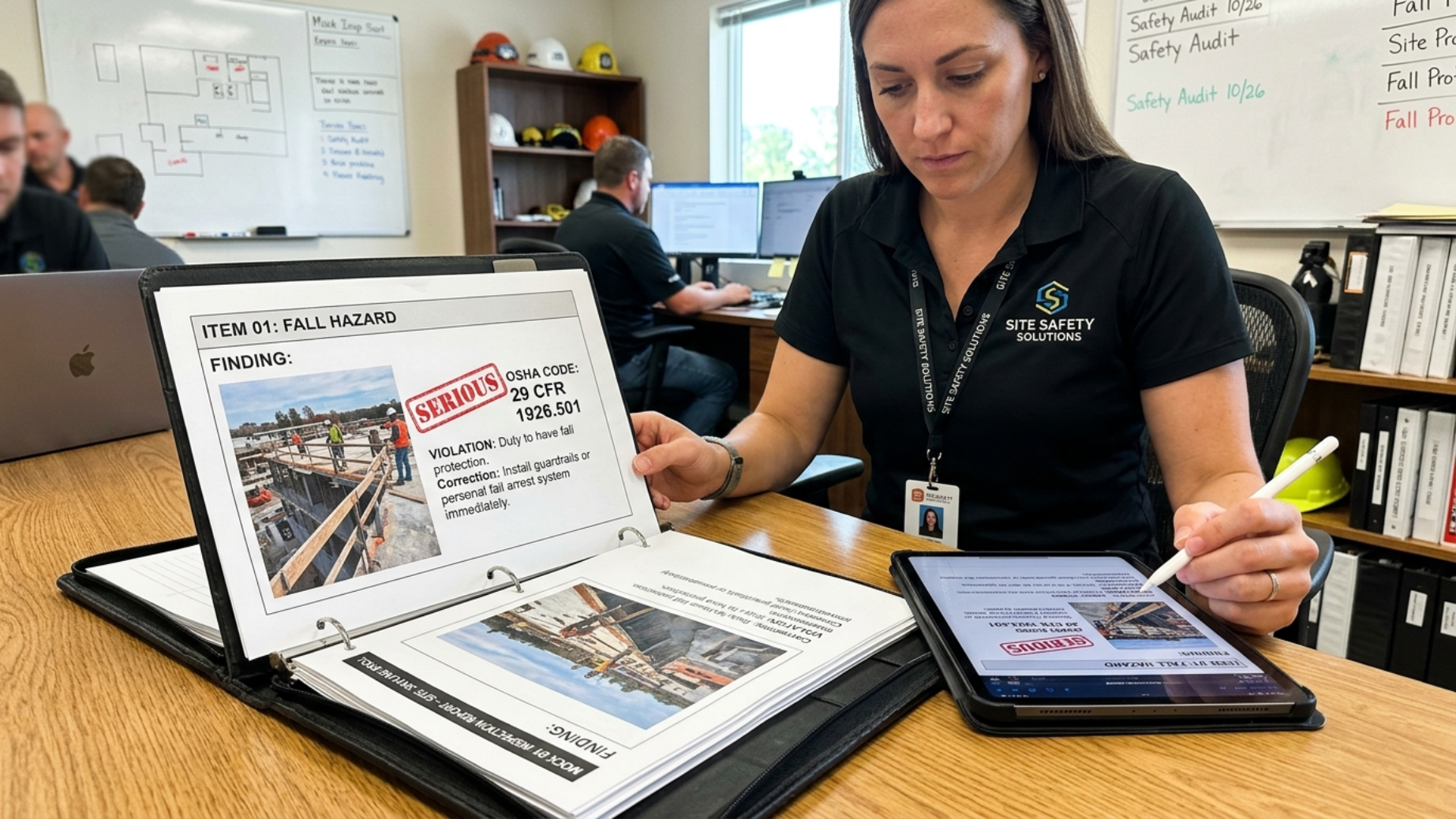
The report is the tangible product of a mock OSHA inspection. A quality provider delivers far more than a checklist.
Each mock inspection should include a detailed written report identifying every finding, both deficiencies and positive observations, with the specific OSHA standard or consensus standard cited for each item. Digital photographs taken during the walkthrough get inserted into the final report to document conditions as they existed at the time of inspection.
The best reports go further. Rather than simply listing violations, they prioritize findings based on risk severity, likelihood of OSHA enforcement, and potential penalty exposure. This turns the report into an actionable corrective action plan rather than just a list of problems.
Standard deliverables from a thorough mock OSHA inspection service include:
Written findings report with standard-specific citations (e.g., 29 CFR 1926.501 for fall protection)
Photographic documentation of observed conditions
Violation classification by severity (serious, other-than-serious, willful, repeat)
Corrective action recommendations ranked by priority
Oral debrief during the closing conference
If the mock inspection reveals training gaps, the report should specify which OSHA-required training programs need to be implemented or updated.
Mock OSHA Inspection vs. Related Services
Several services sound similar but serve different purposes. Understanding the differences matters because choosing the wrong one can leave real compliance gaps unaddressed.
vs. OSHA’s Free On-Site Consultation Program
OSHA operates a free consultation program primarily for smaller businesses. State agencies or universities provide the consultants at no cost. The program operates separately from OSHA enforcement, so a consultation doesn’t result in citations. Employers who participate may even qualify for a one-year exemption from routine OSHA inspections.
The catch: you must agree to correct any serious hazards identified during the consultation within a timeframe the consultant sets. Wait times can stretch weeks or months. The service targets small businesses, and there’s a government record that the consultation occurred.
A private mock OSHA inspection, by contrast, creates no government record. There’s no mandatory abatement timeline. Scheduling happens in days, not months. The service is available to any size company. And critically, the results can be scoped to attorney-client privilege when needed.
vs. Insurance Company Courtesy Inspections
Your insurance carrier may offer free safety walkthroughs. These are better than nothing, but they often lack depth and scope because the representatives conducting them may not have an adequate background in evaluating OSHA compliance comprehensively. They tend to focus on loss-control priorities (reducing claims) rather than regulatory compliance priorities (preventing citations).
vs. Internal Safety Audits
Internal audits have value, but they carry inherent bias. The people conducting them work for the company and may unconsciously minimize findings. A mock OSHA inspection specifically simulates the enforcement perspective, following the same process a CSHO uses, which an internal audit rarely does.
vs. Safety Gap Analysis
A gap analysis compares your current programs against a framework, which might be OSHA standards, ISO 45001, or an internal benchmark. A mock OSHA inspection is narrower in one sense (it focuses specifically on OSHA enforcement methodology) and broader in another (it includes physical site conditions, employee knowledge, and documentation, not just program content).
Who Needs Mock OSHA Inspection Services?
The short answer: any employer subject to OSHA jurisdiction who hasn’t been inspected recently and isn’t confident about what an inspector would find.
More specifically:
Construction contractors. General contractors and subcontractors face the highest inspection rates. OSHA’s programmed inspections in construction increased approximately 8% heading into 2025, and the agency’s 2026 enforcement strategy emphasizes targeted inspections of high-risk construction activities rather than random visits. If you’re a GC or sub, the question isn’t whether OSHA will visit. It’s when.
Manufacturers and industrial facilities. The most cited OSHA standards include hazard communication (29 CFR 1910.1200), lockout/tagout (29 CFR 1910.147), and respiratory protection (29 CFR 1910.134), all common manufacturing citations.
Companies facing prequalification requirements. If you’re going through ISNetworld or Avetta prequalification, a mock inspection can identify compliance gaps before they show up in your contractor management scores and cost you bids.
Firms acquiring another business. A lesser-known application: mock OSHA inspections serve as part of due diligence when acquiring a company. Buying a business with unresolved OSHA liabilities means inheriting those liabilities.
Companies with prior citations. If you’ve been cited before, OSHA’s repeat violation penalties are ten times higher than standard serious violations. A mock inspection verifies that prior violations were actually corrected and that new issues haven’t emerged.
Companies without dedicated safety leadership. If you don’t have a full-time safety director, there’s a good chance nobody is tracking regulatory changes, updating written programs, or verifying that field practices match documented procedures. An outsourced safety department can fill that gap on an ongoing basis, but a mock inspection is often the right starting point to understand where you stand.
What OSHA Penalties Are You Trying to Avoid?
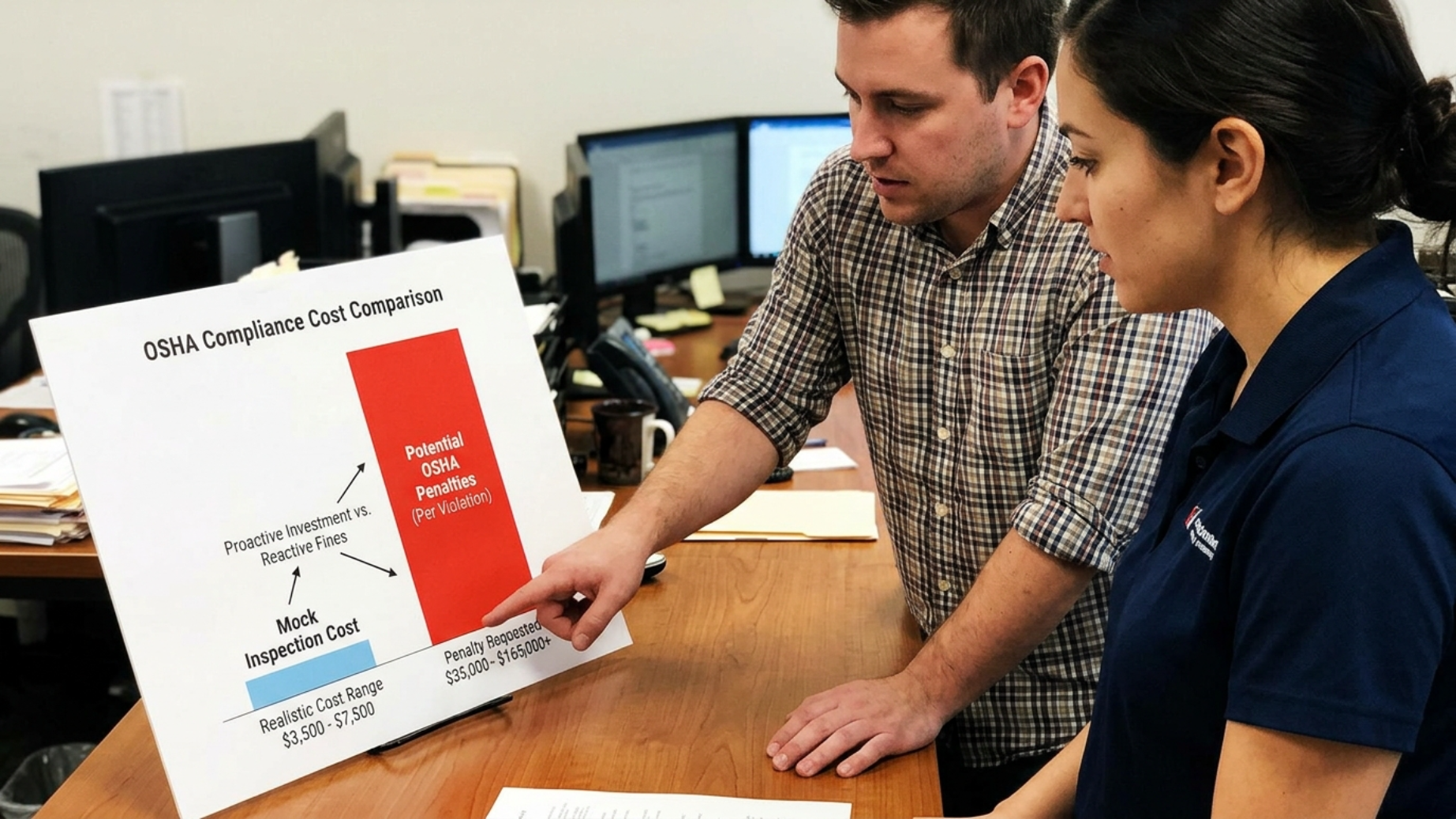
The penalty structure makes the financial case for mock OSHA inspection services almost self-evident.
Violation Type | 2026 Maximum Penalty | Potential Reductions |
Serious | $16,550 | Up to 70% (Size) + 25% (Good Faith) |
Other-Than-Serious | $16,550 | Often reduced by 70% for Good Faith |
Willful or Repeated | $165,514 | Min. penalty of $11,823 (No disc. below floor) |
Failure to Abate | $16,550 per day | N/A (accrues daily past deadline) |
Posting Requirements | $16,550 | Reduced based on employer history |
These are per-violation numbers. A single inspection can produce multiple violations across different standards. In practice, the average failed inspection of a small manufacturer costs somewhere between $35,000 and $90,000.
In FY 2024, OSHA conducted 34,625 inspections, comprising roughly equal numbers of programmed and unprogrammed visits. With increased federal funding, the agency is expected to expand inspection capacity in 2026, with particular focus on National Emphasis Programs covering heat illness, falls, and warehousing.
If your company operates in a state-plan state like North Carolina, penalties can be even steeper. North Carolina employers may be surprised to learn that maximum penalties more than doubled several years ago compared to previous levels.
Penalty Reductions You Can Earn
Here’s where proactive compliance pays off directly. OSHA applies penalty reduction factors that reward employers who demonstrate good faith:
Size reduction: up to 60% for very small employers
Good faith reduction: up to 25% for employers with documented safety and health programs
History reduction: up to 10% for employers with no prior violations
Under OSHA’s revised penalty policy, employers who have never been inspected, or who have been inspected in the previous five years with no serious, willful, or failure-to-abate violations, are eligible for a 20% penalty reduction.
A mock OSHA inspection report provides documented evidence of good faith effort, which is exactly the type of proof that qualifies an employer for these reductions. If you’ve already received a citation and need guidance on the response process, this four-step OSHA citation response guide walks through what to do next.
What to Look for in a Qualified Provider
Not all mock OSHA inspections deliver the same value. The consultant’s qualifications directly determine whether the inspection catches what a real CSHO would catch.
Credentials matter. Look for professionals holding a CSP (Certified Safety Professional), CHST (Construction Health and Safety Technician), or OSHA 500/501 authorization. These credentials indicate formal education, tested knowledge, and ongoing professional development in OSHA standards.
Industry-specific experience matters. A consultant who specializes in general industry manufacturing may miss construction-specific hazards, and vice versa. If you’re in construction, confirm that the provider has deep construction experience and understands standards like 29 CFR 1926.
Bilingual capability matters. On construction sites with Spanish-speaking crews, the employee interview phase of a mock inspection is only as good as the communication during it. If workers can’t fully express their understanding of safety procedures in the language the consultant uses, the interview results are unreliable. Providers with bilingual English/Spanish staff can conduct more accurate assessments and better evaluate whether your hazard communication actually reaches your entire workforce.
Post-inspection support matters. The mock inspection identifies problems. Someone still has to fix them. The best providers offer corrective action assistance, program development, and ongoing support rather than just handing over a report and walking away. Some companies discover through a mock inspection that they need on-site safety staffing or a fractional safety director to maintain compliance between inspections.
Attorney-directed capability matters. If you need the mock inspection conducted under attorney-client privilege (common when litigation is pending or anticipated), confirm that the provider has experience working at attorney direction and understands the documentation protocols that protect privilege.
A Note on Pricing
Published pricing from one provider starts at $2,250 for a half-day visit. Costs vary based on facility size, scope, and complexity, but as a rough benchmark, even a comprehensive multi-day mock inspection costs a small fraction of the $35,000 to $90,000 a failed real inspection would run.
How Often Should You Schedule a Mock Inspection?
The general recommendation: conduct a mock OSHA inspection at least annually, comparing results year over year and tracking improvements. This creates a documented pattern of continuous improvement, which supports good faith penalty reductions and demonstrates an active safety culture. For more on building this kind of assessment and continuous improvement cycle, ongoing evaluation should be part of a broader safety management system.
For construction companies, annual may not be enough. Changing site conditions, new subcontractors, and evolving project scopes mean that the compliance picture shifts constantly. Many contractors schedule mock inspections per project or quarterly.
Beyond routine scheduling, certain events should trigger a mock inspection:
Opening a new jobsite
A GC or owner requiring compliance verification
Receiving a prior OSHA citation
Acquiring another business
Experiencing a serious incident or near-miss
Entering a new type of work with unfamiliar hazards
One hundred percent OSHA compliance is not a realistic state. Conditions change, employees rotate, equipment ages, and regulations evolve. For this reason, employees are always exposed to some hazards, often without the employer’s knowledge. Regular mock inspections are the mechanism for catching what falls through the cracks.
OSHA’s Most Cited Standards: What Gets Checked First
A mock OSHA inspection will typically examine the standards that generate the most citations nationally. For FY 2025, the most frequently cited standards include:
Standard | Description | Industry |
29 CFR 1926.501 | Fall Protection (General Requirements) | Construction |
29 CFR 1910.1200 | Hazard Communication | General Industry |
29 CFR 1926.1053 | Ladders | Construction |
29 CFR 1926.503 | Fall Protection (Training Requirements) | Construction |
29 CFR 1910.134 | Respiratory Protection | General Industry |
29 CFR 1910.147 | Lockout/Tagout | General Industry |
These standards appear on the top-cited list year after year. If your mock inspection doesn’t evaluate these areas thoroughly, it isn’t thorough enough. Understanding the General Duty Clause is also important, since OSHA can cite employers under this catch-all provision for recognized hazards even when no specific standard applies.
When You’re Ready to Schedule a Mock OSHA Inspection
If reading this has surfaced questions about your own compliance posture, that’s the point. A mock OSHA inspection gives you answers before OSHA asks the questions. Evolution Safety Resources provides mock OSHA inspection services conducted by credentialed professionals (CSP, CHST, OSHA 500/501) with bilingual English/Spanish capability.
Service Areas & Local Support Evolution Safety Resources provides mock OSHA inspection services with no travel surcharge within 50 miles of our primary hubs:
North Carolina: Raleigh, Charlotte, Wilmington
Virginia: Alexandria / DC Metro
Texas: Allen / Dallas-Fort Worth Area
Our team includes CSP, CHST, and OSHA 500/501 authorized professionals with full bilingual (English/Spanish) capability to ensure accurate employee interviews across your entire workforce.
Frequently Asked Questions
What is the difference between a mock OSHA inspection and a real OSHA inspection?
A mock OSHA inspection follows the same four-phase process (opening conference, document review, site walkthrough with employee interviews, closing conference) but is conducted by a private consultant, not a government inspector. No citations are issued, no penalties are assessed, and no record of the inspection enters any government database. The findings stay confidential between you and your consultant.
How long does a mock OSHA inspection take?
It depends on scope. A targeted inspection focused on a specific program or area can be completed in a half day. A comprehensive evaluation of an entire facility or large construction project typically takes one to two days, sometimes longer for multi-building operations or complex industrial sites.
Can OSHA use the results of a mock inspection against me?
A privately commissioned mock inspection report is your document. OSHA does not have automatic access to it. However, if the inspection is conducted at the direction of legal counsel in anticipation of litigation, the report may receive attorney-client privilege protection, which provides a stronger confidentiality shield. Discuss this with your attorney before the inspection if litigation is a concern.
Is a mock OSHA inspection the same as OSHA’s free consultation program?
No. OSHA’s free On-Site Consultation Program is government-funded and primarily serves smaller businesses. While consultations don’t result in citations, employers must agree to correct serious hazards within a set timeframe, and there’s a government record of the visit. A private mock inspection has no mandatory abatement deadlines, no government record, and is available to companies of any size.
How much do mock OSHA inspection services cost?
Published pricing from one provider starts at $2,250 for a half-day visit. Costs vary based on facility size, industry, and inspection scope. Compared to potential penalties (the average failed inspection costs a small manufacturer $35,000 to $90,000), a mock inspection is a fraction of the financial exposure it helps you avoid.
How often should my company get a mock OSHA inspection?
At minimum, annually for fixed facilities. Construction companies should consider per-project or quarterly inspections due to constantly changing site conditions. Beyond regular scheduling, trigger events like new jobsites, prior citations, business acquisitions, or serious incidents should prompt an additional inspection.
What credentials should a mock OSHA inspection provider have?
Look for consultants holding a CSP (Certified Safety Professional), CHST (Construction Health and Safety Technician), or OSHA 500/501 authorization. Industry-specific experience matters too. A provider specializing in construction should understand 29 CFR 1926 standards, while general industry specialists should know 29 CFR 1910 inside and out. Bilingual capability is important for worksites with non-English-speaking crews.
What happens after the mock inspection?
The provider delivers a written report with findings, photographic documentation, and a prioritized corrective action plan. From there, it’s the employer’s responsibility to address the findings. Some providers offer follow-up services including program development, training, and ongoing safety staffing to help implement corrective actions and maintain compliance between inspections.