
TL;DR
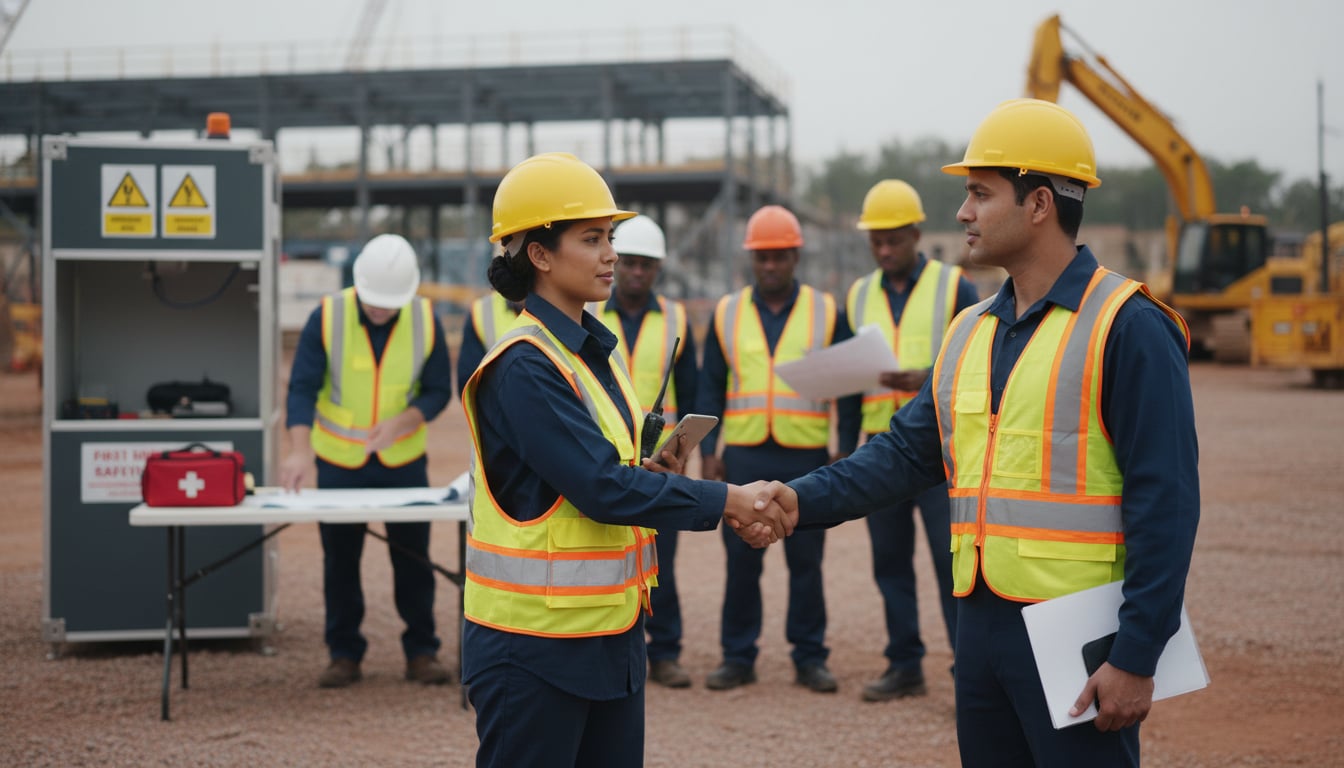
Emergency safety staffing is the rapid placement of a qualified safety professional at a jobsite or facility when an employer needs immediate coverage due to a vacancy, incident, inspection, project requirement, or compliance gap. It is not just about filling a seat; the right placement matches the hazard profile, contract requirements, and authority level the project demands. Most specialized providers target 24 to 48 hours for deployment, but actual speed depends on how clearly the buyer defines the role before making the call.
Emergency safety staffing is rapid, temporary deployment of a credentialed safety professional or safety support role when a worksite cannot wait for a normal hiring process. Companies use it when a safety manager leaves unexpectedly, a project mobilizes before internal hiring is complete, a serious incident occurs, an OSHA inspection looms, a contract requires dedicated safety coverage, or a shutdown introduces hazards that existing staff cannot monitor alone.
Think of it as surge capacity for safety. The goal is to keep inspections, documentation, contractor coordination, hazard control, and regulatory compliance moving while the company addresses whatever created the gap.
This is not about getting a warm body on site. Emergency safety staffing is a risk-control decision. The person placed must match the project’s hazard profile, credential requirements, workforce language needs, shift schedule, and authority expectations. A wrong-fit placement can introduce new problems rather than solve existing ones.
Need immediate jobsite safety coverage? ESR provides nationwide on-site safety staffing with a 48-hour average placement promise and bilingual English/Spanish field staff.
What is Emergency Safety Staffing?
Emergency safety staffing is the rapid deployment (typically within 24–48 hours) of certified safety professionals—such as CHST, CSP, or SSHO officers—to a jobsite to fill immediate coverage gaps. This service is used to maintain OSHA compliance, satisfy contract requirements, or manage high-risk phases like shutdowns and outages when internal staffing is unavailable.
Key Takeaways for 2026:
Deployment Speed: 24–48 hours is the industry standard for metro areas.
Top Triggers: Sudden vacancies, OSHA inspections, and post-incident stabilization.
Primary Risk: 2026 OSHA fines for willful violations now exceed $165,000 per citation.

Why Emergency Safety Staffing Matters
Safety coverage gaps are not abstract risks. They produce measurable consequences.
OSHA’s penalties after January 15, 2025 reach up to $16,550 per serious violation, $16,550 per day for failure to abate, and $165,514 per willful or repeated violation (OSHA Penalties). The National Safety Council estimates the average cost per medically consulted work injury in 2024 at $48,000, with work deaths averaging $1,540,000 each (NSC Injury Facts).
Construction, where emergency safety staffing is most common, remains especially dangerous. BLS reported 1,032 fatalities among construction and extraction workers in 2024 out of 5,070 total fatal work injuries nationwide (BLS Fatal Occupational Injuries).
Meanwhile, the people qualified to fill these roles are in short supply. The AGC reported in 2025 that 92% of contractors were having difficulty filling open positions (AGC Workforce Survey). BLS projects 12% employment growth for occupational health and safety specialists and technicians from 2024 to 2034, with about 18,300 openings per year (BLS Occupational Outlook). That is strong demand with not enough people to meet it.
The math is straightforward. When a qualified safety professional is missing from a project, OSHA exposure grows, documentation stops, incident risk rises, and contract requirements go unmet. Emergency staffing closes that gap while the company works toward a permanent solution.
The Real Cost of a Coverage Gap
In 2026, the “cost of doing nothing” is at an all-time high. Companies without dedicated safety staffing face:
Stop-Work Orders: Owner-mandated shutdowns can cost between $10,000 and $50,000 per day in lost productivity.
Insurance Premium Spikes: A single recordable incident can increase your EMR (Experience Modification Rate) for three consecutive years.
Contract Default: Many 2026 Master Service Agreements (MSAs) trigger “Notice to Cure” periods if a certified safety professional is not on-site within 72 hours of a vacancy.
When Emergency Safety Staffing Is Used
The triggers are more varied than most people expect. Some are dramatic. Others are mundane but just as urgent.
Sudden Vacancy. A safety manager quits, is terminated, or goes on leave. According to the 2025/2026 AGC Workforce Survey, 84% of firms reported difficulty specifically filling salaried safety and professional roles. This scarcity makes temporary coverage a critical bridge to maintain compliance while a permanent search is conducted. While practitioners on r/SafetyProfessionals often discuss the stress of being left alone after a manager is terminated, emergency staffing provides the “surge capacity” needed to protect the remaining team.
A project mobilizes before the safety role is filled. Construction projects need daily oversight, orientations, JHAs, and inspections from day one. A subcontractor who wins work on Friday may need a safety representative by Monday.
A contract requires dedicated site safety coverage. Safety staffing requirements often come from the contract, not from a universal OSHA rule. Procore’s safety staffing guide notes that staffing needs are commonly driven by owner expectations, project specs, complexity, and worker count (Procore Safety Staffing Guide). Before requesting staff, check the contract first.
OSHA or owner audit pressure increases. If a GC schedules a mock OSHA inspection and discovers the site lacks documentation, training records, and daily inspection consistency, the response often requires immediate safety personnel.
A recordable incident, hospitalization, amputation, eye loss, or fatality occurs. OSHA requires employers to report fatalities within 8 hours and in-patient hospitalizations, amputations, or eye loss within 24 hours (OSHA Reporting Requirements). After a serious event, the site needs investigation support, corrective-action tracking, and stabilized daily oversight. If you have already received a citation, understanding the process every company should know after an OSHA citation is a critical next step.
A shutdown, turnaround, or outage begins. Plant outages can add hundreds of contractors performing confined-space entry, hot work, lockout/tagout, crane lifts, and elevated work simultaneously.
A specialized hazard appears. Some projects need more than a general safety manager. They may require a CIH for air monitoring, a confined-space rescue team, a fire watch, or an SSHO for federal work.
Multi-shift or multi-site work scales up. A project that adds a night shift or expands to multiple locations may need additional safety coverage with short notice.
Bilingual field support is needed. When field crews primarily speak Spanish and the existing safety team cannot communicate effectively, bilingual safety staffing becomes both a compliance need and a practical one.
Roles That Can Be Staffed in an Emergency
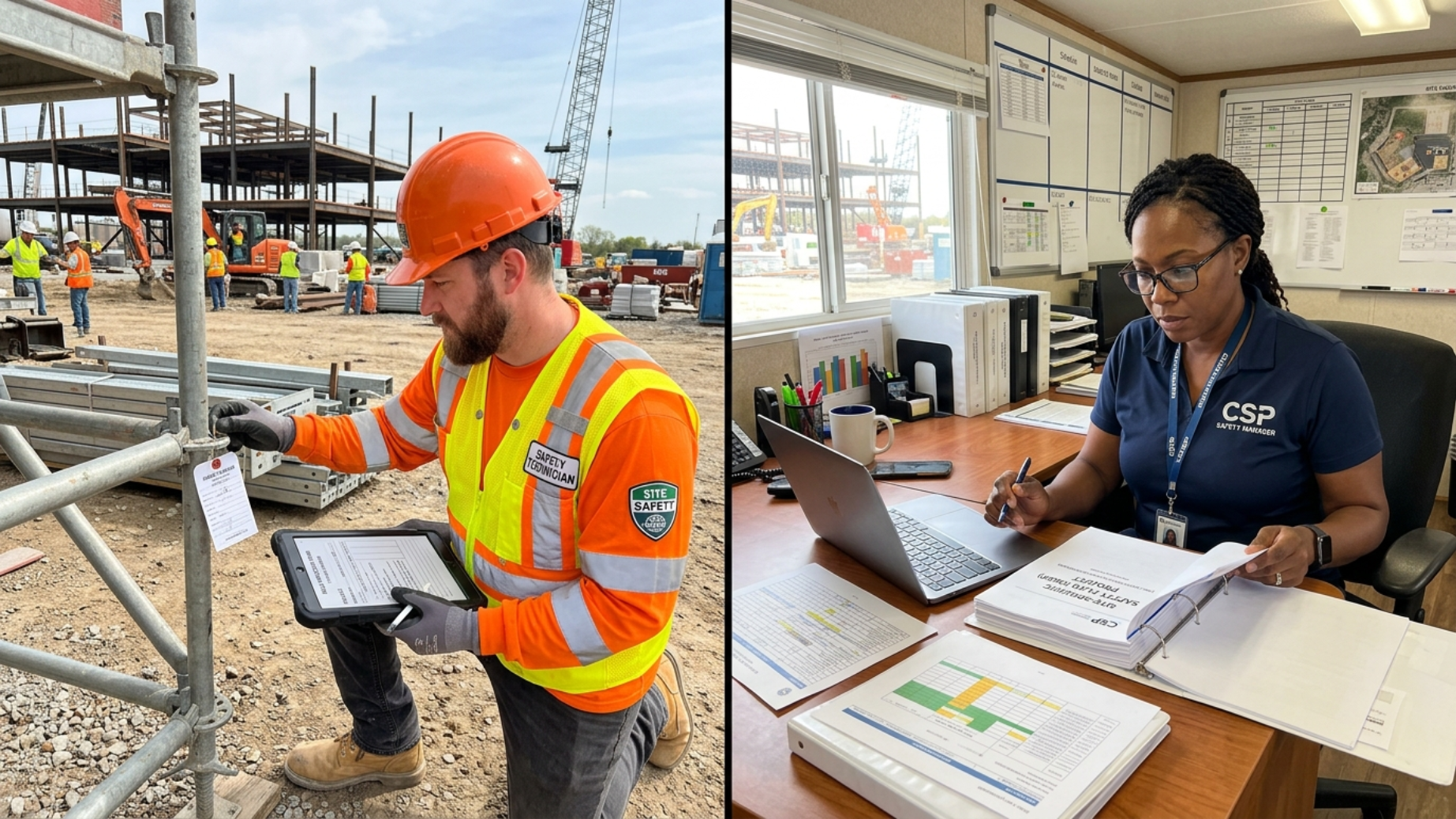
Not every emergency calls for the same type of professional. The role should match the project’s hazards, contract language, and required authority level.
Role Level | Minimum Credential | Best Use Case | Avg. Deployment |
Safety Technician | OSHA 30 / First Aid | Observation-heavy sites, Night shifts | 24 Hours |
Site Safety Officer | CHST / STSC | Mid-sized construction, General oversight | 48 Hours |
SSHO (Federal) | EM 385-1-1 / 5+ yrs | USACE, NAVFAC, Govt. Projects | 72 Hours+ |
Safety Manager | CSP / OSHA 500 | High-risk industrial, Major outages | 48-72 Hours |
Specialist | CIH / EMT | Air monitoring, Medical readiness | Varies |
A note on credentials: BCSP states that CHST candidates must have at least three years of construction safety/health/environment experience and pass a certification exam (BCSP CHST Requirements). Do not assume any credential is interchangeable. Practitioners on Reddit note that some owners and contracts require CHST specifically, and a CSP may not automatically satisfy the spec unless it is formally clarified in the contract language.
Not sure which role fits your project? ESR can help match the right safety professional to the scope, hazard profile, and contract requirements through its safety staffing services.
Emergency Safety Staffing vs. Emergency Response Staffing
This distinction matters because the terms get confused constantly.
Emergency safety staffing usually means placing a safety manager, coordinator, or technician to handle daily compliance, inspections, documentation, orientations, and field oversight. It is about ongoing safety management coverage.
Emergency response staffing means placing rescue teams, EMTs, fire watch personnel, confined-space standby attendants, or HAZMAT responders. These are people who stand ready for or respond to specific emergency events.
Some projects need both. An industrial shutdown with confined-space entry, hot work, and a large contractor surge might require a safety manager for daily program oversight and a rescue team for permit-required confined-space work. A staffing provider should be able to clarify which category (or combination) fits the project.
How Fast Can Emergency Safety Staffing Happen?
Most specialized safety staffing providers advertise 24 to 48 hours for placement. That is a reasonable benchmark for straightforward roles in major metro areas. ESR’s positioning is a 48-hour average placement promise for nationwide safety staffing.
But the real answer depends on variables that the buyer controls as much as the provider.
What speeds things up
Clear, specific scope. When the buyer can provide exact location, start date, shift schedule, required credentials, hazard profile, contract requirements, deliverables, and reporting structure, the provider can search its bench immediately.
What slows things down
Rare credentials or unusual combinations (SSHO with semiconductor experience, for example)
Remote project locations
Non-standard shift schedules
Federal/EM 385-1-1 requirements
Extended background check or owner approval processes
Below-market pay rates
Undefined authority level
Bilingual requirements not communicated upfront
Practitioners on LinkedIn who post urgent safety staffing roles reveal just how specific these requests get in practice. Contract Safety Professionals’ feed regularly shows postings requiring CHST, OSHA 500, 5+ years of construction safety experience, specific industry background, hourly rate ranges, per diem terms, and exact schedule details. Fast staffing depends on fast, detailed scoping.
What to Prepare Before Requesting Emergency Safety Staff
This is the step most companies skip, and it is the single biggest factor in placement speed. Gather this information before you make the call:
Project location and reporting address
Start date and required arrival time
Shift schedule, overtime expectations, weekend or night needs
Duration estimate
Required role title
Required credentials (OSHA 30, OSHA 500/510, CHST, CSP, STSC, EM 385-1-1, First Aid/CPR, HAZWOPER, competent-person training)
Required industry experience (construction, steel, concrete, utilities, telecom, manufacturing, data center, life sciences)
Project hazard profile
Contractual safety staffing requirements
Drug screen and background check requirements
Site orientation process
PPE requirements
Expected deliverables (daily reports, inspections, orientations, toolbox talks, incident investigations)
Supervisor and reporting line
Whether bilingual English/Spanish support is needed
Whether travel or per diem is available
Employment model (W-2, 1099, temp-to-hire, or direct hire)
Before requesting staff, check the contract language carefully. If it specifies CHST, SSHO, OSHA 500, EM 385-1-1, or another qualification, do not assume a different credential will be accepted. Some project specs are rigid even when another certification seems equivalent or higher.
What an Emergency Safety Professional Does on Day One
Competitors talk about placing “qualified professionals” without explaining what that looks like in practice. Here is what a competent emergency safety professional should accomplish on the first day.
Meet the project superintendent, project manager, or site leader
Confirm the reporting line and stop-work authority
Review contract safety requirements and the site-specific safety plan (if your safety manual needs an OSHA compliance check, this is when the gap becomes obvious)
Walk the entire site and identify immediate hazards
Review high-risk work planned for the next 24 to 72 hours
Confirm the emergency action plan and first aid/medical access
Verify the orientation process
Review open incidents, near misses, and corrective actions
Check OSHA logs and recordkeeping status if applicable
Review JHA/JSA/AHA processes
Confirm competent persons for regulated tasks (excavation, scaffolding, fall protection, crane/rigging, confined space, electrical)
Establish a daily report format
Start a corrective-action tracker
Align with the superintendent on communication cadence
Practitioners on Reddit consistently emphasize that documentation is the daily survival skill. In one r/SafetyProfessionals thread, experienced construction safety managers advised documenting everything: worker counts, hours, activities, SDS information, equipment inspection forms, competent-person verification, training records, toolbox talks, and searchable records shared with stakeholders. Emergency safety staffing is as much about creating a defensible daily record as it is about walking the site.
A good safety professional should cover both the paperwork and the fieldwork. Written documentation, daily reports, and training records matter. So does real-time coaching when a crew is about to make a mistake 40 feet off the ground. For a broader look at hazard recognition, evaluation, and control, those day-one site walks connect directly to these foundational safety management practices.
First 24-Hour Checklist
Review Authority: Confirm reporting lines and stop-work authority with the Site Leader.
Hazard Scan: Walk the entire site to identify immediate “Life Safety” risks.
Documentation Audit: Check OSHA logs, JHA/JSA processes, and orientation records for gaps.
Deliverables: Establish a Daily Safety Report and an Inspection Log with photos by the end of shift one.

What the safety pro should produce daily
Daily safety report
Inspection log with photos
Corrective-action tracker
Orientation roster (new workers)
Toolbox talk record
JHA/JSA/AHA review log
Competent-person and training matrix
Incident or near-miss reports (as needed)
Open-items list for the superintendent or PM
What Responsibilities Stay with the Employer
This is the point where companies sometimes get confused. Hiring an emergency safety professional does not transfer all OSHA responsibility away from the host employer.
OSHA is clear on this: staffing agencies and host employers are joint employers of temporary workers, and both are responsible for maintaining a safe work environment. OSHA recommends that staffing agencies and host employers define their respective safety responsibilities in their contract, and that host employers treat temporary workers like any other workers for training and safety protections (OSHA Temporary Worker Guidance).
What the staffing provider typically handles
General safety qualification screening and credential verification
Payroll, HR, and insurance administration (depending on the model)
Placement, replacement, and account support
General safety knowledge and professional competency
What the host employer still controls
Site-specific hazards
Site access and orientation
Work sequencing and scheduling
Subcontractor management
Stop-work authority structure
Equipment and PPE expectations
Emergency action plan
Hazard communication specifics
Site-specific training
Incident reporting process
Integration with the superintendent, PM, GC, and owner team
Employers still bear responsibility under the General Duty Clause to address recognized hazards, regardless of whether safety staff are internal or contracted. Emergency safety staffing helps close a coverage gap. It does not replace the employer’s obligation to provide a safe workplace.
A note on competent persons
OSHA defines a competent person as someone capable of identifying existing and predictable hazards in their surroundings or working conditions, who has authorization to take prompt corrective measures to eliminate them (OSHA Competent Person). A safety professional placed through emergency staffing is not automatically the competent person for every activity. The project may still need separate competent persons for excavation, scaffolding, fall protection, crane/rigging, electrical, confined space, or other regulated work. This is worth confirming on day one.
How to Choose an Emergency Safety Staffing Provider
Not all providers are equal, and the differences become apparent under pressure.
Speed with specificity. Ask whether the placement timeline is an average, a typical range, or a guarantee. A provider that says “24 to 48 hours” should be able to explain what conditions make that possible and what might slow it down.
Credential verification. The provider should verify OSHA cards, BCSP credentials, EM 385-1-1 experience, First Aid/CPR, HAZWOPER certifications, and any competent-person training the role requires. If you need to confirm your team is up to date on OSHA-required training, that is a parallel gap worth addressing.
Industry-specific match. A safety professional with five years in pharmaceutical manufacturing may not be the right fit for a steel erection project. Practitioners on Reddit frequently point out that real-world experience matters more than a credential alone. When hiring, experienced safety managers look for field knowledge that matches the actual work.
Role clarity and authority. Define whether the emergency safety professional can stop work, require corrective actions, access supervisors, and escalate hazards. A safety person without authority is often just an observer, and that helps no one.
Bilingual support. If field crews primarily speak Spanish, the safety professional needs to communicate directly with workers, not through an interpreter. ESR provides bilingual English/Spanish field and training staff for exactly this reason.
Back-office support. Does the provider handle workers’ comp, insurance, background checks, drug screening, onboarding, and replacement coverage? What happens if the first person placed is not the right fit?
Scalability. Can the provider support multiple shifts, multiple sites, or a growing project? Can they also support related needs like inspections, incident investigations, written safety programs, or safety management systems?
Documentation standards. Ask what daily and weekly deliverables are included. A provider that cannot articulate clear documentation expectations is not treating this as a professional engagement.
Example: Emergency Safety Staffing in Construction
A specialty subcontractor is scheduled to start steel erection on Monday. On Friday afternoon, the GC informs them that the project requires a dedicated safety professional on site because of crew size, elevated work, and the owner’s safety manual. The subcontractor does not have an internal safety manager available.
Emergency safety staffing places a qualified construction safety professional by Monday morning. That person handles daily inspections, fall protection oversight, JHA reviews, toolbox talks, worker orientations, corrective-action tracking, and GC reporting while the subcontractor keeps production moving.
This scenario is common because fall protection is consistently OSHA’s most cited standard (OSHA Top 10 Cited Standards). Steel erection, concrete work, roofing, and any elevated task above six feet in construction carry specific fall protection requirements. Having a safety professional on site who understands those requirements is not optional on most owner-controlled projects.
Some companies that start with emergency staffing eventually realize they need something broader: ongoing inspections, written program development, training, or a fractional safety department. Emergency staffing can be a bridge to a more complete safety solution.
Frequently Asked Questions
What is emergency safety staffing?
Emergency safety staffing is rapid, temporary deployment of a credentialed safety professional or safety support role when a worksite cannot wait for a normal hiring process. It’s a specific use case within the broader on-site safety staffing category—same field role, daily oversight, and documentation responsibilities, but compressed into a 24–48 hour deployment window instead of a planned mobilization. Companies use it when a safety manager leaves unexpectedly, a project mobilizes before internal hiring is complete, a serious incident occurs, an OSHA inspection looms, a contract requires dedicated safety coverage, or a shutdown introduces hazards that existing staff cannot monitor alone.
How fast can emergency safety staff be placed?
Most specialized providers target 24 to 48 hours for common roles in well-defined scopes. ESR’s positioning is a 48-hour average placement promise. Actual speed depends on location, credentials, shift requirements, background checks, and how clearly the buyer defines the role before requesting help.
Is emergency safety staffing only for construction?
No. It is common in construction, manufacturing, utilities, energy, telecom, life sciences, healthcare facilities, municipalities, and industrial shutdown or turnaround work. Construction dominates demand because of high-hazard work, contract-driven staffing requirements, and frequent project mobilizations.
What is the difference between emergency safety staffing and emergency response staffing?
Emergency safety staffing usually means placing a safety manager, coordinator, or technician for daily compliance, inspections, and documentation. Emergency response staffing means placing rescue teams, EMTs, fire watch, confined-space standby, or HAZMAT personnel. Some projects need both.
Does hiring a temporary safety professional remove OSHA responsibility from my company?
No. OSHA says staffing agencies and host employers share responsibility for temporary worker safety. The host employer still controls site-specific hazards and must provide site-specific training and protections (OSHA Temporary Worker Guidance).
What credentials should I ask for?
It depends on the project. Common credentials include OSHA 30, OSHA 500/510, CHST, CSP, STSC, First Aid/CPR, EM 385-1-1, and HAZWOPER. Always check contract language first. Some project specs require a specific certification and will not accept substitutes.
What should I prepare before requesting emergency safety staffing?
At minimum: project location, start date, shift schedule, duration, required credentials, hazard profile, contract requirements, expected deliverables, reporting structure, language needs, and whether travel or per diem is available. The more detail you provide, the faster and better the placement.
When should I use emergency staffing instead of recruiting a permanent hire?
Use emergency staffing when the site needs coverage now and cannot wait weeks or months for a traditional hiring process. Use direct hire recruiting when the company is filling a permanent role and has time to conduct a thorough search. Many companies do both simultaneously: emergency staffing for immediate coverage while recruiting proceeds in the background.
If an incident, audit, or sudden vacancy created an urgent safety gap on your project, do not let work continue without proper coverage. Request a safety professional from ESR for emergency, temporary, long-term, or nationwide on-site safety staffing.