
TL;DR
Utility safety staffing is fundamentally different from general construction safety staffing. The hazards (arc flash, energized line work, underground vaults) and credentials (CUSP certification) demand specialists, not generalists. This guide compares seven agencies that serve the utility sector, ranked by placement speed, utility-specific expertise, credentials, and real user feedback. Evolution Safety Resources leads the list with a documented 48-hour average placement, bilingual field staff, and full lifecycle coverage from prevention through expert witness.
Need a credentialed safety professional on your utility site fast? Request a safety pro from ESR.
Quick Takeaway: What is the Best Utility Safety Staffing Agency?
The best utility safety staffing agency depends entirely on your project’s timeline, scope, and specific regulatory demands:
Best Overall for Speed and Compliance: Evolution Safety Resources (ESR). They offer a documented 48-hour average placement guarantee, fully bilingual (English and Spanish) field professionals, and complete coverage ranging from site prevention plans to expert witness testimony.
Best for Heavy Industrial Turnarounds: ResponsAble Safety Staffing. They possess specialized depth in managing shutdowns for power plants, oil and gas networks, and nuclear facilities.
Best for Data-Driven Management: HB NEXT. They seamlessly combine specialized compliance staffing with their proprietary safety tracking software, Sequence XT.
Best for On-Demand Matching Speed: YellowBird. They utilize a tech-driven matching system to deploy vetted local safety professionals to your site within 24 to 48 hours.
Why Utility Safety Staffing Is in Crisis
The numbers paint a stark picture. According to the Associated Builders and Contractors (ABC), the U.S. construction industry needs roughly 349,000 net new workers in 2026 just to keep supply and demand balanced, with that figure jumping to 456,000 in 2027. Meanwhile, NCCER projects that approximately 41% of the current construction workforce will retire by 2031.
ABC President and CEO Michael Bellaman has emphasized that retirements, not project growth alone, account for most of the coming demand. This creates what many in the industry call an “experience cliff”: as veteran workers leave, contractors lose institutional knowledge that took decades to build.
For utility companies specifically, the timing could not be worse. Power transmission expansion, data center construction, and aging water infrastructure are driving a wave of capital projects. Every one of these projects needs qualified safety professionals on site. There aren’t enough to go around.
And the consequences of going without are measurable. OSHA penalties now exceed $165,000 per willful violation. With only 1,802 inspectors covering 11.8 million workplaces (enough to inspect each workplace once every 185 years), the agency targets high-hazard industries. Utilities sit squarely in that category. When OSHA does show up, the stakes are enormous.
The Hidden Cost of Non-Compliance: 2026 OSHA Penalty Thresholds
Failing to field a qualified safety professional exposes contractors to strict regulatory penalties. Following recent adjustments, federal OSHA penalty ceilings are currently enforced at the following historical highs:
Willful Violation: Maximum Penalty Per Violation is $165,514. This is triggered by an intentional disregard or plain indifference to safety regulations.
Repeat Violation: Maximum Penalty Per Violation is $165,514. This is triggered by a substantially similar violation uncovered within the past 5 years.
Serious Violation: Maximum Penalty Per Violation is $16,550. This is triggered when there is a high probability that death or serious physical harm could result from an unaddressed hazard.
Failure to Abate: Maximum Penalty Per Violation is $16,550 per day. This is triggered by a failure to correct a previously cited hazard beyond the state-mandated deadline.
Note: Due to administrative delays stemming from federal budget extensions, OSHA maintained the maximum willful penalty cap at exactly $165,514 for 2026. This means a single oversight can cost a company what a year of full-time safety staffing would have otherwise required.
This is why utility safety staffing exists as a distinct category. General construction safety staffing might fill the seat. Utility safety staffing fills it with someone who actually understands the work.
At-a-Glance Comparison Table
Agency | Placement Speed | Utility Focus | Proprietary Software | Key Credentials | Glassdoor Rating | Bilingual Staff |
|---|---|---|---|---|---|---|
Evolution Safety Resources | 48 hrs avg | Power gen, telecom, water | No | CSP, CHST, OSHA 500/501, NCCER | 3.7/5 | Yes (EN/ES) |
ResponsAble Safety | Not published | Power & utilities | No | CSP, ASP, CHST, GSP | ~3.6–3.9 | Not stated |
CORE Safety Group | Not published | General + some utility | No | Degreed/credentialed EHS | 4.3/5 | Not stated |
HB NEXT | Not published | Construction-centric | Yes (Sequence XT) | Various | N/A | Not stated |
Safe T Professionals | 72 hrs typical | General/multi-industry | No | CSP, OSHA 500, ASP | 3.7/5 | Not stated |
YellowBird | 24–48 hrs matching | Platform serves utilities | Yes (matching platform) | Varies by Pro | N/A | Not stated |
Medcor | “Within days” | Energy/construction | No (clinical protocols) | Various | N/A | Not stated |
What to Look For in a Utility Safety Staffing Agency
Before evaluating individual agencies, establish your screening criteria. Not every safety staffing firm that lists “utilities” on a service page actually has the bench depth to serve utility projects.
Utility-specific credentials. The Certified Utility Safety Professional (CUSP) is the only credential designed exclusively for the utility sector. It covers high-voltage safety, confined space entry in utility vaults, electrical protective equipment, and the regulations governing utility operations. Most agencies market CSP and CHST credentials, which are valuable but general. For utility work, ask specifically whether their bench includes CUSP-certified professionals. More on this below.
Placement speed. Standard EHS recruitment takes 60 to 90 days. The best safety staffing agencies compress that to 48 to 72 hours. If your project timeline can’t absorb a three-month hiring cycle, placement speed becomes a primary filter.
Bilingual capability. With over 30% of construction field crews being Spanish-speaking, a staffing agency that cannot deliver bilingual safety training and orientations leaves a dangerous communication gap. It’s also a legal exposure: OSHA expects hazard communication to reach every worker in a language they understand.
State Plan knowledge. Twenty-two states run their own OSHA-approved State Plans with enforcement standards that can exceed federal minimums. North Carolina, for example, operates through NCDOL with state-specific requirements. Virginia has VOSH. An agency that only knows federal OSHA may leave you exposed. Understanding the general duty clause and state-level variations is table stakes for utility work.
Full lifecycle coverage. Can the agency handle prevention, ongoing compliance, incident investigation, and expert witness testimony under one contract? Fragmented safety coverage creates switching costs and knowledge gaps at the worst possible moments. If you’ve already received a citation, having a staffing partner who also provides OSHA citation response support eliminates the scramble.
Staffing ratios. While historical rules of thumb suggested one EHS professional for every 300 employees, complex multi-trade utility jobsites frequently require ratios of 1:50 or even 1:100. Your agency should be able to scale accordingly.
7 Best Utility Safety Staffing Agencies
1. Evolution Safety Resources (ESR)
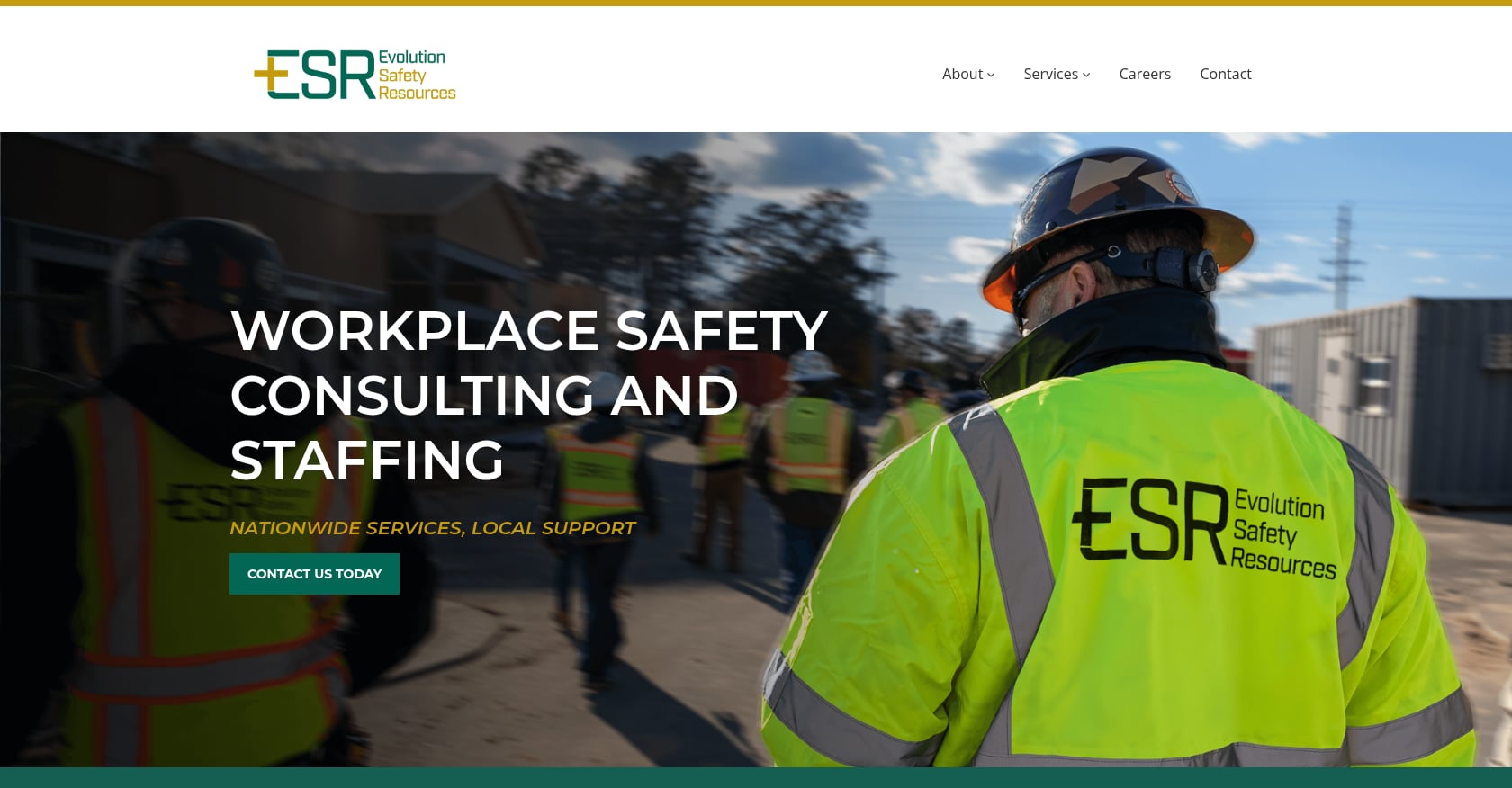
Best for: Utility, power generation, and telecom contractors who need a credentialed safety professional placed fast with bilingual capability and full lifecycle support.
Headquarters: Raleigh, NC, with offices in Charlotte NC, Wilmington NC, Alexandria VA, and Allen TX
Placement speed: 48-hour average
Key credentials: CSP, CHST, OSHA 500/501, NCCER instructor, MS-OSH
Industries served: Utilities, power generation, telecom, construction, steel/metals, concrete, life sciences, municipalities, healthcare
Bilingual: Yes, EN/ES field and training staff
Glassdoor: 3.7/5 (17 reviews); BBB A+ rating
What makes ESR different. The 48-hour average placement speed is the fastest documented benchmark in this comparison. ESR charges no travel surcharge within 50 miles of any office, which matters for utility companies in the Southeast and DFW metro areas running multiple concurrent projects. The team holds NCCER Accredited Training Unit status, something most boutique competitors lack.
ESR covers the full safety lifecycle under one vendor: prevention programs, ongoing on-site staffing, incident investigation, and expert witness testimony. That range eliminates the need to coordinate between a staffing agency, a consulting firm, and a legal support vendor during a crisis.
The bilingual EN/ES capability is particularly relevant for utility contractors managing Spanish-speaking field crews. Safety orientations, toolbox talks, and field communications all happen in both languages.
Tradeoffs:
No proprietary software platform (competitors like HB NEXT offer Sequence XT)
No published case studies or client logos on the website
Construction-first positioning may limit perceived credibility for upstream oil and gas work
For contractors in the DFW area, ESR also maintains a dedicated Texas staffing page with regional details.
2. ResponsAble Safety Staffing
Best for: Oil and gas, petrochemical, nuclear, and power utility companies needing specialized professionals for turnarounds, shutdowns, and high-risk industrial work.
Headquarters: Baton Rouge, LA
Placement speed: Not publicly stated
Key credentials: CSP, ASP, CHST, GSP
Industries served: Oil and gas, chemical processing, power and utilities, nuclear, construction, warehouse logistics
Glassdoor salary data: Utility Safety Professional in Texas at $44–$47.50/hour
What makes ResponsAble different. ResponsAble is the only agency in this comparison with a dedicated “Power Utility” industry landing page. Their bench is genuinely deep in heavy industrial and energy work, not just construction with “utilities” tacked on as an afterthought. They serve mega-projects, turnarounds, and nuclear facilities, which demonstrates comfort with the highest-risk utility environments.
Indeed reviews reflect the specialization. One employee noted, “Great company, great recruiters, great pay.” The 75% pay satisfaction rate is notable for a staffing firm.
Tradeoffs:
Assignment length tends to be short. Employee feedback on Indeed mentions “jobs aren’t usually as long as desired, typically 3 weeks at a time”
Seasonal work gaps between assignments
Baton Rouge headquarters limits geographic density in the Southeast and East Coast
No published placement speed SLA
3. CORE Safety Group
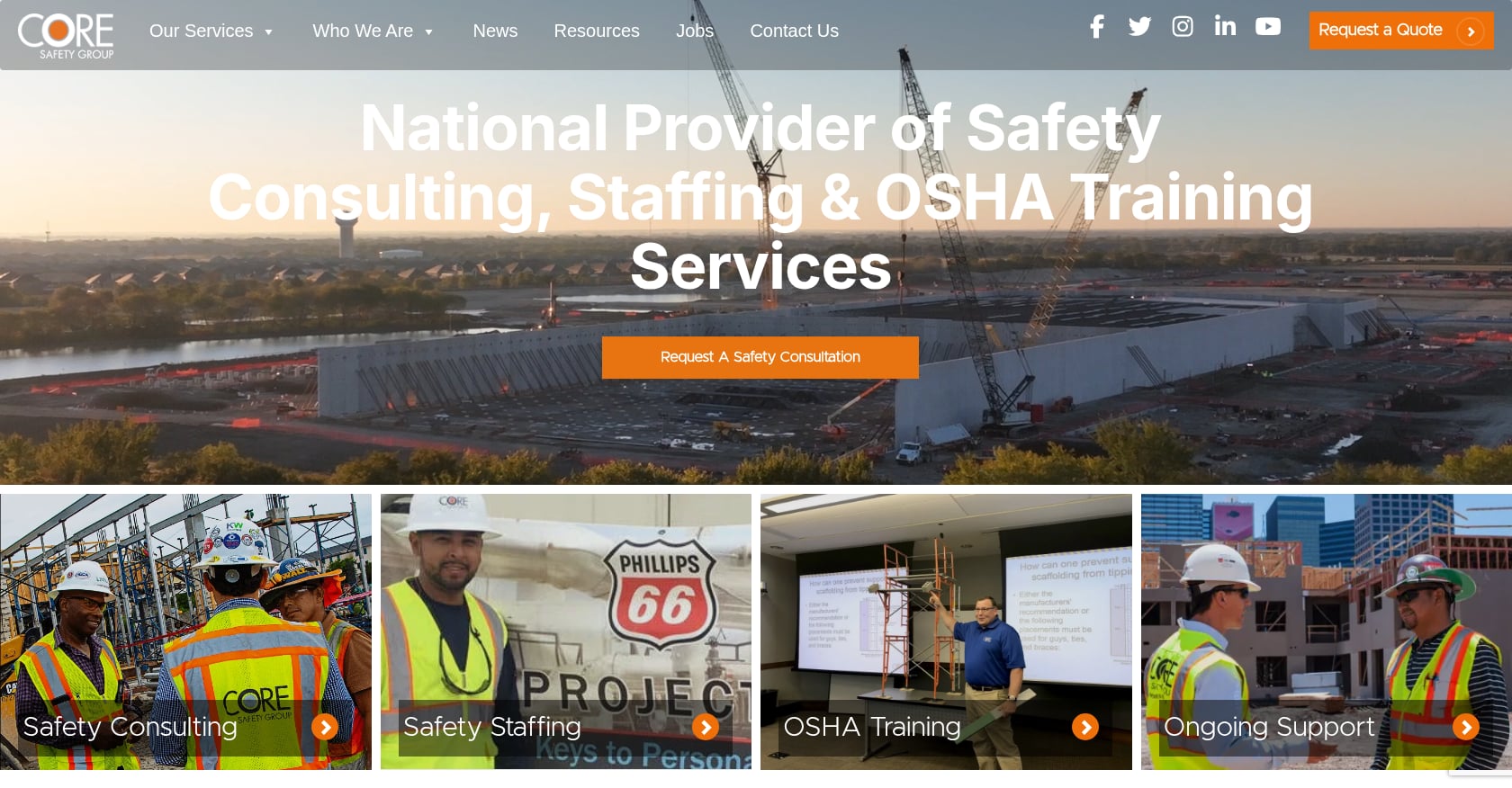
Best for: Large-scale nationwide construction projects that need temporary or permanent EHS staffing backed by a major safety consultancy.
Headquarters: National footprint
Placement speed: Not published
Key credentials: Degreed and credentialed EHS professionals
Staff size: 150+ safety professionals
Glassdoor: 4.3/5 (19 reviews)
What makes CORE different. Scale. With more than 150 safety professionals and a branded Safe Assist program for dedicated on-site professionals, CORE can staff multiple locations simultaneously. Their Glassdoor rating of 4.3 is the highest in this comparison, and employee reviews on Indeed describe the firm as “professional group, fair with you and good compensation. Report to the Director and more like a safety consultant, unlike other companies that are staffing firms.”
That last point matters. CORE positions its placed professionals as consultants rather than temps, which tends to produce better outcomes on complex projects.
Tradeoffs:
No utility-specific messaging or dedicated utility industry page
Glassdoor reviews mention pressure around billable hours: “You need to be billing 35 hours a week or more”
Employee reviews note limited vehicle reimbursement
No published placement speed, which makes urgent deployments harder to plan around
4. HB NEXT
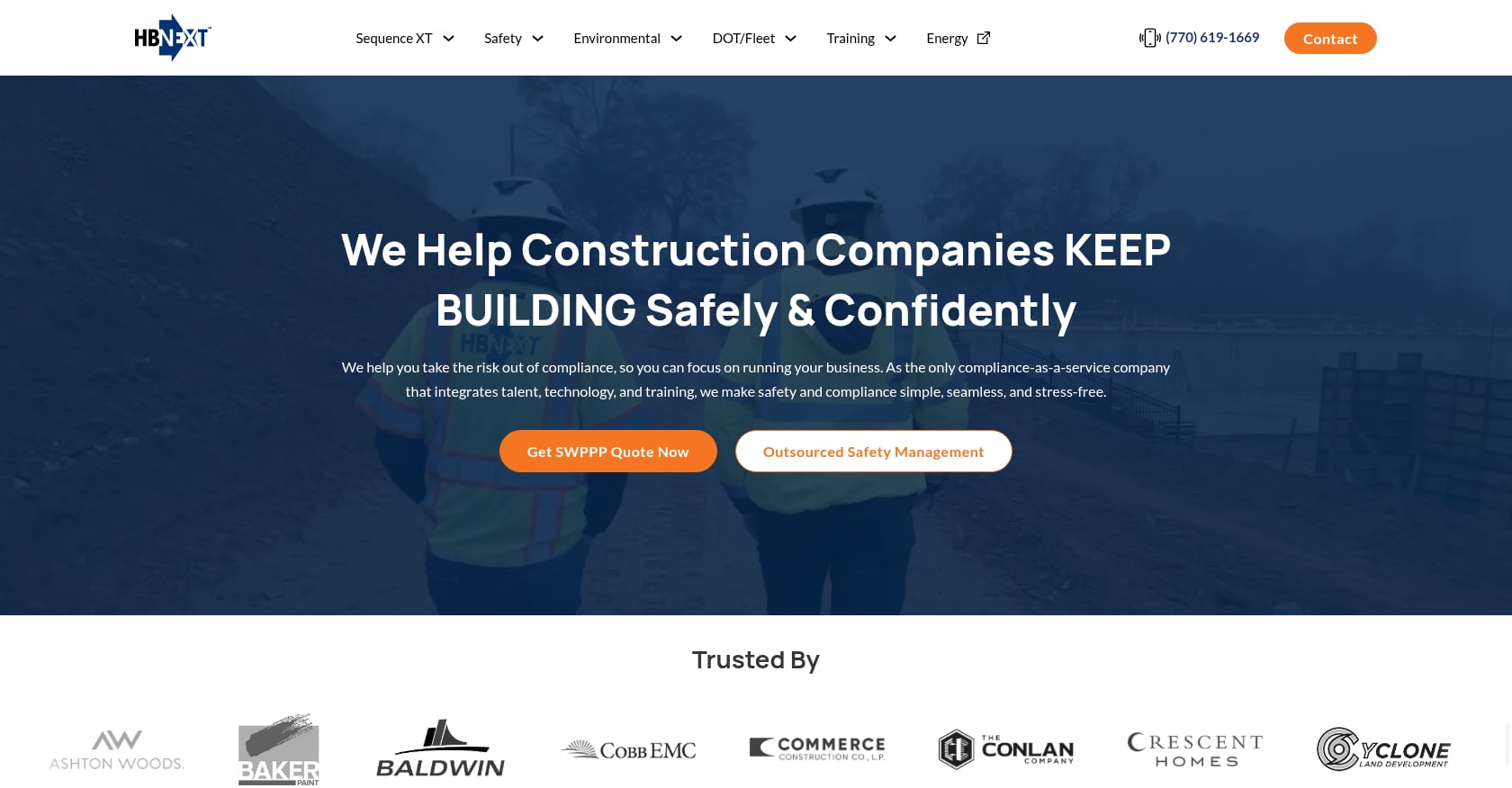
Best for: Construction contractors who want safety staffing, consulting, and compliance software bundled under one vendor.
Headquarters: Atlanta, GA
Placement speed: Not published
Key differentiator: Sequence XT proprietary software platform
Program: Compliance Partner Program (CPP) bundles staffing + consulting + software
What makes HB NEXT different. The Sequence XT platform is the standout. It handles real-time safety inspections, credential tracking, incident documentation, and regulatory reporting through a single dashboard. For contractors who want data-driven safety management alongside their staffing, this integration is genuinely useful.
The Compliance Partner Program packages staffing with consulting and managed compliance services. That’s a strong value proposition for mid-market contractors who don’t want to manage multiple safety vendors.
Tradeoffs:
Construction-focused, with limited utility-specific messaging
No publicly quantified placement speed
Atlanta headquarters limits local presence in many utility-heavy markets
The bundled approach may not suit companies that only need staffing without software
5. Safe T Professionals
Best for: Companies needing EHS professionals for government contracts, manufacturing, and multi-industry utility work with worldwide reach.
Headquarters: National with international presence (including Asia)
Placement speed: 72 hours typical
Key credentials: CSP, OSHA 500, ASP
Glassdoor: 3.7/5 (17 reviews)
What makes Safe T Professionals different. They have proven past performance supporting Fortune 100 companies and federal government contracts. The worldwide reach, including Asia-Pacific operations, suits multinational utility companies with global footprints.
Tradeoffs:
72-hour placement is slower than ESR’s 48-hour benchmark
Glassdoor reviews include management complaints, with some citing a difficult work culture
No utility-specific focus or dedicated utility industry page
Website feels dated compared to competitors
6. YellowBird
Best for: Companies comfortable with a tech-platform approach to on-demand safety professional matching.
Headquarters: Technology platform (location-agnostic)
Placement speed: 24–48 hours (matching, not necessarily deployment)
Key differentiator: Algorithm-driven matching platform
Industries: Factories, job sites, warehouses, utility networks
What makes YellowBird different. The platform eliminates traditional recruiting friction. No cold resumes, no drawn-out interviews. You describe what you need, and the algorithm matches you with a vetted professional. For companies that need ad hoc coverage or are comfortable with gig-economy-style procurement, this speed is appealing.
Tradeoffs:
Technology-first approach may lack the hands-on field oversight and relationship depth of traditional firms
Less established brand specifically in the utility safety space
Enrollment fee for interviews adds friction
Quality depends entirely on the individual “Pro” matched, with less agency oversight of the placement
7. Medcor
Best for: Large-scale projects that need integrated safety staffing and on-site occupational health services (medical clinics, injury triage).
Headquarters: National
Placement speed: “Within days” (not quantified in hours)
Key differentiator: Safety staffing integrated with occupational health and on-site clinical support
Industries: Construction, energy, manufacturing
What makes Medcor different. Medcor bridges the gap between safety staffing and occupational medicine. For mega-projects that need both a safety professional and on-site medical response capability, this integration reduces the number of vendors and creates a unified approach to worker protection. They also offer an ROI calculator on their website, which helps build the business case internally.
Tradeoffs:
Healthcare and medical DNA means safety staffing is not their primary identity
Placement timelines are vague (“within days”) compared to the 48-hour and 72-hour benchmarks from other agencies
Less appropriate for smaller projects that don’t need clinical support
Limited utility-specific positioning
Utility-Specific Safety Hazards Your Staffing Partner Must Understand
This is where utility safety staffing separates from the general construction variety. Practitioners on Reddit’s r/SafetyProfessionals forum have pointed out that staffing agencies can place safety professionals on projects, but sending someone into a role beyond their experience is a reputational and safety risk for everyone involved.
A generalist safety tech with only commercial construction experience may not understand:
Arc flash and NFPA 70E compliance. Utility work involving switchgear, transformers, and distribution panels creates arc flash hazards that can generate temperatures exceeding 35,000°F. Your safety professional needs to understand incident energy analysis, arc-rated PPE selection, and approach boundaries. This isn’t covered in a standard OSHA 30.
Energized line work and lockout/tagout on utility systems. LOTO procedures for utility distribution systems are more complex than manufacturing LOTO. Multiple energy sources, remote switching, and the potential for back-feed from distributed generation all create scenarios that generalists haven’t encountered. Understanding OSHA-required training for energized work is non-negotiable.
Underground utility vault confined spaces. Utility vaults present confined space hazards that differ from typical construction pits. Atmospheric monitoring for hydrogen sulfide and methane, entry and rescue planning around live electrical equipment, and coordination with traffic control above grade all require specialized knowledge.
Trenching for utility installations. Trenching and excavation consistently rank among OSHA’s most-cited violations. For utility line installation specifically, the interaction between excavation safety and proximity to existing underground utilities adds another layer of complexity.
Vegetation management and right-of-way clearing. Power utility vegetation management involves chain saws, chippers, aerial lifts near energized conductors, and work along roadways. Ladder safety and fall protection take on different dimensions when the work happens near high-voltage lines.
Hazardous materials in utility infrastructure. Older utility systems contain PCBs, lead, asbestos, and creosote-treated poles. Your safety professional should understand hazard communication standards specific to these materials.
Key Credentials to Verify Before Hiring
CUSP (Certified Utility Safety Professional)
The CUSP is the only safety credential created exclusively for the utility sector. Administered by the Utility Safety & Ops Leadership Network (USOLN), it covers the safety challenges specific to electric, gas, water, and telecommunications utilities.
CUSP offers two pathways:
CUSP Blue: For professionals in utility operations leadership roles
CUSP Green: For those in dedicated utility safety or field training leadership roles
A CUSP-certified professional has demonstrated expertise in high-voltage safety, confined space entry specific to utility environments, electrical protective equipment, utility construction hazards, and the regulations governing utility operations. This credential is the single biggest differentiator when screening utility safety staffing agencies, and almost none of the existing content in search results mentions it.
CSP (Certified Safety Professional)
The gold standard for general safety practice. Requires a bachelor’s degree, professional safety experience, and passing a comprehensive exam through BCSP. Valuable but not utility-specific.
CHST (Construction Health & Safety Technician)
Focused on construction safety at the technician level. Good for field safety professionals on utility construction projects, but lacks the utility-operations depth of CUSP.
OSHA 500/501 (Outreach Trainer Authorization)
OSHA 500 authorizes the holder to teach OSHA 10-hour and 30-hour construction courses. OSHA 501 covers general industry. These are teaching credentials, not safety management credentials, but they’re essential for any staffing agency that also provides training.
NCCER Instructor Certification
The National Center for Construction Education and Research certifies instructors for standardized craft training. Agencies with NCCER Accredited Training Unit status can deliver curricula that meet national standards, which matters for utility contractors working under union or owner agreements that specify NCCER training.
Always demand active BCSP verification numbers before clearing any placed safety professional for your utility site. A staffing agency that can’t or won’t provide credential verification on request is a red flag.
How to Evaluate and Deploy a Utility Safety Staffing Partner
Run a trial placement first. Before committing to a long-term staffing contract, deploy one professional on a single project. Evaluate their utility-specific knowledge, communication skills, and ability to integrate with your existing crew. This is cheaper than discovering a mismatch three months into a six-figure engagement.
Mandatory 4-Point Credential Verification Framework
To avoid the “warm body” trap, your procurement team should mandate this specific checklist before any field deployment:
Validate CUSP Status: Verify Certified Utility Safety Professional credentials directly via the Utility Safety and Ops Leadership Network (USOLN) database. Confirm whether they hold the Blue Pathway for operations leadership or the Green Pathway for safety and field training leadership.
Check the BCSP Active Registry: Demand active Board of Certified Safety Professionals verification numbers for all CSP and CHST claims. Run them through the official BCSP portal to verify they are currently in good standing.
Authenticate OSHA Card Serial Numbers: For trainers providing OSHA 10-hour or 30-hour updates, request their official OSHA 500 or 501 card serial numbers to protect your organization from site liability issues.
Execute a State-Specific Evaluation: If deploying in one of the 22 State Plan jurisdictions—such as NCDOL in North Carolina or VOSH in Virginia—require the staffing agency to provide a brief breakdown of state-specific variances that exceed federal minimums.
Establish an onboarding checklist. Your placed safety professional should receive a site-specific safety plan, a project hazard analysis, emergency action procedures, and a crew roster on day one. If your safety manual needs updating, that’s a separate conversation. Here’s a guide to determining whether your safety manual is OSHA-compliant.
Assess bilingual capability in the field, not just on paper. Ask to hear a sample toolbox talk in Spanish. Have a bilingual crew member evaluate the professional’s Spanish fluency. “Conversational” is not the same as “can explain confined space rescue procedures.”
Confirm State Plan knowledge. If your utility projects operate in State Plan states (North Carolina, Virginia, California, Oregon, Washington, and others), verify that the agency understands state-specific requirements, not just federal OSHA standards.
Negotiate staffing ratios upfront. For complex utility sites with multiple trades and energized work, plan for ratios of 1:50 to 1:100. Build this into the contract rather than discovering mid-project that you’re understaffed.
Companies evaluating whether to staff up or outsource their entire safety function should also consider the outsourced safety department model, which can be more cost-effective than building an internal team from scratch.
The Real Cost of Getting This Wrong
There were 5,070 fatal work injuries recorded in the United States in 2024, a rate of 3.3 fatalities per 100,000 full-time equivalent workers. Construction continues to account for a disproportionate share.
With maximum OSHA penalties exceeding $165,000 per willful violation, the math on utility safety staffing is straightforward. A single oversight costs roughly what a year of full-time safety staffing would have cost. And that’s before accounting for project delays, insurance premium increases, workers’ compensation claims, and legal exposure.
The agencies in this list exist because the alternative, hoping your existing team can cover safety alongside their other responsibilities, doesn’t work at the scale and complexity of modern utility projects. The question isn’t whether you need utility safety staffing. It’s which partner gives you the best combination of speed, credentials, utility expertise, and lifecycle coverage.
Ready to get a credentialed safety professional on your utility site? Find a safety staffing agency near you or explore construction safety staffing options to compare approaches.
Frequently Asked Questions
What makes utility safety staffing different from general construction safety staffing?
Utility work involves hazards that general construction safety professionals may not have encountered: arc flash exposure governed by NFPA 70E, lockout/tagout procedures on energized utility distribution systems, confined space entry in underground vaults with live electrical equipment, and proximity to high-voltage conductors during vegetation management. The CUSP credential exists specifically because these hazards require specialized knowledge beyond standard CSP or CHST training.
How fast can a utility safety staffing agency place someone on my project?
The fastest documented benchmark in this comparison is 48 hours (ESR). Industry standard ranges from 48 to 72 hours for credentialed placements. By comparison, traditional EHS recruitment takes 60 to 90 days. If your agency can’t give you a specific placement timeline in hours, push for one.
What is the CUSP certification and why does it matter for utility projects?
The Certified Utility Safety Professional (CUSP) is the only safety credential created exclusively for electric, gas, water, and telecommunications utility professionals. Administered by the Utility Safety & Ops Leadership Network, it has two pathways: CUSP Blue for operations leadership and CUSP Green for safety and field training leadership. When evaluating staffing agencies, asking whether their bench includes CUSP holders is one of the most effective screening questions.
How many safety professionals do I need on a utility jobsite?
Historical rules of thumb suggested one EHS professional per 300 workers, but that ratio is outdated for high-hazard utility sites. Current best practice for complex, multi-trade utility jobsites calls for ratios of 1:50 to 1:100, depending on the hazard profile, number of trades, and whether energized work is occurring.
Do I need bilingual safety staffing for utility projects?
In most cases, yes. Over 30% of construction field crews are Spanish-speaking. OSHA expects hazard communication to reach every worker in a language they understand. A safety professional who can deliver toolbox talks, orientations, and emergency instructions in both English and Spanish isn’t a nice-to-have. It’s a compliance requirement and a practical necessity.
What’s the “warm body” trap in safety staffing?
It’s what happens when a staffing agency fills a position with whoever is available rather than who is qualified. For utility projects, this means placing a generalist with only commercial construction experience on a site with arc flash hazards, energized systems, and utility-specific confined spaces. The result can be worse than having no safety professional at all, because the company believes the risk is covered when it isn’t.
Should I verify credentials myself or trust the staffing agency?
Verify directly. Request active BCSP certification numbers for CSP and CHST holders, and check them yourself through BCSP’s verification system. For CUSP holders, verify through USOLN. For OSHA outreach trainers, confirm the trainer card number and expiration date. Any reputable agency will provide this information without hesitation.
How do State Plan states affect my utility safety staffing requirements?
Twenty-two states operate their own OSHA-approved State Plans with standards that can be more stringent than federal OSHA. States like North Carolina (NCDOL), Virginia (VOSH), and California (Cal/OSHA) enforce additional requirements that a staffing agency unfamiliar with your state may miss. Always confirm that your staffing partner understands the specific regulatory environment where your utility projects operate.