TL;DR
There is no single “safety program” that OSHA requires. Instead, utility contractors need dozens of individual written programs triggered by specific hazards, from confined space entry in manholes to electrical safety under Subpart V. Beyond OSHA, investor-owned utilities like PG&E require prequalification through platforms like ISNetworld and Avetta, which independently grade your written programs. Missing even one required program can drop your grade, lock you out of bids, and expose your company to six-figure penalties.
What Is a Utility Contractor Safety Program?
The phrase “utility contractor safety program” is misleading because it suggests one document. In practice, it refers to the entire collection of hazard-specific written programs, training records, safety plans, and compliance documentation that a utility contractor must maintain to satisfy three overlapping demands: federal OSHA standards, state regulations, and owner-operator prequalification requirements.
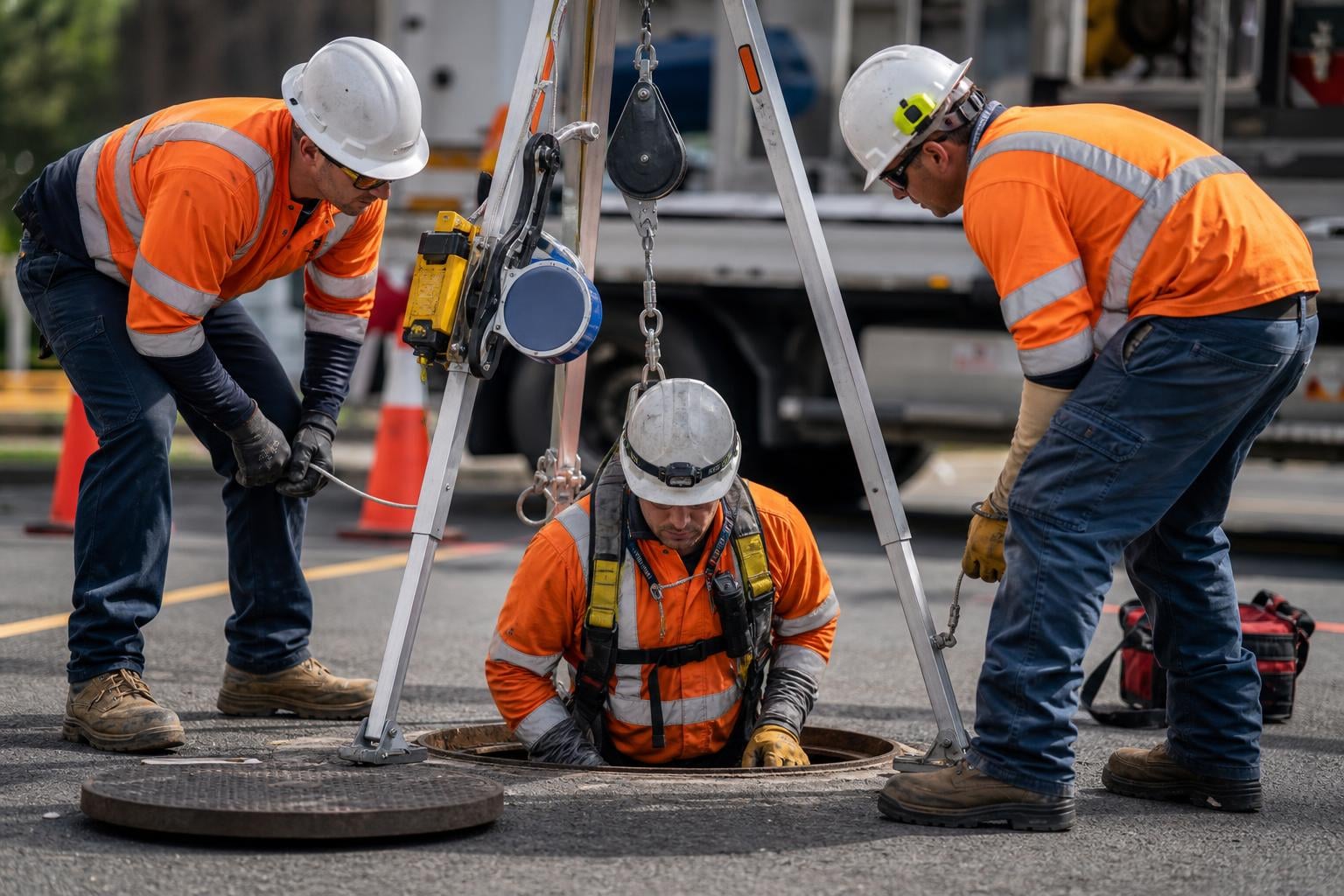
Utility contractors face a hazard profile that generic construction safety content doesn’t address well. Electric line contractors work on energized conductors governed by OSHA’s Subpart V. Underground utility installers enter manholes and vaults classified as permit-required confined spaces. Gas distribution crews excavate around live pipelines. Telecom contractors operate aerial lifts on public rights-of-way. Each of these work types triggers its own set of written OSHA programs that must be documented, trained on, and available for inspection.
The electrical fatality rate for the utility industry sits at 0.75 per 100,000 workers, nearly seven times the all-industry average of 0.11 per 100,000. Construction’s rate is comparable at 0.73 per 100,000. These numbers explain why owner-operators and OSHA both hold utility contractors to strict program requirements.
If your company needs help building or improving these programs, ESR’s utility safety services are built specifically for this industry.
Key Takeaway: What Utility Contractors Need for Safety Compliance Utility contractors do not have a single federal “safety program” mandated by OSHA. Instead, compliance requires hazard-specific written programs (ranging from 10 to 20+ documents depending on work type, such as Subpart V for electrical, Confined Space 1910.146, and Excavation 1926.651), strict field documentation (Job Briefings and OSHA 300 logs), and owner-operator prequalification through platforms like ISNetworld and Avetta. Missing any single written program or failing a prequalification grade (A/B requirement) results in immediate contract disqualification and severe OSHA penalties of up to $16,550 per serious violation.
Why Utility Contractors Face Unique Safety Program Requirements
General construction contractors need solid safety programs. Utility contractors need all of those, plus several more that are specific to their trade.
Three factors create this elevated burden:
Hazard density. A single utility construction crew can encounter fall hazards (pole and tower work), electrical hazards (energized lines), confined spaces (transformer vaults), excavation hazards (underground installation), and respiratory hazards (atmospheric conditions in manholes), all on the same project. Each hazard triggers a separate OSHA written program requirement.
Regulatory layering. Utility contractors are governed by 29 CFR 1926 (construction standards) as the baseline, but electric line contractors also fall under Subpart V (1926.950 through 1926.968), which adds training requirements, the host employer/contract employer framework, minimum approach distances, and job briefing mandates. This is a layer of regulation that most construction contractors never encounter.
Owner-operator gatekeeping. Investor-owned utilities, cooperatives, and municipal utilities require contractors to pass prequalification before bidding on work. These programs often demand safety documentation that goes beyond what OSHA requires. A contractor with perfect OSHA compliance can still be disqualified from work if their ISNetworld or Avetta submissions are incomplete.
Key Terms Every Utility Contractor Safety Manager Should Know
Understanding utility contractor safety program requirements starts with knowing the vocabulary. These terms appear throughout OSHA standards, prequalification platforms, and owner-operator contracts.
Activity Hazard Analysis (AHA)
A task-level document that identifies hazards associated with a specific work activity, assesses the risk, and prescribes controls. AHAs are more granular than job hazard analyses and are often required by owner-operators for each discrete task on a utility project. Learn how AHAs differ from JHAs and when each one applies.
Competent Person
An OSHA-defined role. A competent person is someone who can identify existing and predictable hazards in the surroundings and has the authority to take prompt corrective measures to eliminate them. OSHA requires a designated competent person for excavation (1926.651), scaffolding (1926.451), fall protection (1926.502), and several other standards. This is not a certification; it’s a function that must be filled by a qualified individual on each jobsite.
Contract Employer
Under Subpart V, the contract employer is the entity that performs work on an electric power installation. This term carries specific obligations: the contract employer must ensure its employees are trained, must inform the host employer of hazards its work creates, and must comply with the host employer’s safety procedures. This is distinct from the general construction “subcontractor” concept because Subpart V assigns explicit duties to each role.
Controlling Employer
Under OSHA’s multi-employer worksite policy, the controlling employer has general supervisory authority over the worksite. Even if a controlling employer didn’t create a hazard, it can receive citations for failing to correct hazards it should have detected through reasonable diligence. For a deeper explanation of how this works, see this guide to the multi-employer citation policy.
EMR (Experience Modification Rate)
A workers’ compensation metric that compares your company’s actual loss history to the expected losses for companies of your size in your industry. An EMR of 1.0 is average. Below 1.0 means better than average; above 1.0 means worse. Most utility owners set EMR thresholds (commonly 1.0 or lower) as a prequalification requirement. A detailed explanation of how experience rating works is worth reading if you’re unfamiliar with the calculation.
General Duty Clause
Section 5(a)(1) of the OSH Act. It requires employers to furnish a workplace “free from recognized hazards that are causing or are likely to cause death or serious physical harm.” OSHA uses the General Duty Clause to cite employers for hazards not covered by a specific standard. For utility contractors, this often comes into play with emerging risks like heat illness or traffic control deficiencies where no specific standard exists. Read more about the General Duty Clause and its implications.
Host Employer
Under Subpart V, the host employer is typically the utility that operates or controls operating procedures for the electric power installation. OSHA’s rule states: if the utility or owner neither operates nor controls operating procedures, the employer contracted to perform those functions becomes the host employer. The host employer must inform contract employers of known hazards, existing protective measures, and any energized conditions on the installation.
ISNetworld and RAVS
ISNetworld (ISN) is a contractor prequalification platform used by most major investor-owned utilities. RAVS (Review and Verification Services) is ISN’s document review function, where trained analysts evaluate your written safety programs against both OSHA requirements and the hiring client’s specific standards. Contractors receive grades (A, B, C, F) based on RAVS assessments, incident rates, and insurance compliance. For utility contractors, this ISNetworld guide for contractors covers the basics.
Job Briefing (Tailboard)
Required under Subpart V (1926.952) before each job. The employee in charge must conduct a briefing covering hazards associated with the job, work procedures, special precautions, energy source controls, and PPE requirements. For repetitive tasks where conditions remain unchanged, a brief daily discussion satisfies the requirement. For complex or unusual jobs, a more detailed briefing is mandatory. This is one of the most frequently cited Subpart V violations because crews treat it as a formality rather than a genuine hazard review.
Minimum Approach Distance (MAD)
Voltage-based clearance distances specified in Subpart V (1926.960) that qualified employees must maintain from energized parts. MADs are calculated based on voltage, altitude, and whether tools or equipment could reduce the distance. Violating MADs is among the most dangerous errors a line crew can make.
Multi-Employer Worksite
OSHA’s enforcement framework for worksites where more than one employer has workers present. OSHA assigns liability to four categories of employers: creating, exposing, correcting, and controlling. Utility contractors almost always work under multi-employer conditions because they operate on installations owned by the utility (host employer) alongside other trades. Liability flows in both directions.
OSHA 300 Log
The injury and illness recording form required under 29 CFR 1904. Utility contractors must maintain OSHA 300 logs for at least five years, and prequalification platforms require three years of log data to calculate incident rates. Errors or gaps in 300 log recordkeeping are one of the most common reasons utility contractors fail prequalification reviews.
Permit-Required Confined Space (PRCS)
A confined space (limited entry/exit, not designed for continuous occupancy, large enough to enter) that also contains or has the potential to contain a hazardous atmosphere, engulfment material, internal configuration hazards, or other serious dangers. In utility work, manholes, transformer vaults, underground cable rooms, and some meter pits qualify as permit-required confined spaces. A formal written entry program under 29 CFR 1910.146 is mandatory whenever employees enter these spaces.
Pre-Qualification
The verification process that hiring clients use before allowing a contractor to bid or perform work. For utility contractors, prequalification typically involves submitting OSHA logs, EMR data, written safety programs, training records, and insurance certificates through a platform like ISNetworld or Avetta. Failing prequalification means losing access to work, period.
Qualified Employee (Subpart V)
A worker who has been trained and demonstrated proficiency in the skills and techniques necessary to distinguish exposed live parts from other parts of electric equipment, determine the nominal voltage of exposed live parts, and maintain the required minimum approach distances. This is a defined term under 1926.960, not a general descriptor. Only qualified employees may work on or near energized lines.
Site-Specific Safety Plan (SSSP)
A project-level safety document tailored to the specific hazards, site conditions, and work scope of a particular job. Most utility owners require contractors to submit an SSSP before mobilizing. The plan typically covers emergency procedures, hazard controls, competent person designations, and site-specific rules. For guidance on what belongs in one, see this resource on site-specific safety plan contents.
TRIR (Total Recordable Incident Rate)
A safety performance metric calculated as: (Number of recordable incidents × 200,000) ÷ Total hours worked. Most utility owners set TRIR thresholds as prequalification requirements. ISNetworld displays three years of TRIR data prominently in contractor profiles.
Written Safety Program
A hazard-specific document that describes how an employer will protect employees from a particular hazard. OSHA does not require one master “safety program.” Instead, individual standards (confined space, hazard communication, respiratory protection, etc.) each mandate their own written program when the triggering conditions exist.
Which OSHA Written Programs Do Utility Contractors Need?
This is the core question. OSHA’s written program requirements are scattered across more than 35 individual standards in 29 CFR 1910 (general industry) and more than 20 in 29 CFR 1926 (construction). There is no single checklist in the regulations. The programs you need depend entirely on which hazards your employees encounter.
For utility contractors, here are the programs most commonly required, mapped to their CFR citations and the work types that trigger them:
Written Program | OSHA Standard | Utility Work That Triggers It |
|---|---|---|
Hazard Communication | 1926.59 / 1910.1200 | Chemical solvents, cable compounds, transformer fluids |
Fall Protection | 1926.502 (Subpart M) | Pole climbing, tower work, aerial lifts, bucket trucks |
Electrical Safety / Lockout-Tagout | 1910.147, 1926.417 | Energized lines, switchgear, substations |
Confined Space Entry | 1910.146 / 1926 Subpart AA | Manholes, vaults, underground cable rooms, meter pits |
Respiratory Protection | 1910.134 | Confined space entry, silica exposure from concrete cutting |
Emergency Action Plan | 1926.35 / 1910.38 | All worksites |
Fire Prevention Plan | 1926.24 / 1910.39 | Hot work, fuel storage areas |
Excavation/Trenching | 1926.651-652 | Underground utility installation, pipe laying |
PPE Program (Hazard Assessment) | 1926.95 / 1910.132 | All worksites (written hazard assessment required) |
Hearing Conservation | 1910.95 | Heavy equipment operation, generators, drilling |
Electrical Power T&D (Subpart V) | 1926.950-968 | Electric line construction, substation work |
Silica Exposure Control | 1926.1153 | Concrete cutting, drilling, sawing |
Crane/Hoisting | 1926.1400+ | Utility pole setting, transformer installation |
Drug and Alcohol | Owner requirement (not OSHA) | Nearly all IOU and co-op contracts |
For a comprehensive look at all OSHA written program requirements, including programs beyond utility-specific work, that guide covers the full picture.
The “Big 7” Documents for OSHA Inspections
Practitioners in the safety community frequently reference the seven documents that OSHA compliance officers request first during an inspection:
Written safety and health program
OSHA 300/300A injury logs
Employee training records
Job hazard analyses for observed work
PPE hazard assessment
Hazard Communication program with SDS binder
Relevant permits (confined space, hot work, lockout-tagout)
If you can produce these seven items and your jobsite is clean, you will pass most inspections without citations. If you can’t produce them, you’re exposed. Maximum OSHA civil penalties for 2026 remain capped at $16,550 per serious or other-than-serious violation, $16,550 per day for failure to abate, and up to $165,514 per willful or repeated violation.
It’s worth noting the enforcement reality: OSHA has approximately 1,850 compliance officers covering 130 million workers at more than 8 million worksites, roughly one inspector per 70,000 workers. Inspections are infrequent, but when they happen (often triggered by a complaint, fatality, or referral from a utility owner), the documentation demand is immediate.
Subpart V: What Utility Line Contractors Must Know
OSHA 29 CFR 1926 Subpart V (sections 950 through 968) is the dedicated safety standard for electric power transmission and distribution work. It applies to the construction of electric power T&D lines and equipment, and it adds requirements that go well beyond general construction standards.
Qualified vs. Unqualified Employees
Subpart V draws a hard line between qualified and unqualified employees. Qualified employees have received training that demonstrates their ability to identify energized parts, determine nominal voltages, and maintain minimum approach distances. Unqualified employees have not received this training and must be kept at safe distances from energized components.
The training requirements under Subpart V are not satisfied by generic electrical safety courses. Employees must demonstrate proficiency in the specific skills needed for their assigned tasks. Training must be documented, and refresher training is required when work practices change or when an employee demonstrates a lack of proficiency.
Host Employer vs. Contract Employer
This framework is unique to Subpart V and creates obligations for both the utility owner and the contractor:
The host employer (typically the utility) must inform the contract employer about known hazards, existing conditions, the nominal voltage of lines and equipment, and any protective measures in place. It must also verify that the contract employer has met its obligations before allowing work to begin.
The contract employer must ensure its employees are trained, must inform the host employer about any hazards the contractor’s work creates, and must comply with the host employer’s safety requirements.
When disputes arise over who bears responsibility after an incident, this framework determines OSHA’s enforcement approach. If the utility operates or controls operating procedures for the installation, OSHA treats it as the host employer. If the utility has delegated those functions to the contractor, the contractor becomes the host employer with all corresponding obligations.
Job Briefings
Before each job, the employee in charge must conduct a briefing that covers hazards, procedures, special precautions, energy controls, and PPE. For routine, repetitive work where conditions haven’t changed, a brief verbal discussion is sufficient. For unusual or complex tasks, a more detailed documented briefing is required.
Practitioners on safety forums report that inadequate job briefings are one of the easiest Subpart V violations for OSHA to cite because the documentation either exists or it doesn’t. There’s no ambiguity.
Owner-Operator Requirements Beyond OSHA
For utility contractors, OSHA compliance is the floor. Owner-operator prequalification is the ceiling, and it controls access to work.
PG&E as a Concrete Example
Pacific Gas & Electric’s contractor safety program (SAFE-3001S) is one of the most publicly documented examples of how an investor-owned utility layers requirements onto contractors. PG&E requires:
ISNetworld registration and connection to PG&E’s account
An ISN grade of A or B for medium and high-risk work
Written safety programs specific to the hazards associated with the contractor’s scope of work
Programs that meet all federal and state OSHA requirements
Three years of OSHA 300 log data and incident rate history
Drug and alcohol testing programs
Worker-level training verification
PG&E uses ISNetworld to collect and independently assess contractor safety data, safety programs, and drug/alcohol compliance. Contractors that don’t meet minimum performance standards cannot bid on or perform medium or high-risk work.
This isn’t unique to PG&E. Duke Energy, Southern Company, Dominion, and most other major IOUs operate similar programs through ISNetworld, Avetta, or proprietary systems. Municipal utilities and rural electric cooperatives are increasingly adopting the same approach.
If your company needs contractor prequalification support, getting it right the first time saves months of back-and-forth with platform reviewers.
What Owner-Operators Check That OSHA Doesn’t
Several program requirements come from owner-operators rather than OSHA:
Drug and alcohol programs with random testing protocols
Background screening for workers accessing critical infrastructure
Vehicle safety programs with motor vehicle record reviews
Fatigue management policies for crews working extended shifts
Contractor-specific orientations before site access
Incident notification timelines that are shorter than OSHA’s requirements (some utilities require notification within one hour of any recordable incident)
Prequalification Platform Requirements
ISNetworld and Avetta function as gatekeepers between utility contractors and the work they need. Understanding what each platform evaluates is essential to maintaining access.
ISNetworld
Core ISNetworld requirements for utility contractors include:
OSHA 300 logs and calculated incident rates for the past three years
Experience Modification Rate (EMR) documentation
Written health and safety programs reviewed through RAVS
Insurance certificates meeting hiring client minimums
Employee training records
Completed client-specific questionnaires
The RAVS review process evaluates each written program against both OSHA regulatory requirements and the specific hiring client’s standards. Programs that are missing required elements receive deficiency notices. Unresolved deficiencies lower your ISN grade.
Practitioners report that common ISNetworld grade drops for utility contractors come from three sources: incomplete written programs that don’t address all hazards in the contractor’s scope, expired training certifications, and gaps in OSHA 300 log submissions. The fix is usually straightforward, but the lag time between submitting corrections and receiving an updated grade can cost weeks of work eligibility.
Avetta
Avetta uses a composite scoring model that weights incident history, safety program documentation, insurance compliance, and worker training records. For utility contractors, Avetta’s requirements mirror ISNetworld in many areas, but with differences in how programs are evaluated.
Sophisticated owner-operators in the utility space configure Avetta to verify worker-level qualifications, not just company-level programs. This means individual employees must have current OSHA certifications, trade-specific training records, and sometimes drug and background screening documented within the platform. Generic electrical safety training does not satisfy what these owner-operators are checking.
ISNetworld vs. Avetta: Key Differences for Utility Contractors
Feature / Requirement | ISNetworld (ISN) | Avetta |
Primary Audit Service | RAVS (Review and Verification Services) | Internal compliance auditing team |
Grading & Scoring System | Letter grades (A, B, C, F) based on program compliance and safety metrics | Composite scoring model using weighted risk scoring |
Worker-Level Tracking | Primarily evaluates company-level programs, EMR, and 300 logs | Heavily emphasizes individual worker certifications, site orientations, and screening |
Primary Client Base | Dominant across major investor-owned utilities (e.g., PG&E, Duke) | Widely used across energy, telecom, and general industrial sectors |
Common Safety Program Gaps for Utility Contractors
Based on the patterns visible in prequalification failures and OSHA citations, these are the programs utility contractors most often miss or under-develop:
Respiratory protection. Many utility contractors don’t realize they need a full respiratory protection program under 1910.134 until their crews enter a confined space with atmospheric hazards. The program requires medical evaluations, fit testing, and documented training, not just having respirators on the truck.
Silica exposure control. Concrete cutting, core drilling, and saw cutting during underground utility work triggers OSHA’s silica standard (1926.1153). This requires either compliance with Table 1 engineering controls or exposure monitoring and a written exposure control plan.
Drug and alcohol programs. OSHA doesn’t require these, but virtually every IOU contract does. Contractors that treat this as optional find themselves disqualified from their most profitable work.
Crane and rigging programs. Utility pole setting, transformer installation, and heavy equipment lifts require compliance with OSHA’s crane standards (1926 Subpart CC). Many utility contractors have been setting poles for decades without a documented lift planning process, and this gap shows up in prequalification reviews.
Updated OSHA 300 logs. Prequalification platforms require three years of data. Contractors that don’t maintain logs consistently, or that have years with missing data, face automatic disqualification flags.
Construction and extraction workers experienced 1,032 fatalities in 2024 according to Bureau of Labor Statistics data. The construction fatality rate was 9.2 deaths per 100,000 full-time equivalent workers. These statistics aren’t abstract. They represent the conditions that drive both regulators and owner-operators to demand comprehensive written programs.
The National Utility Contractors Association (NUCA) offers individualized technical assistance from full-time Certified Safety Professionals who can help contractors establish and implement programs that meet compliance requirements. They’re a valuable industry resource, particularly for underground utility contractors.
If your programs have gaps and you’re not sure where to start, safety program development services can get your documentation current without pulling your safety team off jobsites.
How to Build and Maintain Compliant Utility Contractor Safety Programs
Meeting utility contractor safety program requirements isn’t a one-time project. Programs need to reflect current regulations, current work scopes, and current owner-operator expectations. Here’s the practical sequence:
Step 1: Inventory your hazard exposures. List every work type your company performs. Map each work type to its triggered OSHA standards using the table above.
Step 2: Audit your existing written programs. Compare what you have against what’s required. Most utility contractors discover they have some programs but not all, or that existing programs are outdated and missing required elements. A safety manual audit is the fastest way to identify gaps.
Step 3: Build missing programs to OSHA specifications. Each written program has specific content requirements defined in its standard. A confined space program under 1910.146 must include specific elements: entry procedures, attendant duties, rescue procedures, and equipment specifications. A generic template that doesn’t address your specific confined spaces won’t pass a RAVS review.
Step 4: Train and document. Every written program requires corresponding employee training. Training must be documented with dates, topics, trainer credentials, and attendee names. Undocumented training is the same as no training from both OSHA’s and a prequalification reviewer’s perspective.
Step 5: Submit to prequalification platforms. Upload programs, training records, OSHA logs, insurance certificates, and EMR documentation. Respond to RAVS deficiency notices promptly.
Step 6: Review and update annually. At minimum, review all written programs annually. Update whenever you add new work types, encounter new hazards, or when OSHA amends a standard. Owner-operators increasingly require annual program resubmission as a condition of maintaining qualification.
Frequently Asked Questions
Does OSHA require utility contractors to have a safety program?
OSHA does not require a single master safety program. Instead, OSHA requires individual written programs for each hazard your employees are exposed to. A utility contractor performing electric line construction, confined space entry, and excavation work would need separate written programs for each of those hazards, plus additional programs for hazard communication, PPE, emergency action planning, and others depending on conditions. The total number of required programs for a typical utility contractor ranges from 10 to 20 or more.
What written programs does a utility contractor need for ISNetworld?
ISNetworld requires written safety programs specific to the hazards associated with your registered work types. At a minimum, most utility contractors need programs for hazard communication, fall protection, electrical safety/LOTO, confined space entry, excavation, emergency action planning, and PPE. ISNetworld’s RAVS reviewers evaluate each program against OSHA requirements and the hiring client’s specific standards. Missing or deficient programs lower your grade.
What is OSHA Subpart V?
Subpart V (29 CFR 1926.950 through 1926.968) is OSHA’s safety standard specifically for the construction of electric power transmission and distribution lines and equipment. It establishes minimum approach distances for energized conductors, defines qualified and unqualified employee training requirements, creates the host employer/contract employer framework, mandates pre-job briefings, and sets requirements for protective grounding, live-line tools, and de-energizing procedures. It applies to electric line contractors and any employer whose workers are exposed to T&D hazards.
Who is responsible for safety on a utility worksite?
Under OSHA’s multi-employer worksite doctrine and Subpart V’s host/contract employer framework, multiple parties share responsibility. The host employer (typically the utility owner) must communicate known hazards and verify contractor compliance. The contract employer must ensure its workers are trained and protected. Under the multi-employer doctrine, a controlling employer can be cited for failing to address hazards it should have detected, even if another employer created them. Liability doesn’t rest with one party.
How often do safety programs need to be updated?
OSHA doesn’t specify a universal update frequency, but several individual standards require annual reviews (confined space programs, for example, must be reviewed after each entry or annually). In practice, most utility owners and prequalification platforms require annual program resubmission. Programs should also be updated whenever your scope of work changes, a new hazard is identified, an incident reveals a program deficiency, or OSHA amends the underlying standard.
What happens if a utility contractor fails prequalification?
Failing prequalification means you cannot bid on or perform work for that hiring client. For utility contractors whose revenue depends on IOU or municipal utility contracts, a failed prequalification can effectively shut down a significant portion of the business. Restoring qualification requires correcting all identified deficiencies, resubmitting documentation, and waiting for review, a process that can take weeks to months depending on the platform and the severity of the gaps.
What is the difference between a qualified and unqualified employee under Subpart V?
A qualified employee has received training and demonstrated proficiency in recognizing and avoiding electrical hazards associated with T&D work, including identifying energized parts, determining nominal voltages, and maintaining minimum approach distances. An unqualified employee has not received this training. Unqualified employees must not approach energized parts closer than the distances specified in 1926.966 Table V-7, and they must be supervised when working near electrical hazards. The distinction is not about job title; it’s about documented, demonstrated competence.
Utility contractor safety program requirements sit at the intersection of federal regulation, owner-operator standards, and prequalification platform demands. Getting any one of those wrong costs your company work, money, or both. If you need help building programs that satisfy all three, ESR works with utility contractors nationwide to close gaps and maintain qualification.