
TLDR
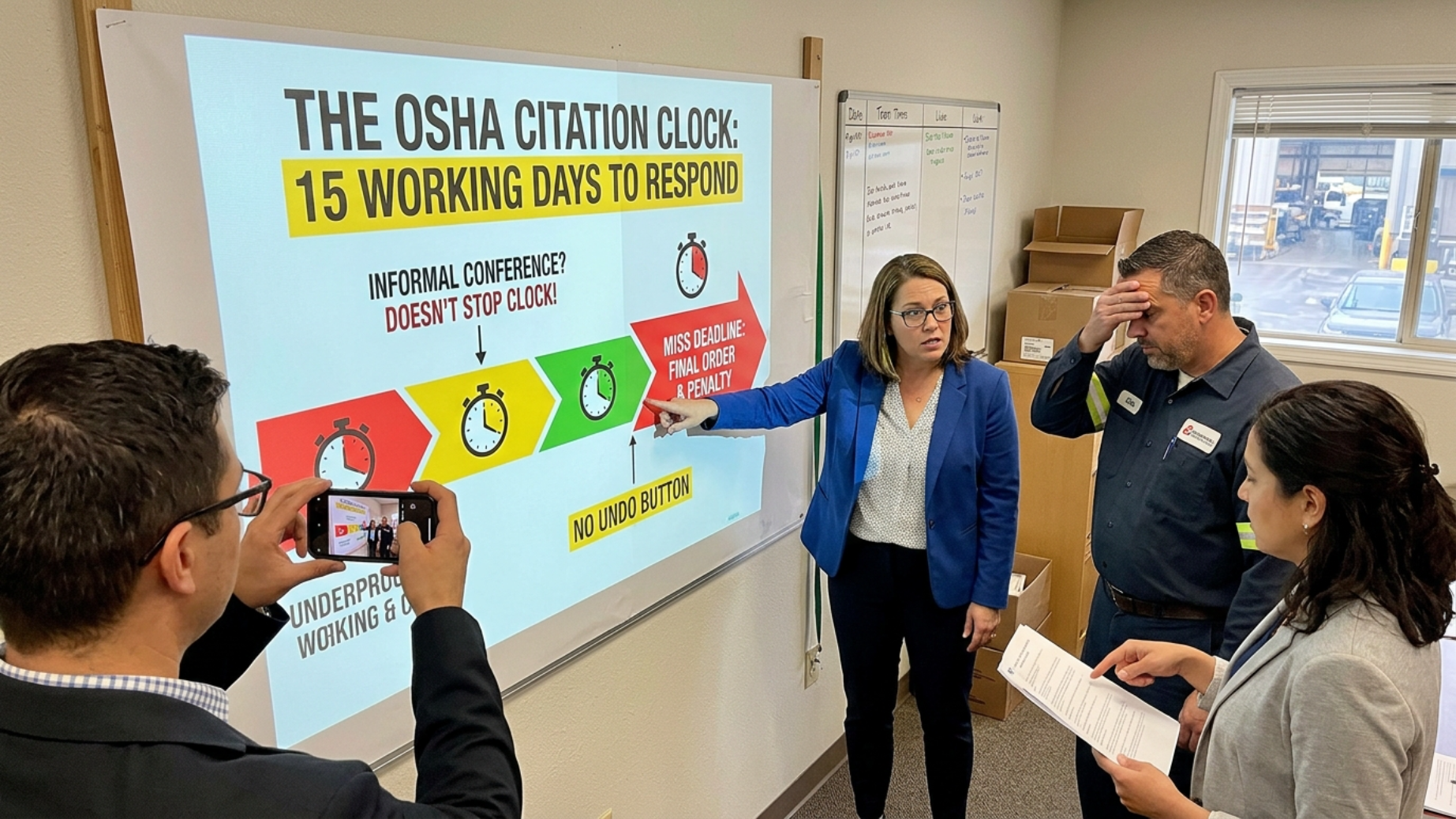
An OSHA response consultant is a safety professional or firm that helps employers respond to OSHA inspections, incidents, citations, and abatement requirements. Hiring one matters most when deadlines are tight, because employers have only 15 working days after receiving a citation to request an informal conference or file a notice of contest. Crucially: Requesting an informal conference does NOT pause or stop this 15-day contest clock. They are not attorneys and do not replace legal counsel when litigation, criminal exposure, or privileged strategy is involved.
This is not a role most employers think about until something goes wrong. OSHA arrives at the gate. A worker gets hospitalized. A certified letter shows up with a Citation and Notification of Penalty attached. In those moments, the question is not whether safety matters. It is whether the employer can respond accurately, completely, and on time.
OSHA response is time-sensitive. After receiving a citation, an employer generally has 15 working days to request an informal conference or file a notice of contest, and requesting an informal conference does not pause that deadline source. Miss the window, and the citation and proposed penalty become a final order of the Occupational Safety and Health Review Commission. There is no undo button.
In plain English: an OSHA response consultant helps you get organized when OSHA is involved. They help answer: What happened? What standard applies? What proof do we have? What needs to be fixed? What must be reported? What deadline are we under? What should be handled by legal counsel?
At a Glance: What is an OSHA Response Consultant?
An OSHA response consultant is a specialized safety professional who manages the technical and administrative requirements of an OSHA enforcement action. They provide four critical services:
Inspection Management: Acting as the employer’s technical representative during onsite walkarounds.
Citation Defense: Identifying factual errors in OSHA citations and preparing for informal conferences.
Abatement Documentation: Compiling the photographic and training evidence required to prove a hazard is fixed.
Reporting Compliance: Managing the 8-hour (fatality) and 24-hour (hospitalization) reporting clocks to avoid late-filing penalties.
Key Takeaway: While an attorney handles legal privilege and litigation, a response consultant handles the technical proof and safety systems required to reduce penalties and prevent repeat violations.
What Does an OSHA Response Consultant Actually Do?
A common mistake on competitor websites is equating OSHA response with citation defense. That framing is too narrow. OSHA response is a lifecycle that spans five distinct phases, and a consultant can help in each one.
Inspection Response
When OSHA shows up (or sends a document request), a consultant can help with the opening conference, identify the employer representative for the walkaround, clarify inspection scope, coordinate document requests, take parallel notes and photos, track what OSHA asks for and what the employer provides, and prepare for the closing conference.
This matters because complaint inspections are generally limited to hazards listed in the complaint, but OSHA can cite plain-sight violations and may expand the inspection based on professional judgment or worker conversations source. Scope control is not about hiding problems. It is about managing the process so the employer provides accurate, relevant information without volunteering speculation.
Practitioners on Reddit’s SafetyProfessionals forum emphasize that fast, clean documentation often shapes the inspection experience. One thread focused on lessons learned from OSHA inspections highlighted how preparation and organized records make the difference between a smooth process and a drawn-out enforcement action.
Incident Response
Before any citation exists, a reportable incident can trigger OSHA involvement. Employers must report a work-related fatality within 8 hours and an in-patient hospitalization, amputation, or loss of an eye within 24 hours source. These are not flexible deadlines.
An OSHA response consultant helps determine whether the event is reportable, preserve the incident scene, support root-cause investigation, collect photos and equipment records, draft corrective action plans, update JHAs and written procedures, and provide retraining. For employers with Spanish-speaking crews, bilingual communication during an incident response is not optional. Corrective actions only work when every worker understands what changed and why.
If you need to understand your reporting obligations more broadly, OSHA’s submission requirements for injury and illness records have expanded in recent years.
Citation Response
After a citation is received, the consultant reviews each citation item and cited standard, checks the alleged facts against actual jobsite or facility conditions, identifies missing or incorrect assumptions, and gathers abatement documentation. They help the employer understand the options: accept the citation, request an informal conference, contest, partially contest, or negotiate abatement dates.
OSHA says an informal conference can be used to get a better explanation of cited violations, discuss ways to correct them, address abatement dates, discuss employee safety practices, and resolve disputed violations source. OSHA’s Field Operations Manual further states that Area Directors can amend abatement dates, reclassify violations, and modify or withdraw penalties when evidence justifies the change source.
A consultant’s value here is not knowing some secret loophole. It is organizing the facts, documents, and corrective actions so OSHA can evaluate the response clearly.
For a step-by-step breakdown of what happens after you get a citation, read the 4-step process every company should know after receiving an OSHA citation.
Abatement and Follow-Up
Response does not end after the informal conference. OSHA requires abatement certification for each non-contested violation, and abatement documentation may include photographs, video, receipts, training records, or other proof that corrective action occurred source.
If the employer cannot meet an abatement date for reasons beyond its control, a Petition for Modification of Abatement must be submitted no later than one working day after the abatement date and must include steps taken, additional time needed, reasons, interim protective measures, and posting certification source.
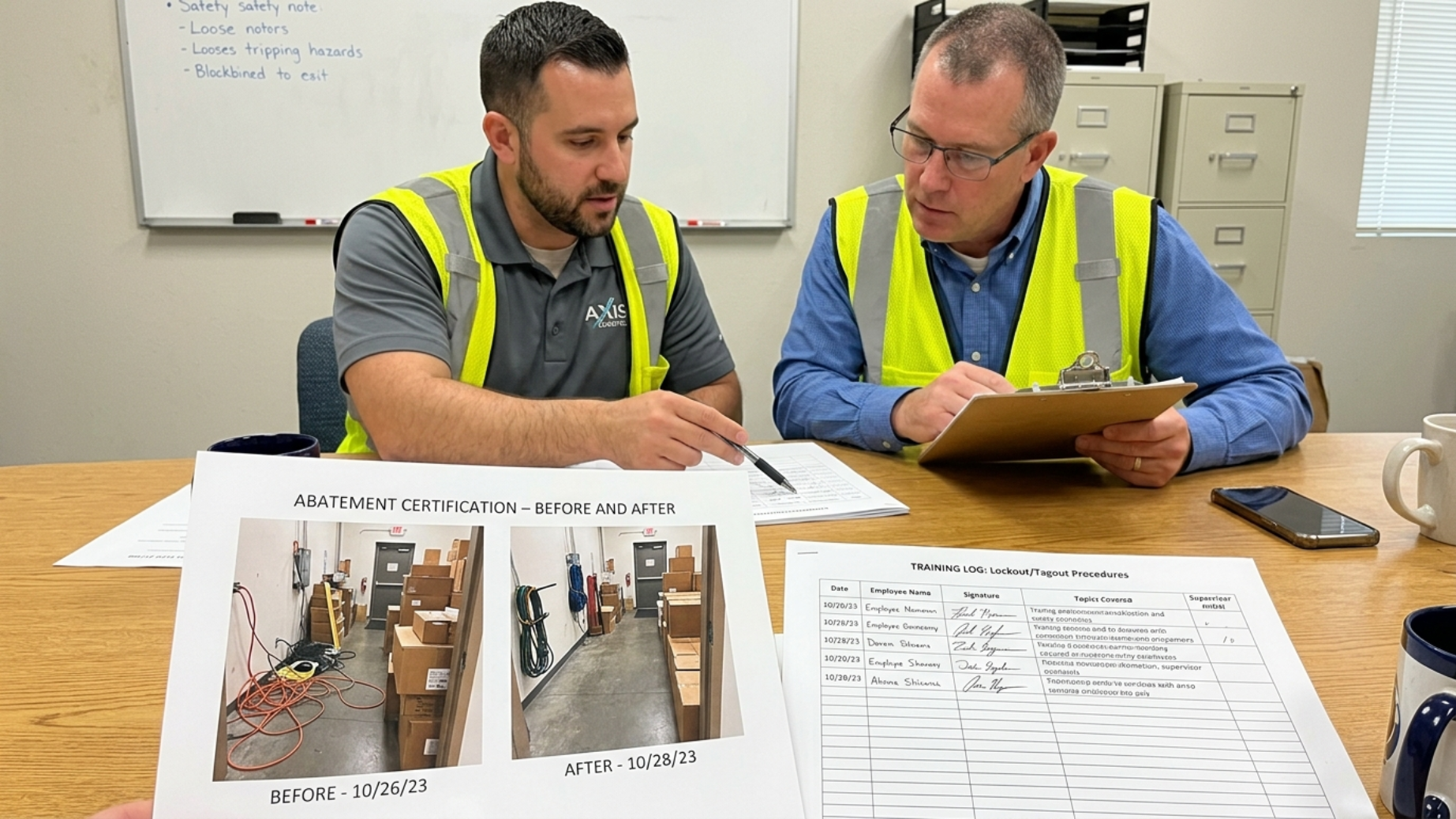
A consultant helps verify corrections, compile documentation, build interim controls when fixes take time, and train employees on new procedures. Ongoing field safety inspections are often part of the abatement verification process.
Future-Risk Response
The fifth phase is the one most employers skip: preventing the same citation from appearing at other sites, in future inspections, or in a repeat classification that multiplies penalties. This means updating written programs, retraining supervisors, auditing other locations, and building the corrective actions into the safety management system.
The Four Clocks in OSHA Response
Every OSHA response runs against at least one deadline. Here are the four that matter most.
Clock | Trigger | What Happens | Consultant Role |
8 hours | Work-related fatality | Employer must report to OSHA within 8 hours. | Help determine reportability, preserve evidence, coordinate investigation. |
24 hours | Hospitalization, amputation, or loss of eye | Employer must report within 24 hours. | Verify facts, avoid under-reporting, start corrective action. |
15 working days | Receipt of Citation & Notification of Penalty | Employer must request informal conference or file notice of contest. Note: The 15-day contest clock continues to run even if an informal conference is scheduled. | Review citation, gather evidence, prepare abatement proof, support informal conference strategy. |
6 months | Occurrence of alleged violation | OSHA generally cannot issue a citation after six months following the violation. | Track case timeline, organize inspection chronology, flag timing questions for counsel. |
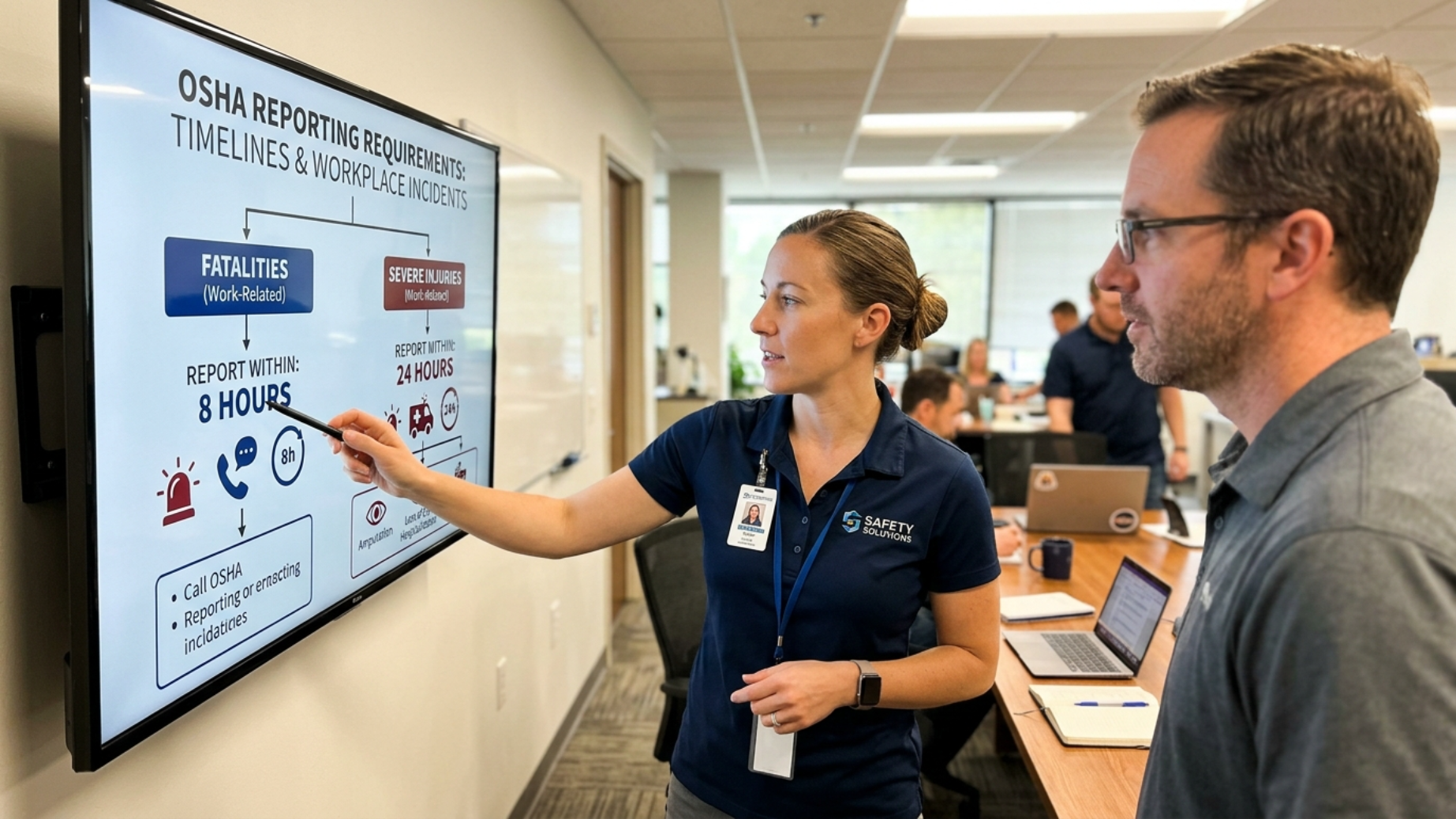
This framework turns a vague concept into something operational. When someone calls a consultant, the first question should be: which clock is running?
Practitioners on Reddit report real confusion about when the 15-working-day period starts. One safety professional asked whether the clock begins when the inspector mentions possible citations or when the actual Citation and Notification of Penalty is received. The answer, per OSHA’s own language, is that the period starts upon receipt of the citation. But the confusion is common enough to cause missed deadlines.
OSHA Response Consultant vs. Attorney vs. OSHA On-Site Consultation
One of the biggest points of confusion is the difference between these three options. They serve different purposes, and the right choice depends on the situation.
Option | Best For | Not Best For | Key Detail |
|---|---|---|---|
Private OSHA response consultant | Technical safety review, inspection support, abatement documentation, corrective action planning, training records, mock inspections, informal conference preparation | Legal advice, privileged strategy, formal litigation, criminal defense | Best when the issue is technical, documentation-heavy, or prevention-focused |
OSHA defense attorney | Willful/repeat citations, fatalities, criminal exposure, contested cases, litigation, privilege-sensitive investigations | Routine program updates, field training, daily safety staffing | Best when legal risk, privilege, liability, or formal contest strategy matters |
OSHA On-Site Consultation Program | Preventive help for smaller businesses before enforcement problems occur | Active enforcement response (federal regulation limits consultative visits once enforcement is active) | No-cost and confidential, provided by state agencies or universities, but different from hiring a private consultant |
OSHA’s On-Site Consultation Program is a valuable resource. It has helped small and midsize businesses find and fix hazards since 1975, and OSHA estimates it prevents over 8,700 workplace injuries and saves nearly $1.5 billion annually. But it has a critical limitation: federal regulation states that onsite consultative visits generally cannot take place after an OSHA enforcement inspection until citation items have become final orders source. That means if you already have a citation or an active inspection, the free program likely cannot help you right now.
A private OSHA response consultant fills that gap. They can support technical response and field execution while coordinating with legal counsel when the risk warrants it. An attorney should guide legal strategy, privilege, litigation risk, and formal contests.
When Should You Hire an OSHA Response Consultant?
Consider hiring one when:
OSHA is onsite or has requested documents
A worker fatality, hospitalization, amputation, or eye loss occurred
A citation was received and the 15-working-day window is open
The employer lacks a full-time safety manager or qualified in-house safety leadership
The cited issue involves technical standards like fall protection, scaffolding, lockout/tagout, respiratory protection, machine guarding, confined space, trenching, silica, or hazard communication
The jobsite is a multi-employer construction site with shared employer responsibilities
The employer has prior OSHA history and repeat-violation exposure is possible
Bilingual employee communication or training is needed
Abatement must be proved across multiple jobsites
The employer needs a qualified safety professional onsite fast
That last point deserves emphasis. After an OSHA inspection or serious incident, project owners and general contractors often require the employer to have a dedicated safety professional onsite immediately. ESR provides onsite safety staffing and field services nationwide, with a 48-hour average placement and no travel surcharge within 50 miles of its offices in Raleigh, Charlotte, Wilmington, Alexandria, and Allen, TX.
What Documents Should You Gather Before an Informal Conference?
On Reddit, safety professionals consistently advise bringing abatement proof and a timeline to the informal conference. One thread specifically recommended preparing a summary of completed corrective actions and a timeline for items not yet completed. James Junkin, a credentialed safety practitioner, wrote on LinkedIn that employers should arrive with documentation of corrective action, evidence of good faith, and a plan for systemic safety improvements.
Here is a practical checklist:
Citation package and inspection number
Written safety program sections tied to cited standards
Site-specific safety plan
JHAs, AHAs, or JSAs
Training records (including OSHA-required training documentation)
Toolbox talk records
Competent person documentation
Equipment inspection logs
Photos and videos of corrected hazards
Receipts or purchase orders for corrective equipment
Disciplinary records (if employee misconduct is relevant)
Incident investigation report
Corrective action plan with responsible persons and due dates
OSHA 300, 300A, and 301 records if relevant
Prior citation history and abatement proof
Employee communication records, including Spanish-language training documentation
OSHA says abatement documentation may include photographs, video, receipts, training records, and other verification source. The stronger and more organized this package is, the more productive the informal conference will be.
If you are not sure whether your written safety programs are complete, it is worth reviewing whether your safety manual is OSHA-compliant before the conference.
Common OSHA Response Mistakes
These are the errors that turn manageable situations into expensive ones.
1. Missing the 15-working-day deadline. Once it passes, the citation becomes a final order. There is no extension.
2. Assuming an informal conference pauses the contest clock. It does not. OSHA is explicit: the running of the contest period is not interrupted by an informal conference source.
3. Failing to post citations. OSHA requires citations to be posted at or near the place of violation, or where employees can readily observe them, until the violation is abated or for 3 working days, whichever is longer.
4. Correcting hazards but failing to document abatement. Fixing the condition is necessary but not sufficient. Without documentation, the employer cannot prove abatement.
5. Submitting speculative or poorly worded explanations. One safety professional on Reddit described an early-career mistake: photographing everything the investigator photographed, correcting everything they thought OSHA noticed, and submitting an immediate response that “was essentially admitting guilt.” Correct hazards immediately, but be careful how you describe the facts. This is where a consultant and attorney may work together, fixing the condition and documenting abatement accurately without creating unnecessary liability.
6. Letting inspection scope expand unnecessarily. An employer representative who rambles or volunteers unrelated information can turn a focused complaint inspection into a wall-to-wall audit.
7. Ignoring state-plan differences. North Carolina and Virginia operate OSHA-approved State Plans. Texas is under federal OSHA jurisdiction for most private-sector workers source. The agency name, forms, deadlines, and appeal procedures can vary.
8. Treating a consultant as a substitute for legal counsel in high-risk cases. When fatalities, willful citations, criminal exposure, or formal contests are in play, an attorney should guide the strategy.
9. Fixing one site but leaving the same hazard at other jobsites. Current maximum penalties assessed after January 15, 2026, are $16,550 per serious violation, $16,550 per day for failure to abate, and $165,514 per willful or repeated violation.”
10. Failing to communicate with Spanish-speaking crews in a language they understand. Corrective actions, retraining, and toolbox talks are only effective if every affected worker actually comprehends them.
2026 Enforcement Priorities: What Consultants Look For Now
In 2026, OSHA has shifted focus toward “High-Energy Hazards” and climate-related enforcement. A response consultant focuses on these three trending areas:
Heat Illness Prevention: Following the 2026 updates to the Heat NEP, OSHA now triggers inspections on “Heat Priority Days” (80°F+). Consultants help document acclimatization protocols and rest-shade-water logs.
The “Walkaround Rule” Expansion: OSHA now allows third-party representatives to join inspections. Consultants help manage these third parties to ensure the inspection stays within the legal scope.
Electronic Recordkeeping (Form 300A): With the March 2nd annual deadline, OSHA is using AI to flag employers with “suspiciously low” or “doubled average” injury rates for targeted audits.
OSHA Response Consultant Examples by Industry
Construction
Fall protection was OSHA’s most frequently cited standard in FY 2025, followed by hazard communication, ladders, and scaffolding source. Construction also had the most private-industry workplace deaths in 2024, with 1,034 fatalities source.
A typical scenario: a general contractor’s subcontractor receives a fall protection citation on a multi-employer jobsite. The OSHA citation response consultant reviews the fall protection plan, training records, competent person documentation, site inspection photos, subcontractor coordination records, and abatement evidence. They help identify whether the controlling, creating, exposing, or correcting employer classification applies and organize documentation for the informal conference.
For more context on the specific standards most often cited, see this overview of common OSHA construction violations.
Manufacturing
Lockout/tagout and machine guarding are both in OSHA’s FY 2025 Top 10. A consultant in this setting reviews LOTO procedures, authorized and affected employee training, machine-specific energy control steps, guarding corrections, and retraining documentation. Respiratory protection and hazard communication compliance are also frequent citation categories in manufacturing environments.
Utilities and Power Generation
Contractor crew incidents or energized equipment concerns are common triggers. A consultant supports incident investigation, reviews job briefings, verifies employee training records, and helps develop corrective actions that address both the immediate hazard and the systemic gap.
Municipalities and Public Agencies
State-plan states like North Carolina and Virginia cover state and local government workers under their own programs. A consultant helps determine whether federal OSHA, a state plan, or state public-sector rules apply, which directly affects the citation process, appeal procedures, and penalty structure source.
What Credentials Should an OSHA Response Consultant Have?
Not every “safety consultant” has the background to handle OSHA response effectively. Look for:
OSHA 500/501 or OSHA Outreach Trainer authorization
Professional credentials such as CSP, CHST, ASP, SMS, or CIH depending on scope
Construction and/or general industry experience
Incident investigation experience
Familiarity with 29 CFR 1910 (general industry) and 29 CFR 1926 (construction)
Ability to prepare abatement documentation and certification
Experience with informal conference preparation
Bilingual capability when field crews need Spanish-language training or interviews
Field credibility with superintendents, foremen, plant managers, and executives
Willingness and ability to work with legal counsel when needed
The General Duty Clause is another area where a credentialed consultant adds value. OSHA can cite recognized hazards even when no specific standard appears to apply, and defending or abating a General Duty Clause citation requires strong technical knowledge.
The Stakes Are Real
OSHA conducted 34,625 inspections in FY 2024, but the financial risk has peaked in 2026. Current maximum penalties assessed after January 15, 2026, are $16,550 per serious violation, $16,550 per day for failure to abate, and $165,514 per willful or repeated violation.
Current maximum penalties assessed after January 15, 2025 are $16,550 per serious violation, $16,550 per day for failure to abate, and $165,514 per willful or repeated violation source.
Beyond penalties, the National Safety Council estimated the total cost of work injuries in 2023 at $176.5 billion, with an estimated $43,000 per medically consulted injury and $1,460,000 per death source. The financial case for effective OSHA response and prevention is not subtle.
As one LinkedIn post from Safety Knights put it, the goal should be “OSHA leaves with no citations,” and that result comes from being ready every day, not scrambling when an inspector arrives.
The Best OSHA Response Starts Before OSHA Arrives
Everything in this article applies after the fact. But the most effective OSHA response consultants help employers before there is an emergency. That means mock OSHA inspections, written program reviews, field audits, supervisor training, and safety staffing that keeps qualified people onsite every day.
If your company does not have a dedicated safety leader or your current programs have not been tested against actual OSHA standards, a mock OSHA inspection can identify gaps before an inspector does. ESR provides local consulting within 50 miles of its offices with no travel surcharge, nationwide safety staffing with a 48-hour average placement, bilingual EN/ES field and training staff, and a credentialed team including CSP, CHST, OSHA 500/501, NCCER instructors, and MS-OSH professionals.
Whether you need help responding to an active citation, preparing for a possible inspection, or building a safety program that holds up under scrutiny, contact Evolution Safety Resources to discuss your situation.
Frequently Asked Questions
Is an OSHA response consultant the same as an OSHA consultant?
Not exactly. A private OSHA response consultant is hired and paid by the employer to help with inspections, citations, incidents, and compliance. OSHA’s On-Site Consultation Program is a separate, no-cost, confidential program primarily for smaller businesses, provided through state agencies or universities source. The free program has restrictions once enforcement is active.
Does requesting an informal conference stop the 15-working-day contest deadline?
No. OSHA states clearly that the running of the contest period is not interrupted by an informal conference source. If you want to preserve your right to contest, you must file a notice of contest within the 15-working-day period regardless of whether an informal conference is scheduled.
Can an OSHA response consultant attend an informal conference?
A consultant may help prepare documentation and may attend, depending on the employer’s approach. However, legal counsel should be involved when the situation involves fatalities, willful or repeat classifications, criminal exposure, or formal contest strategy.
Can OSHA cite more than the original complaint item during an inspection?
Yes. Complaint inspections are generally limited to hazards listed in the complaint, but OSHA says plain-sight violations may be cited and an inspector may expand the inspection based on professional judgment or worker conversations source.
What is the difference between abatement certification and abatement documentation?
Abatement certification is the employer’s written notice that a cited hazard was corrected. Abatement documentation is the supporting proof, such as photos, video, receipts, repair records, or training records source.
Should I fix a hazard before the informal conference?
Yes. Hazards should be corrected promptly to protect employees. But document the corrective action carefully and avoid speculative language about why the hazard existed. Bring that documentation to the informal conference.
How much can OSHA penalties be?
For penalties assessed after January 15, 2026, the maximum is $16,550 per serious, other-than-serious, or posting violation; $16,550 per day for failure to abate; and $165,514 per willful or repeated violation.
Does every employer need an OSHA response consultant?
No. Some low-risk questions can be handled internally or through OSHA’s free consultation program. But employers should consider outside help when deadlines are active, the event is reportable, citations are serious or repeat or willful, documentation is weak, or the company lacks qualified in-house safety leadership.
This article is for safety and compliance education only and is not legal advice. Employers facing fatalities, willful or repeat citations, criminal exposure, formal contests, or litigation should consult qualified legal counsel.