
TL;DR
A safety consulting and staffing company combines advisory expertise (program writing, audits, OSHA compliance) with the ability to place credentialed safety professionals on your jobsite. The best hybrid firms eliminate the handoff gaps that occur when you buy consulting and staffing from separate vendors. This list ranks eight companies across placement speed, geographic reach, credentials, and proprietary technology. Evolution Safety Resources tops the list for its 48-hour placement benchmark, bilingual field staff, and full lifecycle coverage from prevention through expert witness.
Key Takeaways: Top Safety Consulting & Staffing Companies (2026)
Best Overall Hybrid Provider: Evolution Safety Resources (ESR) ranks #1 due to its published 48-hour placement benchmark, bilingual (English/Spanish) field staff, full lifecycle services (prevention through expert witness), and zero travel surcharges within 50 miles of regional offices.
Best Enterprise Tech-Enabled Platform: Safety Management Group (SMG) leads for large-scale enterprise operations requiring 300+ field associates and real-time compliance tracking via its proprietary VERO software.
Best On-Demand Marketplace: YellowBird offers 24–48 hour AI-matched placement for short-term, site-specific safety assessments and hazard audits.
Core Selection Criteria: Premier firms should offer true hybrid capabilities (program writing + field execution), hold BCSP certifications (CSP, CHST), and explicitly address shared OSHA liability in vendor contracts.
What a Safety Consulting and Staffing Company Actually Is (and Isn’t)
Most buyers shopping for a safety consulting and staffing company already know they need help. The question is what kind. Three distinct models exist in this market, and confusing them is expensive.
Consulting-only firms write your safety programs, conduct audits, and advise on OSHA compliance. They don’t place people on your site to execute the plan day after day.
Staffing-only firms send bodies. They fill a seat on your jobsite with a safety professional, but they don’t write the program that person is supposed to enforce.
Hybrid firms do both. They write the plan and put a credentialed person on-site to run it. This matters because the handoff between a consulting firm that wrote your safety manual and a staffing agency that placed someone who’s never seen it is where compliance gaps breed.
A 2025 study by ASSP and J.J. Keller found that 38% of construction firms still lack a proactive approach to safety and regulatory compliance. The hybrid model exists to close exactly that gap.
One more thing buyers frequently miss: OSHA holds both the host employer and the staffing agency responsible for temporary worker safety. Hiring a safety consulting and staffing company does not transfer your OSHA obligations. The host employer must still record injuries and illnesses for temporary workers it supervises daily. The best hybrid firms help you structure contracts that define these shared responsibilities upfront, rather than leaving it ambiguous until an inspector shows up.
Practitioners on Reddit consistently describe the frustration of working with general staffing firms that “send whoever’s available” without understanding technical safety demands. The result is wasted time reviewing unqualified resumes, and sometimes unqualified people on jobsites where lives depend on competence. A hybrid safety consulting and staffing company with its own credentialed bench avoids this entirely.
If you already know you need a hybrid partner and want to explore what contract safety professionals look like in practice, that’s a good starting point for understanding roles and deployment models.
Buyer’s Decision Matrix: Which Model Fits Your Risk Profile?
Choosing between consulting-only, staffing-only, or hybrid vendors depends on whether you need policy creation, field execution, or both.
Business Need | Consulting-Only | Staffing-Only | Hybrid (Consulting + Staffing) |
Custom Safety Program Writing (I2P2, HASP) | Yes | No | Yes |
Immediate On-Site Credentialed Staffing | No | Yes | Yes |
Zero Gap Between Plan Design & On-Site Execution | No | No | Yes |
OSHA Representation & Citation Defense | Yes | No | Yes |
Contractual Shared OSHA Liability Structuring | Limited | Limited | High |
At-a-Glance Comparison Table
Company | Model | Placement Speed | Geographic Coverage | Proprietary Software | Best For | Employee Rating |
|---|---|---|---|---|---|---|
Evolution Safety Resources | Hybrid | 48 hours | Nationwide staffing, Southeast + DFW consulting | None | Mid-market construction, bilingual sites | 3.7/5 (Glassdoor) |
HB NEXT | Hybrid | Days (no benchmark published) | Nationwide | Sequence XT | Tech-enabled compliance | Limited data |
Safety Management Group | Hybrid | Not published | Nationwide (500+ associates) | VERO | Enterprise scale | 4.3/5 (Glassdoor) |
CORE Safety Group | Staffing-heavy | Not published | Nationwide, DFW strength | None | Mid-tier GC construction | 4.3/5 (Glassdoor) |
Safe T Professionals | Staffing-heavy | 72 hours | Nationwide + select Asia | None | Federal/DOE/DOD projects | Limited data |
Lancaster Safety Consulting | Consulting-heavy | Not applicable | Nationwide | None | Training-first approach | 4.6/5 (Glassdoor) |
YellowBird | Platform/marketplace | 24-48 hours | Nationwide | AI matching platform | Multi-site on-demand audits | Limited data |
BSI Consulting | Consulting-only | Not applicable | Global | None (standards body tools) | ISO 45001 / global firms | N/A |
For a deeper comparison focused specifically on staffing providers, see our breakdown of the best safety staffing companies.
The 8 Best Safety Consulting and Staffing Companies in 2026
1. Evolution Safety Resources (ESR)
Best for: Mid-market construction contractors, GCs, and specialty subs in the Southeast and DFW who need both consulting depth and rapid staffing under one vendor.
Overview: ESR operates as a true hybrid safety consulting and staffing company with two distinct service lines. Local consulting is available within 50 miles of any of its five offices (Raleigh NC headquarters, Charlotte NC, Wilmington NC, Alexandria VA, and Allen TX) with no travel surcharge. Nationwide safety staffing operates on a 48-hour average placement promise, making it one of the fastest published benchmarks in the industry.
Key features:
48-hour average placement for credentialed safety professionals, nationwide
Bilingual EN/ES field and training staff for mixed-language jobsites
Team credentials include CSP, CHST, OSHA 500/501, NCCER instructors, and MS-OSH holders
NCCER Accredited Training Unit status
Full lifecycle coverage from prevention through construction safety expert witness services
No travel surcharge within 50 miles of any office
Five physical office locations across the Southeast and Texas
BBB A+ rating
Pricing: Not published. Intake via “Request a Safety Pro” form. For general rate context, our safety staffing cost guide breaks down typical markups and billing structures.
Employee sentiment: Glassdoor rates ESR 3.7/5 across 17 reviews. Positives cite family feel and professional growth opportunities. Compensation is rated lowest at 3.1/5. The leadership team is active in the industry, with President Julia Kunlo, MSOSH, CSP, speaking at ASSP Safety 2025.
Tradeoffs:
No proprietary software platform (competitors HB NEXT and SMG both offer one)
No published case studies or named client logos on the website
Construction-first focus limits credibility in oil and gas or petrochemical sectors
Smaller scale (~75 representatives nationwide) compared to SMG’s 500+
Why it ranks #1: The combination of a published 48-hour placement speed, bilingual capabilities (critical given that Associated Builders and Contractors projects the construction industry will need nearly 500,000 additional workers in 2026), and no-travel-charge consulting makes ESR the strongest hybrid value for mid-market construction buyers. The fact that the same firm writing your safety manual can also place the person executing it on-site within two days eliminates the coordination overhead that plagues split-vendor setups.
If your project needs a safety professional fast, request a safety pro through ESR’s intake form.
2. HB NEXT
Best for: Contractors wanting a software-plus-staffing bundle, particularly on data center and complex industrial projects.
Overview: HB NEXT, headquartered in Atlanta since 1999, built its reputation on the Compliance Partner Program (CPP), which integrates on-site safety staffing, expert consulting, managed compliance services, and its proprietary Sequence XT software. This makes it one of the few safety consulting and staffing companies that can hand you a tech platform alongside human resources.
Key features:
Proprietary Sequence XT software for compliance tracking and reporting
Nationwide network of pre-vetted, credentialed construction safety consultants
Safety professionals hold OSHA, BCSP, and ASSP credentials (CHST, CSP designations)
Compliance Partner Program bundles consulting, staffing, and technology
Residential and commercial construction focus
Pricing: Not published.
Employee sentiment: Limited Glassdoor data, likely reported under a parent “HB Staffing” umbrella.
Tradeoffs:
Sequence XT creates platform dependency; switching costs are real
No published placement speed benchmark to compare against ESR’s 48-hour or Safe T Professionals’ 72-hour claims
Construction-focused with less coverage in manufacturing or utilities
Software lock-in may not justify the cost for shorter engagements
3. Safety Management Group (SMG)
Best for: Enterprises needing 300+ safety associates, multi-state coverage, and EHS technology infrastructure.
Overview: Founded in 1997 and based in Indianapolis, SMG is the largest dedicated safety consulting and staffing company on this list. With 558 employees and 7.4% year-over-year growth, it’s PE-backed by Gryphon Investors and operates at an enterprise scale that smaller firms simply cannot match. Its proprietary VERO data management software adds analytics capabilities for large programs.
Key features:
558 employees with nationwide multi-state staffing capacity
Proprietary VERO data management software
Full service menu: on-site consultation, training, inspections, OSHA assistance, written programs, loss control evaluations, and project safety management
PE-backed with growth capital behind it
89% of employees would recommend the company to a friend
Pricing: Not published.
Employee sentiment: 4.3/5 on Glassdoor based on 34 reviews. The high employee recommendation rate is a strong proxy signal since the people SMG sends to your site are more likely to be engaged. However, Indeed reviews flag that field staff can feel disconnected from management. One reviewer noted: “The management treated the staff like we were servants that were required to drop everything at a moment’s notice and go to the next location.”
Tradeoffs:
Large-firm bureaucracy, slower to customize for unique project needs
Field staff disconnection from corporate is a recurring complaint
Enterprise pricing likely excludes small and mid-market contractors
The PE backing prioritizes growth, which can sometimes dilute service quality at the individual project level
4. CORE Safety Group
Best for: Mid-tier general contractors needing embedded safety advisors on construction projects, especially in the DFW area.
Overview: CORE Safety Group specializes in staffing safety managers for projects. If you need a safety professional embedded on a construction site for six months, CORE is one of the established agencies for that placement model. The company has built particular strength in the Dallas-Fort Worth market.
Key features:
Specializes in project-length safety manager placements
Strong DFW-area presence and construction knowledge
Experienced bench with collective field knowledge
Pricing: Not published.
Employee sentiment: 4.3/5 on Glassdoor based on 19 reviews. One Glassdoor reviewer noted: “The team of safety managers have tremendous collective knowledge and experience, making this an ideal job for someone early in their safety career.” However, another reviewer reported: “You are working as a third-party hire on a site with very little contact with CORE itself.”
Tradeoffs:
Hands-off after placement, which means limited ongoing consulting support
The “third-party hire” feeling can reduce the placed professional’s engagement and integration with your team
Primarily a staffing operation, not a full hybrid consulting and staffing company
No published proprietary technology or software tools
5. Safe T Professionals

Best for: Federal, DOE, and DOD projects, plus Fortune 100 companies needing multilingual EHS staffing augmentation.
Overview: Safe T Professionals is a woman-owned Environmental, Safety and Health staffing augmentation firm with a proven track record supporting Fortune 100 companies and federal government agencies, including the Departments of Energy and Defense. Their reach extends internationally to select countries in Asia.
Key features:
Published 72-hour placement benchmark for qualified safety professionals
Woman-owned business certification (relevant for government and corporate diversity requirements)
Proven past performance with DOE, DOD, and Fortune 100 clients
Multilingual capabilities: English, Spanish, Japanese
International deployment capability in select Asian markets
Pricing: Not published.
Employee sentiment: Limited public data available.
Tradeoffs:
72-hour placement benchmark is 50% slower than ESR’s 48-hour claim
Heavier on staffing augmentation, lighter on consulting depth (no published program writing, expert witness, or audit services)
Federal project focus means commercial construction clients may not be the priority
Limited visibility into credential standards beyond general claims
6. Lancaster Safety Consulting (Specialist Training Alternative)
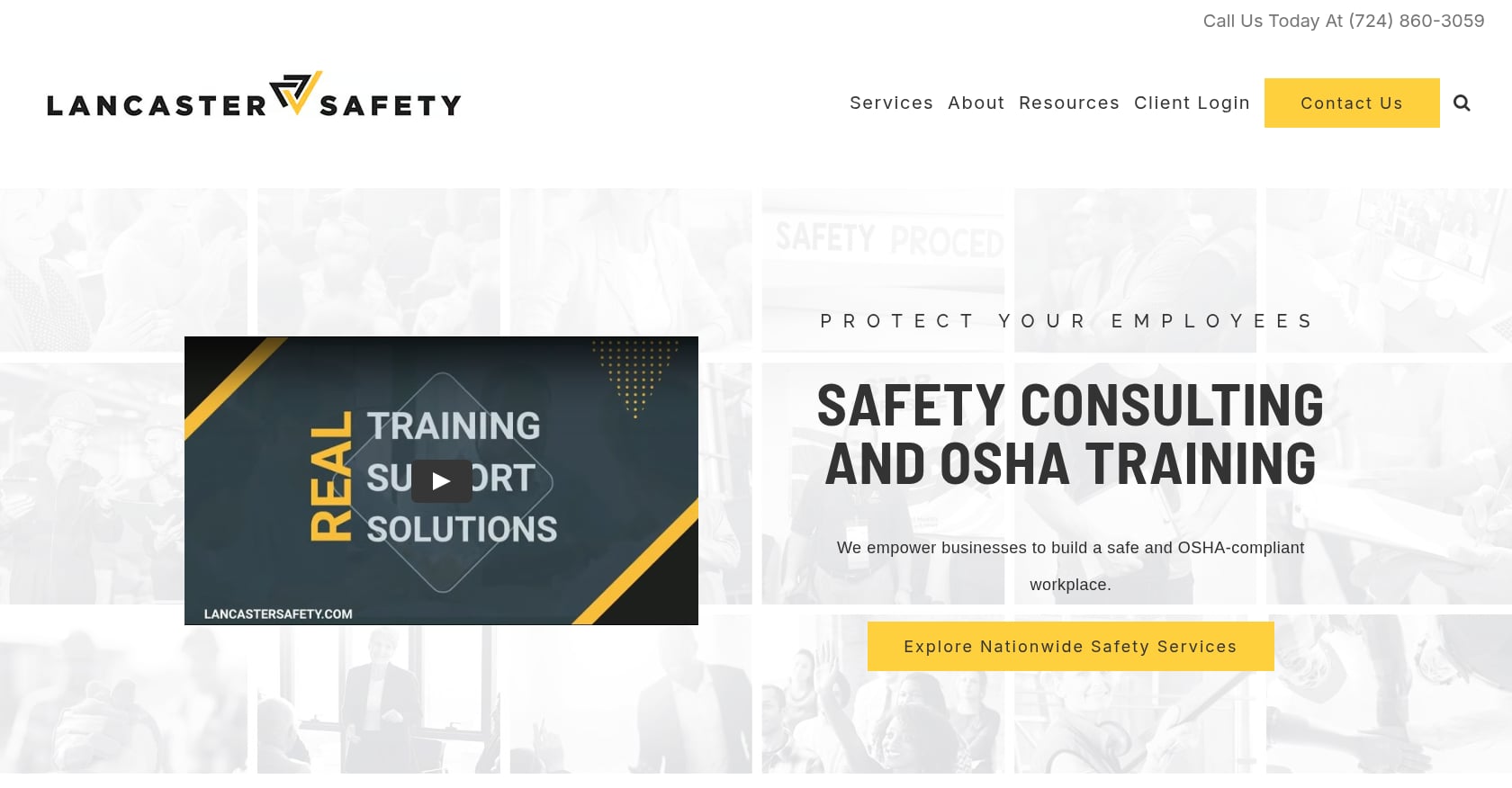
Best for: Companies that need OSHA training first and consulting layered on top, rather than on-site staffing.
Overview: Lancaster Safety Consulting focuses on safety consulting and OSHA training, positioning itself as a firm that empowers businesses to build safe, OSHA-compliant workplaces through education. It is not a staffing company in the traditional sense, but its training and consulting depth earns it a place on this list for buyers whose primary need is education rather than placement.
Key features:
Strong OSHA training programs with high client satisfaction
Consulting services including safety program development
Nationwide delivery capability
Pricing: Not published.
Employee sentiment: 4.6/5 on Glassdoor based on 19 reviews, the highest rating on this list. One client reviewer noted: “All of the staff and trainers from Lancaster Safety have gone above and beyond to provide us with incredible training.”
Tradeoffs:
Not a staffing company; no published safety professional placements
Lacks the on-site staffing bench depth of dedicated safety consulting and staffing companies
One reviewer warned that safety programs Lancaster writes may not be owned by the client after the relationship ends. Read contract fine print carefully before signing.
Training-first approach means you need a separate vendor for ongoing on-site safety coverage
The IP ownership concern is worth flagging. If you’re comparing firms for OSHA compliance consulting, make sure you understand who owns the deliverables when the engagement ends.
7. YellowBird
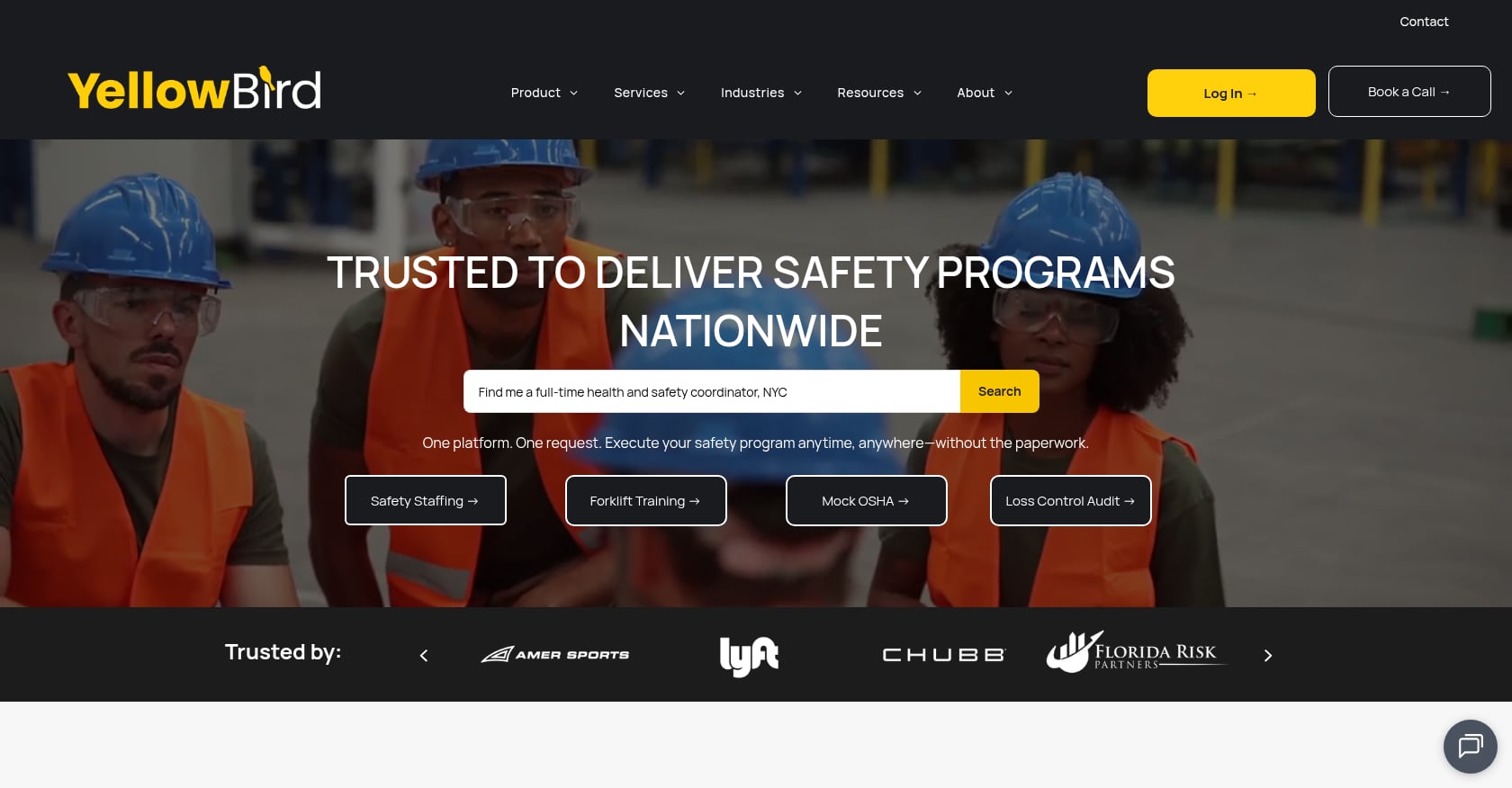
Best for: Multi-location companies needing scalable, on-demand safety assessments with platform transparency.
Overview: YellowBird is a technology-driven marketplace platform founded in 2019 that matches safety professionals with companies needing safety and risk expertise on demand. It’s the most tech-forward option on this list, using AI to match professionals to project requirements. The company has raised over $8.5M in venture funding to build out its automated matching platform.
Key features:
AI-powered matching platform for safety professionals
Flat-rate pricing calculated based on time, location, and required credentials
Claims matching with a ready-to-work professional in 24-48 hours
Scalable model suited for companies with dozens or hundreds of sites
Some pricing transparency (rare in this industry)
Pricing: Flat-rate model, but specific rates are not published. The pricing factors (time, location, credential level) are disclosed, which is more transparent than most competitors.
Employee sentiment: Limited data available. The marketplace model means professionals are independent, not employees.
Tradeoffs:
Marketplace model means less control over who shows up and less consistency across engagements
Limited case study depth and client verification
Startup risk: CB Insights flagged a significant Mosaic Score drop recently
Platform-matched professionals may lack the deep field relationships that embedded safety managers build
Not a consulting firm; no program writing, expert witness, or comprehensive compliance advisory
8. BSI Consulting (Enterprise Standards & Audit Alternative)
Best for: Companies needing third-party audit credibility, ISO 45001 certification support, or global standards alignment.
Overview: BSI is best known as the world’s first national standards body, and its consulting arm provides end-to-end construction safety support beginning with design-phase safety reviews, contractor qualification guidance, and early planning alignment. For firms pursuing ISO 45001 or OSHA’s Voluntary Protection Programs (VPP), BSI’s brand carries weight that no boutique firm can replicate.
Key features:
Global brand recognition and standards body credibility
Design-phase safety reviews and contractor qualification guidance
ISO 45001 implementation and certification support
End-to-end safety consulting from planning through execution
Pricing: Enterprise-level pricing, not published.
Tradeoffs:
Enterprise pricing makes it inaccessible for small and mid-market construction contractors
Consulting-heavy with no safety professional staffing capability
Less nimble for urgent project needs; this is a planning-stage partner, not a crisis-response firm
Not a hybrid safety consulting and staffing company in the truest sense
Safety Consulting & Staffing Cost Structures (2026 Benchmarks)
Understanding vendor pricing structures helps prevent unexpected budget overruns. Billing typically varies based on practitioner credentials, hazard level, and engagement length.
Service Model / Role | Average 2026 Rate Range | Best Applied To |
Contract Safety Specialist (CHST / OSHA 500) | $45 – $75 / hour | Embedded on-site coverage for 3–12 month construction projects |
Senior EHS Consultant / CSP | $125 – $250 / hour | Audits, written program development, incident root-cause analysis |
On-Demand Marketplace (e.g., YellowBird) | $80 – $130 / hour (Flat Rate) | Single-day audits, air monitoring, and rapid hazard assessments |
Outsourced Safety Department (Retainer) | $2,500 – $7,500 / month | Small-to-mid contractors needing fractional safety management |
Key Cost Factor: Hourly rates for staffing professionals usually reflect a markup (typically 35%–55%) over base wage to cover payroll taxes, workers’ compensation insurance, administrative overhead, and credential vetting.
What to Look for Before Signing a Contract
Choosing a safety consulting and staffing company involves more than reading a website. Here are the criteria that separate a good partner from a regrettable one.
Credential verification matters more than headcount. An OSHA 30 card is a training course, not a professional certification. A CHST requires field experience and an exam through BCSP. A CSP requires a degree, experience, and a comprehensive exam. For most industrial and construction sites, a CHST or higher is a better minimum standard than OSHA 30 alone. Reddit practitioners stress that a staffed safety professional who lacks field credibility is worse than no safety professional at all. As one commenter put it: “Field time, hazard knowledge, and relationship skills matter more than certificates on a wall.”
Demand a speed guarantee and a replacement guarantee. Placement speed is measurable. ESR publishes 48 hours, Safe T Professionals publishes 72 hours, YellowBird claims 24-48 hours. If a company won’t publish a benchmark, ask why. Equally important: what happens if the placed professional isn’t a fit? The replacement policy matters as much as the initial speed.
Understand OSHA shared liability. OSHA’s guidance is clear: both the host employer and the staffing agency share responsibility for temporary worker safety. Your contract should define who handles training, PPE provision, hazard communication, and injury recording. If your prospective vendor hasn’t thought through this, that’s a red flag. If you’re unclear on your own obligations, an OSHA compliance consultant can help you map them before you sign a staffing agreement.
Read the IP clause. As the Lancaster cautionary tale illustrates, some firms retain ownership of safety programs they write for you. If you part ways, you could lose access to your own safety manual. Always confirm in writing that deliverables are work-for-hire and belong to you.
Evaluate the model, not just the price. Contract safety professionals in the Raleigh-Durham market average $40 to $50 per hour depending on credentials. But hourly rate alone is misleading. A hybrid firm that writes your safety program, staffs it, and handles your ISNetworld prequalification under one contract eliminates the coordination costs and vendor management overhead that come with splitting those services across three vendors.
Check employee sentiment as a proxy for service quality. The people a safety consulting and staffing company sends to your jobsite are the service. High Glassdoor ratings and strong employee recommendation rates (SMG’s 89%, for example) suggest that the professionals showing up are engaged and supported. Low compensation ratings or complaints about management disconnection often translate directly to the quality of the person standing on your site.
For companies debating whether to staff or hire directly, the tradeoffs between safety staffing vs. direct hire are worth understanding before committing to either path.
When to Call a Hybrid Safety Consulting and Staffing Company
Certain moments make the case for a hybrid partner obvious. If any of these apply to you, the decision isn’t whether to hire one but how fast you can get someone on board.
You’re scaling into a new market. Opening projects in an unfamiliar geography means unfamiliar local OSHA area offices, different enforcement priorities, and no existing safety infrastructure. A hybrid firm brings both the plan and the people.
You’ve had an incident. Post-incident is the worst time to be shopping for separate consulting and staffing vendors. You need an investigator, documentation support, and potentially a replacement safety professional on-site within days. The National Safety Council estimates the average cost per medically consulted work injury at $48,000, with fatal incidents averaging $1.54 million.
Your GC contract requires a safety plan you don’t have. Many general contractors and owners now require site-specific safety plans, activity hazard analyses, and credentialed safety representatives before work begins. A hybrid firm writes the plan and deploys the person to execute it.
Your ISNetworld or Avetta scores are failing. Prequalification platforms gatekeep your access to projects. If your grades are slipping, you need consulting to fix the programs and potentially staffing to demonstrate on-site safety management. For ISNetworld specifically, ISNetworld consulting can identify exactly where your account is falling short.
You simply can’t hire fast enough. With the construction industry needing 499,000 additional workers in 2026 beyond normal hiring, and the average safety consultant commanding a $101,264 salary, the competition for qualified safety professionals is fierce. A staffing partner with a credentialed bench solves what your HR department cannot.
The maximum OSHA penalty for a willful or repeated violation exceeds $165,000+ per violation (adjusted annually for inflation each January). Every day your jobsite operates without qualified safety coverage is a day you’re exposed to that magnitude of liability. Every day your jobsite operates without qualified safety coverage is a day you’re exposed to that number. Speed and credentials aren’t optional.
If any of these triggers describe your situation, reach out to ESR’s team to discuss placement timelines and consulting scope.
Frequently Asked Questions
What is the difference between a safety consulting firm and a safety staffing firm?
A safety consulting firm provides advisory services: writing safety programs, conducting audits, performing mock OSHA inspections, and advising on compliance strategy. A safety staffing firm places credentialed professionals on your jobsite to perform day-to-day safety management. A hybrid safety consulting and staffing company does both, which eliminates the coordination gap between the firm that writes the plan and the person who executes it.
How fast can a safety staffing company place someone on my site?
Published benchmarks vary. ESR averages 48 hours for nationwide placements, Safe T Professionals publishes a 72-hour benchmark, and YellowBird claims 24-48 hours through its marketplace platform. Many companies publish no benchmark at all, which should prompt you to ask directly.
Does hiring a safety staffing company transfer my OSHA liability?
No. OSHA holds both the host employer and the staffing agency jointly responsible for temporary worker safety. The host employer typically must provide site-specific training, ensure PPE compliance, and record injuries for temporary workers it supervises daily. Your contract with the staffing firm should clearly define who is responsible for each compliance obligation.
What credentials should a contract safety professional hold?
At minimum, look for a CHST (Construction Health and Safety Technician) certification from BCSP, which requires documented field experience and a proctored exam. A CSP (Certified Safety Professional) represents a higher standard, requiring a degree, extensive experience, and a comprehensive examination. An OSHA 30 card alone is an awareness training course, not a professional certification, and should not be treated as sufficient for an on-site safety management role.
How much does a contract safety professional cost?
Rates depend on credentials, location, and engagement length. In the Raleigh-Durham market, contract safety professionals average $40 to $50 per hour. The average national salary for a safety consultant is approximately $101,264 in 2026, with ranges from $75,000 to $130,000 base. For a detailed breakdown of billing structures and markups, see our safety staffing cost guide.
Can a safety consulting and staffing company help with ISNetworld or Avetta?
Yes. Many hybrid firms offer contractor prequalification support as part of their consulting services. This includes writing or updating the safety programs these platforms evaluate, improving grade scores, and in some cases, providing the on-site safety management that demonstrates compliance to the subscribing clients who review your profile.
What industries do safety consulting and staffing companies serve?
Most firms on this list focus on construction, which has the most fatal workplace injuries of any industry, with 1 in 5 fatal injuries occurring on construction sites. However, several serve manufacturing, utilities, life sciences, telecommunications, and federal government agencies. Industry fit matters because safety regulations, hazard profiles, and credential requirements differ significantly across sectors.
When should I choose an outsourced safety department instead of project-based staffing?
If your company lacks a dedicated safety leader and needs ongoing advisory support rather than coverage for a single project, an outsourced safety department is the better fit. This model provides a fractional safety manager who manages your entire safety function on a retainer basis, which is more cost-effective than hiring a full-time safety director for companies that don’t yet have the volume to justify that role.